
In today’s operational theaters, combat medics must deploy multiple cognitive, manual, and social skills to perform efficient life-saving interventions, provide basic medical and nursing care, and ensure the safe transportation of casualties off the battlefield. In a contemporary warfare environment, first-line healthcare professionals face disruptive tactical challenges and novel technological threats [1]. Due to these particularly complex working conditions and this broad spectrum of responsibilities, educational and training programs must emphasize a strong knowledge base and intense practice of basic and advanced damage control resuscitation and surgical procedures. Furthermore, when combined, this knowledge and these skills should stimulate agile physiological thinking, appropriate clinical prioritization and time management, and the conservation of material and human resources, while considering cultural differences and ethical issues where necessary [2].
The integration of adult education principles can actively contribute to enhancing these learning performances. Adult education is defined as a teaching model that incorporates strategies of student self-direction toward goals of practical relevance for the learner [3]. According to Illeris, learning has individual cognitive, emotional, and external environmental dimensions [4]. An integrative and cross-fertilization process – the start of any learning process – takes advantage of five types of stimuli: (a) perception of the raw material; (b) transmission by another person (e.g., in lectures and instruction or through questions); (c) experience; (d) imitation; and (e) participation [5]. Consequently, accommodative and transformative learning that
enlarges stimulation modes can contrast with restricted cumulative and assimilative learning. More specifically, theories of adult education aim to value the prior learning and experience of adults [6]. In a systematic review of faculty development initiatives designed to improve teaching effectiveness in medical education, the use of experiential learning, feedback, and effective peer relationships was found to be paramount to the success of these programs [7].
However, for a long time, the superiority of adult education principles in the specific domain of healthcare professionals’ education was a matter of debate [8-10]. Interactive learning methods can be used in new contexts that do not resemble the original learning situation [8]. Scientific evidence supports the view that multimodal
and interactive learning principles can lead to higher performance during medical education and training [11-13]. Additionally, problem- or case-based learning appears to promote greater critical thinking, better integration of facts, and improved self-evaluation compared to traditional teaching models with teacher-directed learning and non-interactive modes of teaching [14].
Although these principles of adult learning have been well-described for over 50 years, comparatively little is known regarding their integration into combat medic education or training programs.
In 2021, the Belgian Defense, Tactical Medical Training Cell (TacMed) introduced an integrative and immersive model of an educational program in the Advanced Emergency Medicine Technicians (EMT) certification. All Combat Medics candidates for the advanced course are systematically exposed to this learning model. The principles of the course shape theoretical and practical skills as support for individual professional development and, by extension, leadership maturing. The essential components for individual and collective medical training were identified following the NATO SOF doctrine [15]. Different training principles, such as Life Tissue training (LT) and simulation with role players (SIM), are combined. The last serves as a core education pivot because of the abundance of peer-reviewed evidence from military studies that clearly demonstrates that training methods using human patient simulators for teaching trauma care skills were superior and more cost-effective than many other learning techniques [16]. Finally, specific efforts are put into hyperrealistic and immersive simulation training scenarios as stimulators of team performance [17]. Like other authors [18,19], the course organizers conceived team performance as a multilevel process that includes the interrelation between individual-level and team-level taskwork and teamwork processes. The coordinated activities of a team of well-educated and trained individuals were considered the main objective [20,21].
The primary objective of the study was to establish, within an integrative hyperrealistic education model, the associative principles between theoretical and practical domains in order to explore global performance outcomes. As a secondary objective, success rates for specific achievements were inventoried, and a complementary analysis of their association profiles was performed.
Advanced Combat Medic candidates presenting at the Medical Component Competence Centre, Belgian Defense, were included in this single-center retrospective cohort study.
This study was carried out from January 2021 to December 2022. Instructors, evaluators, and Exercise Controllers systematically collected and processed all theoretical and practical examination results.
A yearly refresher Tactical Combat Casualty Care (TCCC) educational program must be attended by all Belgian soldiers. The operational units of the Belgian Medical Component and combat units, including Special Operation Forces, detached their Combat Medic candidates. In their respective units, they applied voluntarily for a specific position as first-line responders. All candidates were consecutively included. To exclusively explore the course benefits, only students who failed the entrance examination were excluded from this study.
A three-week theoretical module covering TCCC, Pre-Hospital Trauma Life Support (PHTLS), and Advanced Medical Life Support (AMLS) principles is preceded by an initial entrance exam on general anatomy and physiology. At the end of this sequence, and after succeeding in the theoretical exam in these domains, a three-week practical module is launched. This module includes dead tissue training, trauma patient simulation (using role players or manikins), clinical scenarios (individual or team-based), and a broad spectrum of clinical practicals. These are focused on amphibious medical incidents, mass casualty situations, complex casualty extrication, and CASEVAC (Casualty Evacuation). During a 72-hour final synthesizing on-field examination, all candidates were evaluated based on three independent secondary domains: their capability to act as Medical Practitioner, Medical Leader, and Tactical Leader.
Continuous monitoring by experienced healthcare professionals and psychologists during the on-field certification period ensured adherence to ethical guidelines and psychological safeguards.
Two main domains (total theoretical and practical scores at the final examination) and three practical secondary domains were considered as performance outcomes. The three practical secondary domains were designed to cover cognitive, procedural, and environmental dimensions. These three practical domains were linked to the following positions:
a. The Medical Leader (ML) was responsible for overall clinical assessment and management. The ML’s responsibilities included: preliminary medical assessment, medical decision-making, guidance of medical activities, securing medical evacuation, and leadership of medical providers. Evaluation methods for this function assessed the quality of the medical approach (both diagnostic and therapeutic), the effectiveness of control over hard skills by team members, the quality of general clinical guidance, adequate and effective communication with the superior clinical echelon, control of safety rules, and final clinical responsibility.
b. The mission of the Medical Practitioner (MP) was to execute technical medical skills under the leadership and supervision of the ML. Particular attention was paid to the quality of material preparation, completeness, and safety in execution. The specific soft skills evaluated were: empathy towards the casualty, reactivity to ML demands, quality of reporting to the ML, and interaction and communication with the ML and other MPs.
c. Finally, the Tactical Leader (TL) was responsible for team security, controlling situational awareness, and coordinating the medical team’s tactical actions. This function was evaluated through quality indicators of situational awareness, safety rules, planning of team actions, and consolidation of the medical evacuation plan proposed by the ML.
During the theoretical evaluation, the candidates were evaluated on the percentage of correct responses at the end of the theoretical module. At least two independent evaluators from TacMed scored the respective ML, MP, and TL performances during the practical examination. Concerning the scenarios with role players, three main objectives were preliminarily defined and specifically evaluated through a scoring system reportable on a percentage scale. The first evaluation objective was always dealing with the hard skills, the second with the individual soft skills, and the third with the individual contribution to the collective dynamics.
The evaluators had received the same education and training for this purpose. The education of evaluators respects the NATO standards and includes additional skills from the civilian evaluation systems developed for health care. They regularly train for this function and are obliged to participate in all evaluation exercises organized by TacMed. At least one of the observers is educated and certified in an Observer/Trainer function following the NATO standards (International Military Medical Observer Trainer Course (IMMOT) course, NATO MED-MS-36887, NATO Centre of Excellence for Military Medicine). During the preparation of the scenario, the defined objectives and evaluation tools per objectives are revised together within the evaluator’s team. All evaluators use the same evaluation scale.
Evaluators are blinded to theoretical scores and scores from the other scenarios run by the candidate.
The evaluation indicators were independently evaluated by each evaluator and compiled into a final score. The final score for each function was obtained by simple cumulation of the individual scores of all of the examinators. Each candidate went through the different positions at least two times.
The final global practical score corresponded to the sum of all scenarios’ scores of the candidate.
In support of this scoring system materials, additional videos or pictures were captured.
At the end of each scenario, during the debriefing, individual and collective learning points were pointed out by each candidate as well as by the entire team.
An overall description of all populations/outcomes was statistically explored. Categorical variables were summarized using frequencies and percentages. Continuous variables were summarized using medians and standard deviations (SD). After checking for normality using the Kolmogorov-Smirnov test, the data were found to be not normally distributed (statistic = 0.127; df = 107, p < 0.001). The Wilcoxon Rank Sum test was used to compare two groups, paired or unpaired. The Mann-Whitney U and Kruskal-Wallis tests were used to compare a continuous variable with a categorical variable with two or more categories, respectively. Correlations between theoretical/practical results and individual results from the secondary domains were calculated using Spearman’s rank correlation, two-tailed. The overall practical results (%) were defined as the dependent variable for multivariate linear regression, with multiple independent variables being demographic or individual results. A p-value < 0.05 was considered statistically significant. Biostatistical analyses were supported by IBM SPSS Statistics Version 29.0.1.0 (171) (License Ghent University, Belgium).
One hundred thirty-seven combat medic candidates for EMTa certification were recruited, and their individual scores were collected. Their participation was well-distributed during the two-year study period: from January 2021 to December 2022 (Table 1). With a mean seniority in the army of 8.99 years (SD = 5.13 years, range = 1-22 years), the candidates had a mean age of 30.30 years (SD = 5.89 years, range = 21-49 years). The vast majority of candidates were male (97.8%), with only 2.2% being female. In the total group, 71.5% of candidates succeeded in the final test, and 9.5% failed. Nineteen percent of the total group did not complete the entire course or final certification examination, mainly due to changed work schedules. Although not statistically significant, older candidates were found to be more resilient regarding non-completion of the course.
A mean success score of 90.6% (SD = 6.5%) was found for the theoretical examination. On the other hand, the mean of the total practical examinations was 80.1% (SD = 4.8%) at the end of the 72-hour certification field exercise. All age and seniority groups presented this drop between theoretical and practical results, with no significant difference observed between younger and older candidates.
The mean results displayed the following respective scores: for the ML function, the success rate was 79.1% (SD = 6.49%); for the MP, 80.8% (SD = 6.28%); and for the TL function, 81.1% (SD = 5.68%). Candidates scored significantly better as TL (p = 0.014) in comparison with their function as ML. When observing the secondary domain success scores, no significant difference was observed between the age or seniority categories.
| Characteristic | N | Mean | StdDev | Range |
|---|---|---|---|---|
| Age (years) | 137 | 30.20 | 5.89 | 21-49 |
| Seniority (years) | 137 | 8.99 | 5.13 | 1-22 |
| Count | Percentage | |||
| Gender | ||||
| Male | 134 | 97.8% | ||
| Female | 3 | 2.2% | ||
| Year of completion | ||||
| 2021 | 75 | 55.5% | ||
| 2022 | 61 | 44.5% | ||
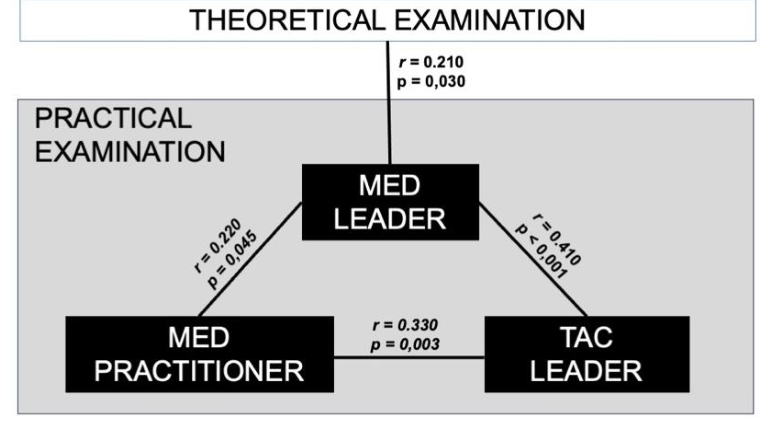
Interestingly, the theoretical results were found to be weakly but significantly correlated not with the total practical score, but only with the ML function (r = 0.210, p = 0.030) (Figure 1). As expected, the total practical scores were significantly correlated with their secondary domains: ML (r = 0.210, p < 0.001), MP (r = 0.565, p < 0.001), and even more strongly with TL (r = 0.793, p < 0.001) functions. Furthermore, the secondary domains were found to be statistically correlated with each other: weakly or fairly but significantly correlated between ML and MP (r = 0.220, p = 0.045), and between MP and TL (r = 0.330, p = 0.003), while the correlation between ML and TL was found to be statistically stronger (r = 0.410, p < 0.001).
With the total results at the practicals as the dependent variable, the multivariate linear regression identified all practical secondary domains as independent predictors of the total practical results (p < 0.001), with the theoretical results as a weaker but significant independent predictor (p = 0.04) (Table 2). Candidate age and seniority were not found to be predictors of higher performance scores at the final practical examination.
| Coefficients* | ||||
|---|---|---|---|---|
| Coefficient Std Error | Standardized coefficients β | t | Sig | |
| Age | 0.005 | -0.005 | -0.771 | 0.443 |
| Seniority | 0.006 | 0.002 | 0.254 | 0.800 |
| Candidate category | 0.041 | 0.003 | 0.876 | 0.384 |
| Scores theoretical results | 0.003 | -0.008 | -2.095 | 0.040 |
| Medical leader | 0.003 | 0.553 | 128.107 | <0.001 |
| Medical provider | 0.003 | 0.353 | 83.922 | <0.001 |
| Tactical leader | 0.003 | 0.412 | 103.293 | <0.001 |
R2 = 0.999; F Change = 10945.960; Sig F. Change <0.001; StdError of the estimate = 0.15587; N=137
* Dependent variable: Total scores at practicals
In this study, we explored performance scores during military educational and training programs for combat medics. An integrative and immersive combat medic-specific training was proposed in a structured and stratified manner. During the practical examination, three different positions were tested, and this analysis shows how they were associated with each other. During the educational phase of the program, candidates were stimulated in their leadership (medical and tactical) positions through an integrative and cross-fertilization process, taking advantage of five types of stimuli identified by Jensen [5]. On the other hand, the role of the MP was not restricted to the adequate and safe execution of medical hard skills. Although well-structured assessment testing of medical hard skills is beneficial [22], additional soft skills such as communication, reporting, or mutual support were also added to the MP’s educational program.
Our education and training principles were largely inspired by the eight learning fundamentals of Haraldseid-Driftland et al. (2023) – categorizing collaborative, practical, and content elements – to help develop learning principles and tools to translate resilience into healthcare practice [23]. We complemented these with some of the six guiding recommendations of Sousa et al., including simulation, milestones as course learning objectives, and a multi-dimensional, competency-based assessment system [24]. The ultimate goals of this approach were to optimize crew resource management on one hand, and the individual resilience of first-line responders on the other. Especially in healthcare, communication, teamwork, and leadership top the list of nontechnical skills pivotal for clinical success [25,26]. As an illustration, deficiencies in nontechnical skills are among the leading causes of adverse events in the operating room [27,28]. In the early 1990s, Crew Resource Management principles initially developed to reduce pilot errors were applied to the medical field by anesthesia instructors, who developed the concept of Anesthesia Crisis Resource Management [29,30], with later extension to other actors in the operating room [31]. Across levels and contexts, this approach was found to stimulate healthcare professionals to collaborate, adapt to change, maintain processes and functions, and improve quality and safety through interactions such as exchanging information, coordinating, negotiating, aligning needs, and developing buffers [32]. Increased resilience has been shown to positively impact nursing practice by Thomas and Asselin [33]. In this context, resilience appears to be an important asset [34], and resilience-enhancing interventions to prepare healthcare students for their future professional practice were found to be beneficial [35].
Observing performance results, this study identified statistical associations between different positions within a combat medic team. For instance, in our study, the TL position – even if primarily more oriented towards situational awareness – was associated not only with global performance scores but also with the quality of more specific medical functions. Over the past century, educational psychologists and researchers have posited many theories to explain how individuals acquire, organize, and deploy skills and knowledge [36,37]. The three different processes of learning identified by Illeris – cognitive, emotional, and social – can occur simultaneously, forming a holistic learning process [4]. Additional dimensions of learning, such as physical or spiritual, could probably be added to this scheme.
At a cognitive level, our study has shown that the execution of medical techniques is not simply linked to previous knowledge acquisition. MP performance was correlated with the presence of two leading functions. Based on our methodological limitation of using a retrospective observational protocol, we cannot establish any intrinsic causal strength. Cognitive learning theories support the view that learning is a targeted internal process focusing on thinking, understanding, organizing, and consciousness. Even if successful in many learning aspects, such as information processing, curiosity stimulation, and motivation, they were found not to be strong enough to transfer the required knowledge to all learners. Additionally, they require considerable time and a trained workforce [37]. This evidence justified our choice not to exclusively concentrate on hyperrealism or single structural fidelity. We hypothesized that it may be more productive from an educational standpoint to consider the fidelity of the simulation scenario relative to clinical task demands along with physical resemblance [38-41], referring to evidence from the literature in this field [39-44]. This advantage of using multimodal simulation was supported by recent literature [42,43,45,46].
The emotional dimension of learning was not specifically explored in our study. However, our educational approach took advantage of an additional social dimension by encouraging and persuading previously learned behaviors, drawing the attention of learners, and creating strong responses [39-44]. Thanks to selective attention and memory, humans learn more from their experiences and organize these experiences into internal representations that facilitate future behavior [40-45]. Passive formats, lack of relevance, and disconnection from students’ needs are some arguments supporting the apparent lack of efficacy of formal lectures [38, 46]. It appeared that the candidate’s age or seniority in the army was not correlated with performance scores. Seniority and its consequent experience in the army, initially considered as a possible confounding factor or indirect advantage in this integrated learning model, cannot exclusively support the entire learning process. This finding stressed that medical and tactical leadership functions within a Combat Medic team must be learned and trained in addition to acquiring the necessary medical hard skills.
Finally, to emphasize the social dimension of this learning process, we chose event-based assessment as an essential method to deal with the complexity of authentic clinical interactions [47]. It potentially overcomes the shortcomings of not being able to observe tacit behaviors and cognitions and allows team members to assess the unobservable elements of teamwork [48,49].
Our results only describe performance patterns, and our study was not designed to measure inferences within intrinsic cognitive mechanisms. Further analyses should be conducted to describe causality between indicators, identify all influencers, and measure their respective effect sizes on performance. The reported interactions could be considered the basis for a virtuous circle between these three functional abilities: medical guidance, execution, and external situational vigilance.
First, this study confirmed existing scientific evidence stating that a strong integration of various learning methods or tools leads to solid theoretical and practical results, even when considering specific practical tasks.
Secondly, a strict tasking of ML, MP, and TL functions within a combat medic team facilitated the organization and the detection of medical or tactical issues. These multiple but complementary views on the same medical situation positively influenced the final performance of each individual in the group. This task was initially designed to avoid interference and improve the quality of healthcare. All these tasks appear not to act separately but can reinforce each other. However, this approach imposes complementary education and training in soft skills, such as communication and reporting.
Finally, these considerations are not restricted to the specific environment of the Belgian Army. The program developed by TacMed at Belgian Defense was based on existing national or international protocols and studies, whether developed by or for armed forces or not. It took into account the military culture in Belgium and existing programs in other professional communities. The combination of educational tools was tested and adapted within the military, but external civilian experts adjusted program content or assessment methods. For this reason, some of these findings can be generalized beyond the specific Belgian military context.
This study has limitations. The education program benefited from knowledge accumulated from the trainers’ expertise, general trends in adult education, and guiding principles in EMT practice. Although efforts were made to minimize their effects, bias and unmeasured factors due to this retrospective design are still an issue. Because of their retrospective and observational nature, correlations could not establish causation between parameters. The conclusions of this study are based on the 71.5% of candidates who successfully completed the certification process. This high attrition rate could introduce a bias towards overestimating competency and positive correlations. Furthermore, the study is subject to all the limitations of a monocentric study design. Finally, while this is a preliminary qualitative investigation of integrative practice and leadership views in a military prehospital context, the perspectives represented may not reflect the entire profession, given the small overall sample size. Despite these limitations, these results provide valuable insight into some performance indicators in a complex work environment.
Inspired by recent findings in adult education, our integrative and immersive education program for advanced combat medic certification has demonstrated high success rates at both theoretical and practical levels. Furthermore, the performance levels of the different functions within the Combat Medic team, even if initially well-delimited, were found to be correlated with each other. These reported interindividual interactions open new perspectives for the consolidation of learning outcomes.
The authors declare no conflict of interest. This research received no external funding.
Conceptualization, F.W., J.J. and J.B.W.; methodology, J.B.W.; validation, F.W., J.J. and N.D.; formal analysis, J.B.W.; investigation, F.W. and J.B.W.; resources, J.B.W.; data curation, J.B.W.; writing—original draft preparation, J.B.W.; writing—review and editing, F.W., J.J., N.D. and J.B.W.; visualization, J.B.W.; supervision, J.B.W.; project administration, F.W. All authors have read and agreed to the published version of the manuscript .
The authors did not use a generative artificial intelligence (AI) tool or service to assist with preparation, data analysis, or interpretation of results. AI was utilized to refine the language of the main body text after initial editing and review. The authors take full responsibility for the content of this publication.
This study was conducted in accordance with the Declaration of Helsinki, and approved by the institutional office for data protection and the Ethics Committee (EC) of Ghent University and Ghent University Hospital (UZ Gent) and registered under number ONZ-2023-0600.
Not applicable. Our retrospective study used examination results which regularly collected data from the databases. The consent for the use of personal data was given by each candidate as a routine procedure of the Centre of Medical Expertise, Belgian Defense provision.