
Grief is a normal emotional reaction to interpersonal loss, usually transient, as the individual’s coping mechanisms are activated and adjustment to the new life situation occurs. On the contrary, pathological grief (PG) is a phenomenon that is considered excessive, reported to deviate from the person’s cultural and social norms in terms of amplitude, duration, discomfort, and/or functional impairment.
PG has been approached in the literature from multiple perspectives across major psychological and psychiatric traditions, with historically distinct aspects of this clinical phenomenon emphasized, ranging from unconscious impulses to neurobiological dysfunctions, and from attachment styles to existential crisis (Fig. 1).
The psychoanalytic perspective, starting with Sigmund Freud, evaluates PG as the result of difficulties in detaching libido from the loved one, and distinguishes between normal mourning and melancholia [1]. As described in Freud’s seminal work, “Mourning and melancholia” (1917), mourning is terminated when the subject severs its emotional attachment to the lost one and reinvests the freed libido in a new object [2]. Later, the founder of psychoanalysis revisited his theory on grief and stated that identification associated with melancholia is an integral component of mourning [2]. Identification, at the unconscious level, with the deceased may lead to self-reproach, guilt, and persistent suffering, and unconscious conflicts and unresolved ambivalence toward the same individual are other contributors to the onset and persistence of PG, in the psychoanalytic framework [1,3,4]. According to psychodynamic theory, pathological mourning may be manifested as defensive processes such as splitting (one part of the subject is aware of the loss, while the other wishes that the loved one were still alive), repression, and dissociation [5].
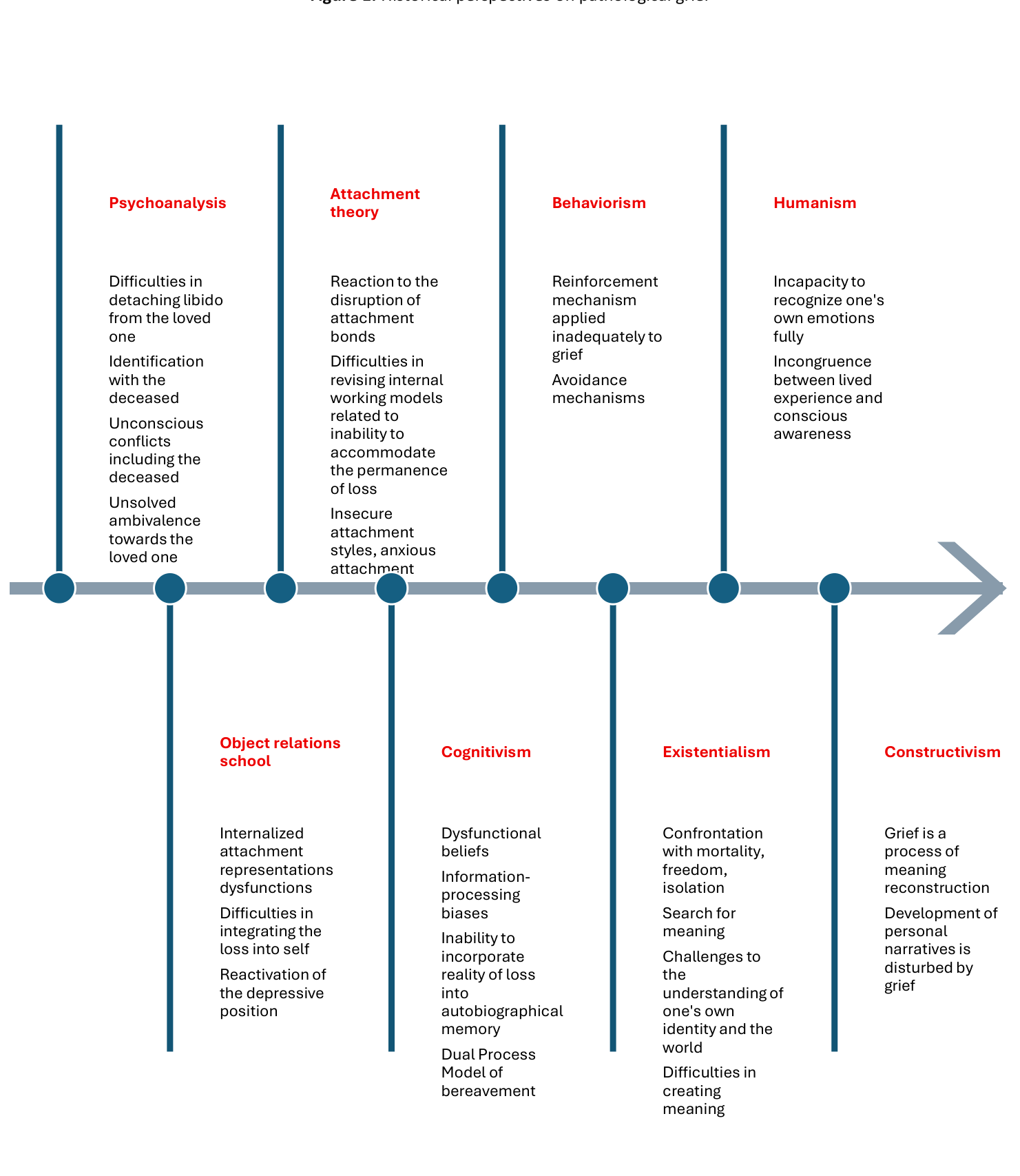
Modern research is looking to connect psychoanalytic core concepts with neurobiological findings, starting from the observation that pathological grief and depression involve persistent activation of brain systems related to attachment, reward, and self-referential processing of stimuli [6]. These data suggest that difficulties disengaging from the lost object may be associated with identifiable neural mechanisms, providing a neurobiological basis for psychoanalytic accounts of melancholia [6]. According to this framework, activation of the subgenual cingulate may represent a neurobiological correlate of repression, whereas the default mode network is presented as a potential neural substrate for ego functions [6].
Later object-relations theorists have explored the disruptions in internalized attachment representations and difficulties integrating the loss into the self [7,8]. Building on earlier psychoanalytic formulations, Melanie Klein proposed that mourning reactivates the depressive position, a developmental state characterized by anxiety over the loss or destruction of loved internal objects [4,9]. Successful mourning involves the restoration and reintegration of these internal representations, whereas PG arises when this process is disrupted, resulting in persistent guilt, despair, or an inability to relinquish the lost object [7]. Within this paradigm, therapy for PG focuses on helping the individual to consciously re-experience repressed destructive impulses, overcome the unconscious guilt, and integrate the “good” and “bad” aspects of the lost object [10]. Working through the depressive position (by encouraging the patient to overcome denial and omnipotent control, and to tolerate the ambivalence of loving and hating the lost one), interpreting projective identification, addressing pathological organizations (or “psychic retreats” in the face of guilt over destructive impulses), and encouraging reparation (by verbalizing and mourning their destructive unconscious fantasies) are processes of healing in patients with PG [10,11].
Building on these ideas, attachment theory, developed by John Bowlby, conceptualized grief as a response to the disruption of attachment bonds and suggested that chronic mourning reflects difficulties in revising internal working models to accommodate the permanence of the loss [12]. The vulnerability to PG is considered enhanced by early attachment insecurities, especially anxious attachment, which can prevent individuals from developing stable internal models and engaging in “hyperactivating” strategies [12-15]. Due to these insecurities, individuals are prone to prolonged yearning, separation anxiety, and severe dependency that make the process of mourning especially difficult [13-15]. Also, avoidant attachment may lead to deactivating strategies that suppress painful emotions; therefore, an inhibited mourning is negatively interfering with the recovery from the loss of the loved one [13-15].
Cognitive perspectives on PG emphasize maladaptive beliefs and information-processing biases, as well as difficulties in integrating the reality of loss into autobiographical memory [16]. Examples of dysfunctional beliefs related to PG are “Life is meaningless without the deceased”, “I should have prevented the death”, or “Moving on would be a betrayal”. Continuous processing of these cognitions (i.e., in a ruminative manner) and catastrophic interpretations maintain a high level of distress and discomfort [16-18]. A prominent contemporary model is the cognitive-behavioral formulation of prolonged grief developed by Stroebe and Schut (1999) through the Dual Process Model (DPM) of bereavement, and later expanded by Boelen and colleagues (2005), who emphasized maladaptive cognitions, avoidance behaviors, and difficulties integrating the reality of the loss [16-18]. DPM is based on the presence of loss- and restoration-oriented stressors and on the dynamic regulatory process of oscillation between confrontation and avoidance across different tasks of grieving [16]. According to DPM, adaptive coping comprises confrontation of reality and avoidance of loss and restoration stressors [16]. This model is important because it normalizes relief by validating experiences of distraction, productivity, or happiness as healthy mechanisms, rather than simply forgetting the deceased, and it also explains individual differences in grieving at different paces [16-18].
From a behavioral perspective, PG is maintained through reinforcement mechanisms and avoidance behaviors that interfere with adaptation to loss [18-21]. Individuals experiencing prolonged grief may avoid reminders of the deceased, including places, objects, memories, or situations associated with the loss, thereby preventing adequate emotional processing and integration of the bereavement experience [18-21]. This avoidance is negatively reinforced because it temporarily reduces distress; however, it simultaneously impedes confrontation with the reality of the loss and prolongs grief-related symptoms. In addition, bereaved individuals often withdraw from social, occupational, and recreational activities, reducing opportunities for positive reinforcement and meaningful engagement with life. Such behavioral patterns contribute to persistent sadness, isolation, and functional impairment, creating a self-perpetuating cycle in which avoidance and disengagement maintain emotional suffering over time [18-21]. As a consequence of these theories, behavioral therapists should encourage exposure to the feared situations by the use of imagination (e.g., patients recount the story of loss while working with the therapist), or in vivo (e.g., the patients are gradually guided to visit places where they were together with the deceased, and which they avoided during the bereavement period), but also behavioral activation (e.g., scheduling pleasurable, meaningful, or previously enjoyed activities for the patient) [22,23].
From an existential perspective, grief is understood as a profound confrontation with the fundamental realities of human existence, including mortality, freedom, isolation, and the search for meaning [24]. The death of a significant other is able to disrupt established assumptions about the self and the world, often challenging an individual’s sense of identity, purpose, and continuity, and that is why normal grief can facilitate personal growth and existential reflection, while pathological grief may make the bereaved person unable to reconstruct meaning following the loss or integrate the experience into a coherent life narrative [25]. In the last situation, bereavement may precipitate an existential crisis characterized by persistent questioning of one’s identity, life purpose, and capacity to live in the face of mortality [24]. Existential theorists argue that successful adaptation to loss requires engaging with, rather than avoiding, these existential concerns and developing a renewed sense of meaning and self-understanding [24,25]. Consequently, pathological grief is viewed not only as emotional suffering but also as a disruption in the individual’s capacity to create meaning, confront existential anxiety, and reconstruct identity after loss [24,25].
From a humanistic perspective, grief is viewed as a natural and meaningful response to loss that reflects the individual’s capacity for attachment, love, and personal growth [26-28]. Humanistic theorists emphasize the importance of experiencing and expressing grief authentically rather than suppressing or avoiding painful emotions [26-28]. PG may develop when individuals are unable to fully acknowledge their emotional experiences, either due to internal defenses or to external pressures that discourage the open expression of sorrow [26-28]. Such incongruence between lived emotional experience and conscious awareness can impede adaptation to loss and hinder psychological growth [26-28]. Recovery is therefore understood not as the elimination of grief but as a process of acceptance, emotional integration, and the reconstruction of a meaningful life in the absence of the deceased [26-28]. Through self-exploration, emotional congruence, and renewed engagement with personal values and relationships, bereaved individuals can achieve greater self-understanding and continue their developmental journey despite loss [26-28]. Within this framework, grief is regarded as a potentially transformative process that may foster resilience, authenticity, and self-actualization when navigated successfully [26-28].
From a constructivist perspective, grief is understood as a process of meaning reorganization, following the disruption of an individual’s created perspective on the world [25,29,30]. People develop personal narratives that provide coherence, purpose, and continuity to their lives; however, bereavement can profoundly challenge these narratives and destabilize previously held beliefs about the self, relationships, and the world [25,29,30]. PG may arise when the loss cannot be successfully integrated into the individual’s existing meaning system, resulting in persistent distress, identity disruption, and difficulty adapting to life without the deceased [25,29,30]. Constructivist theorists emphasize that successful mourning involves reconstructing meaning, revising one’s life narrative, and developing a renewed sense of identity that accommodates the reality of the loss [25,29,30].
As can easily be observed, virtually all the relevant schools of thought in clinical psychology and psychotherapy have approached the phenomenon of bereavement. However, there are multiple differences in conceptualizing the dimensions of normal and pathological bereavement, stages of these processes, and the most efficient way to approach individuals presenting problems in processing grief. Therefore, the objective of this article is to develop a conceptual framework that explains how bereavement may lead to distinct yet overlapping psychiatric outcomes, such as different clinical diagnoses, and to improve case management in these cases. At the origin of this research is the unmet need to formulate a transdiagnostic perspective with clinical relevance, due to the overlap of PTSD (posttraumatic stress disorder), MDD (major depressive disorder), and PGD symptoms, but also due to the diagnostic controversies related to PG.
The proposed model was developed through a structured conceptual synthesis of the literature. Relevant constructs associated with bereavement-related psychopathology were identified and organized into three domains: diagnostic classification, shared transdiagnostic mechanisms, and clinical outcomes. Mechanisms repeatedly described across disorders were mapped by their presence and relative centrality, yielding a transdiagnostic conceptual model. This analysis was based on data from the literature, structured according to three main directions: (1) current psychiatric perspective on diagnosing PG and related phenomena; (2) epidemiological, pathophysiological, and therapeutic data supporting a continuum model of PG; (3) clinical data on bereavement-related psychopathology. The integration of relevant data into a conceptual model of PG is expected to highlight the current state of research in the field and the main directions for future research, with the ultimate objective of improving the quality of medical assistance for patients with PG-related functional impairments.
The retrieved corpus of literature was organized according to the formulated research objectives, resulting in a synthesis of evidence supporting a comprehensive theoretical model of PG.
In the DSM-5 (2013), pathological grief was not recognized as an official mental disorder. Instead, it was included in Section III under the designation Persistent Complex Bereavement Disorder (PCBD), a category reserved for conditions requiring further research [31]. PCBD was characterized by persistent yearning for the deceased, intense emotional pain, difficulty accepting the loss, identity disruption, and significant impairment in social or occupational functioning [31]. Although the condition acknowledged that some bereaved individuals experience severe and enduring grief reactions, its placement in Section III reflected ongoing uncertainty regarding its diagnostic boundaries and distinction from other psychiatric disorders, particularly MDD and PTSD [31].
Accumulating empirical evidence over the following decade led to a substantial revision in the DSM-5-TR (2022), which formally recognized Prolonged Grief Disorder (PGD) as a distinct mental disorder [32]. The diagnosis applies to individuals who continue to experience persistent longing or preoccupation with the deceased beyond culturally expected periods of mourning, accompanied by symptoms such as identity disruption, disbelief, avoidance of reminders of the loss, emotional numbness, intense loneliness, difficulty reintegrating into everyday life, or a sense that life has lost its meaning [32]. For adults, symptoms must persist for at least 12 months following the death and cause clinically significant distress or functional impairment [32].
The transition from PCBD to PGD reflects a broader shift toward recognizing pathological grief as a distinct clinical entity rather than merely a variant of depression or trauma-related disorders. Compared with the DSM-5 criteria, the DSM-5-TR diagnostic framework is more streamlined and clinically applicable, while retaining an emphasis on functional impairment and symptom persistence. Furthermore, the DSM-5-TR places greater emphasis on evaluating grief reactions within their cultural, religious, and social context to avoid pathologizing normative mourning experiences.
The revised diagnosis of PGD also aligns more closely with the ICD-11 classification of Prolonged Grief Disorder, reflecting growing international consensus regarding the nature and diagnosis of persistent maladaptive grief reactions [33]. According to the World Health Organization (WHO) classification, uncomplicated bereavement (code QE62) corresponds to normal grief, while PGD is a disturbance characterized by persistent and pervasive grief, with longing for the deceased or persistent preoccupation with the deceased, accompanied by intense emotional pain [33]. ICD-11 acknowledges that the duration of core PGD symptoms should be at least 6 months, and mentions that symptoms are in excess of cultural norms [33]. Grief reactions that are persistent, but within the normative period of grieving, taken into consideration the individual’s cultural and religious context, are considered normal bereavement [33]. The functional impairment criterion is also mentioned by ICD-11 for PGD [33].
In conclusion, the conceptual evolution regarding pathological grief in the DSM-5 and 5-TR reflects significant advances in the understanding of this phenomenon, starting from clinical and epidemiological data. The formal recognition of PGD in the most recent nosographic systems acknowledges that, for some individuals, grief can become persistent, debilitating, and clinically significant beyond culturally expected periods of mourning. At the same time, both DSM-5-TR and ICD-11 emphasize the importance of considering normative religious and social contexts when evaluating grief responses, thereby distinguishing PG from normal bereavement, thus avoiding overpathologization. The increasing convergence between DSM-5-TR and ICD-11 criteria further supports an ongoing international consensus regarding the identification, diagnosis, and treatment of prolonged and maladaptive grief reactions, facilitating more accurate assessment and improved access to appropriate clinical care.
| Mechanism | PGD | PTSD | MDD | ASD | AjD | Key references |
|---|---|---|---|---|---|---|
| Attachment dysregulation | ✓ | ± | ± | – | ± | [12-15,35,36] |
| Persistent yearning/separation distress | ✓ | – | – | – | ± | [32-35,48] |
| Intrusive cognitions/memories | ✓ | ✓ | ± | ✓ | ± | [35,36,50] |
| Avoidance behaviors | ✓ | ✓ | ± | ✓ | ± | [16-21,36] |
| Emotional dysregulation | ✓ | ✓ | ✓ | ✓ | ✓ | [35,36] |
| Identity disruption | ✓ | ± | ± | – | ± | [11,32,36,37] |
| Meaning-making difficulties | ✓ | ± | ± | – | ± | [23-25,29,30] |
| Altered reward processing | ✓ | ± | ✓ | – | – | [6,35] |
| Fear/threat processing | ± | ✓ | – | ✓ | ± | [48-53] |
| Low mood/anhedonia | ± | ± | ✓ | – | ± | [34,37,52,53] |
| Functional impairment | ✓ | ✓ | ✓ | ✓ | ✓ | [32,33,51] |
AjD= adjustment disorder, ASD= acute stress disorder, PGD= prolonged grief disorder, PTSD= posttraumatic stress disorder, MDD= major depressive disorder. Note: ✓ = core feature; ± = frequently present but not defining; – = not typically characteristic.
The existing data in the literature support a continuum model of PG, in which PGD, PTSD, acute stress disorder, MDD, and adjustment disorder represent partially overlapping but clinically distinguishable responses to loss-related stress, while preserving a certain degree of individual specificity. Epidemiological studies demonstrate substantial comorbidity between PGD, PTSD, and MDD, while also showing that PGD constitutes a distinct diagnostic construct characterized primarily by persistent separation distress, yearning, and preoccupation with the deceased rather than the fear-based symptoms of PTSD or the pervasive anhedonia and low mood typical of MDD [34,35].
Regarding the pathophysiology of these disorders, they were observed as sharing several mechanisms, including emotional dysregulation, intrusive cognitions, avoidance behaviors, alterations in reward processing, and difficulties integrating stressful experiences into autobiographical memory, suggesting common vulnerability pathways following severe stress or attachment loss [36,37]. However, PGD seems to involve grief-specific processes, especially persistent activation of attachment mechanisms, difficulty of accepting the irrefutability of the loss, and disturbance of identity and meaning-making following bereavement [36,37].
Therapeutic evidence is also supportive of such a continuum perspective. Although symptoms of depression, anxiety, and trauma may improve with general, non-specific psychotherapeutic and counseling interventions, grief-focused cognitive behavioral therapies consistently demonstrate superior efficacy in reducing PG manifestations and improving functional outcomes, thus showing that PG requires targeted treatment approaches beyond those developed for depression or trauma alone [23,38-40]. Treatments for MDD are continually expanding, but PGD-targeted pharmacological interventions are still lacking, maybe due also to the novelty of the diagnosis [41,42].
Consequently, PG may be understood as a distinct yet closely related condition within the broader spectrum of stress- and loss-related psychopathology, placed in an intermediate position between normative bereavement and other trauma- and stressor-related disorders. To further illustrate this diagnosis overlap and specificity of the principal mechanisms involved in PG-related psychopathology, the major transdiagnostic dimensions identified in the literature are summarized in Table 1.
Clinical studies support the idea that responses to bereavement arise along a spectrum from normal grief to psychiatric disorders, supporting a continuum model of bereavement-related psychopathology [43-46]. Longitudinal cohort studies indicate that the majority of individuals with bereavement experience a gradual decline in grief severity in time, while a significant minority develop persistent and impairing clinical manifestations [43-46]. Data in the literature suggest that almost 7–10% of bereaved adults meet criteria for PGD at 6–12 months after the loss of a dear one [35,47]. Comorbidity percentage across the spectrum varies, with between 20 and 30% of individuals with PGD meeting criteria for MDD, and up to 30–40% meeting criteria for PTSD; also, a substantial percentage of individuals with PTSD or MDD report a death loss as the precipitating event in the recent personal history [34,48,49]. Acute stress disorder is a nosologic entity occurring in the immediate aftermath of a loss and stands as a strong predictor of later PTSD and PGD onset [50].
| Characteristics | Normal bereavement | Adjustment disorder | Acute stress disorder | Major depressive disorder | Posttraumatic stress disorder | Prolonged grief disorder |
|---|---|---|---|---|---|---|
| Position on continuum | Normative/adaptive | Mild psychopathology | Acute trauma response | Depressive syndrome | Trauma-related syndrome | Persistent grief syndrome |
| Typical onset | Immediate–weeks | Within weeks | Days to 1 month | Weeks–months | Weeks–months | ≥6 months (ICD-11); ≥12 months (DSM-5-TR) |
| Core symptoms | Sadness, yearning, transient distress | Distress disproportionate to stressor; impaired functioning | Intrusions, avoidance, dissociation, arousal | Low mood, anhedonia, guilt, worthlessness | Re-experiencing, avoidance, hyperarousal | Persistent yearning, preoccupation, identity disruption |
| Approximate prevalence among bereaved | 80–85% | 10–20% | 10–30% (acute phase) | 10–20% | 10–20% | 7–10% |
| Risk of persistence | Low | Low–moderate | Moderate | Moderate–high | Moderate–high | High |
| Key predictors | — | Prior mental illness, low support | Intense acute distress, dissociation | Prior depression, functional impairment | Traumatic loss, prior trauma | Attachment insecurity, loss centrality, ongoing stressors |
Adjustment disorder, characterized by distress that is disproportionate to the stressor and associated functional impairment, is frequently observed following bereavement and typically represents a milder and more time-limited clinical response [51]. Factor-analytic and latent class studies consistently demonstrate that PGD, PTSD, and MDD are related but distinguishable syndromes with partially overlapping symptom clusters and disorder-specific core features: yearning and preoccupation with the deceased in PGD, fear-based re-experiencing and hyperarousal in PTSD, and pervasive low mood and anhedonia in MDD [37,52,53]. Analyzed together, these data are in favor of a dimensional stress-response continuum in which individual vulnerability, characteristics of the loss, and ongoing psychosocial stressors determine whether bereaved persons experience transient distress or progress toward persistent psychopathology (Table 2).
Based on the presented data, the continuum hypothesis of grief-related phenomena, from a normal reaction to stress, to psychiatric disorders, can be framed into a conceptual model. Common vulnerability factors that may increase risk for MDD (reactive type), PTSD, acute stress disorders, adjustment disorder, and PGD are prior psychiatric history, insecure attachment, childhood adversity, social isolation, low resilience, female sex, sudden death, and violent death [34-40].
This suggested conceptual model is based on the dominant mechanisms and main emotions identified for each disorder cluster during the literature search (Fig. 2). The three domains shown in Figure 2 were derived by clustering the mechanisms summarized in Table 1, thereby reuniting the most relevant features of each psychiatric disorder within this spectrum. Starting with the PGD, the dominant mechanisms include attachment dysregulation, separation distress, persistent yearning, and inability to integrate loss, while the core emotion placed at the core of the clinical manifestations may be considered longing.
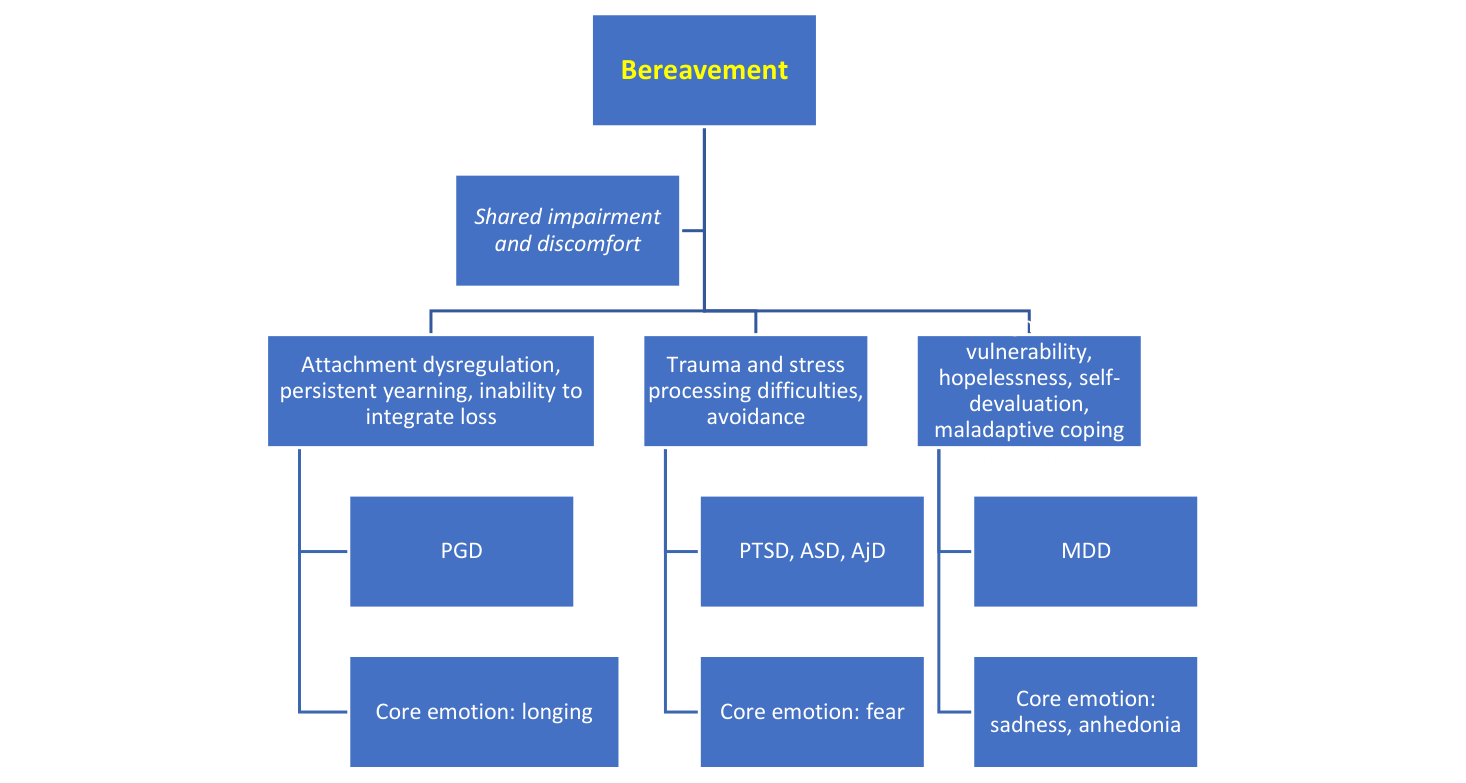
AjD= adjustment disorder, ASD= acute stress disorder, PGD= prolonged grief disorder, PTSD= posttraumatic stress disorder, MDD= major depressive disorder
Regarding the vital stress and trauma processing cluster, the dominant mechanisms are considered traumatic exposure, threat processing, intrusive memories, and avoidance. This cluster of disorders shares the core emotion of fear (i.e., of death or destruction).
The third cluster, represented by disorders centered on depressive manifestations, which have as representative the MDD, has as dominant mechanisms hopelessness, self-devaluation, anhedonia, and negative cognitive schemas. The core emotions in these disorders are sadness and anhedonia.
Therefore, although the current nosographic systems treat PGD, PTSD, acute stress disorder, adjustment disorder, and MDD as separate entities, comorbidity is common, symptoms overlap, risk factors overlap, and treatment targets are also similar. In this context, bereavement-related psychopathology may be better conceptualized as a spectrum of partially overlapping syndromes rather than completely distinct disorders. Therapeutic management of MDD and PTSD benefits from the same lines of interventions [54-57]; extrapolation of these to PGD seems more than logical, at a clinical level.
The development of transdiagnostic frameworks is not unique to psychiatry, since similar integrative approaches have been proposed in other medical specialties where heterogeneous clinical manifestations arise from common underlying biological mechanisms. For example, systemic amyloidosis may present with diverse gastrointestinal, neurological, and cardiovascular manifestations despite sharing a common pathogenic substrate [58,59]. Such observations support the broader principle that apparently distinct clinical syndromes may be better understood through shared mechanistic pathways rather than exclusively categorical classifications. This perspective reinforces the rationale for conceptualizing bereavement-related psychopathology as a spectrum of partially overlapping disorders rather than completely independent entities [58,59]. The proposed framework adopts a dimensional perspective while preserving categorical distinctions. PGD remains a distinct diagnosis, but one that exists within a broader continuum of bereavement-related psychopathology. Shared mechanisms justify partial transfer of therapeutic principles across disorders, but available evidence indicates that grief-focused interventions remain preferable when PGD is the primary diagnosis.
Limitations of this research are related to the limited availability of studies dedicated to PGD, since it was only recently recognized in the DSM-5 TR (2022), and to the non-systematic strategy for collecting data from the literature. Also, this model requires empirical validation, which can only be achieved through prospective studies that monitor and treat PGD and related disorders.
Future directions of research include conducting large-scale trials focused on early detection markers for vulnerability to PG-related disorders, but also on new treatments, both pharmacological and psychotherapeutic, that can be used in approaching patients with complicated bereavement.
The recognition of PGD has represented an important advance in bereavement psychiatry, reflecting the growing clinical relevance of this phenomenon. Nevertheless, the substantial overlap between PGD, PTSD, acute stress disorder, adjustment disorder, and MDD suggests that these conditions may represent related manifestations of a broader bereavement-response spectrum. A transdiagnostic framework may improve diagnostic precision, facilitate personalized interventions, and guide future research into the mechanisms that determine divergent trajectories following loss.
The authors declare no conflict of interest. This research received no external funding.
Not applicable. Generative AI was used for grammar and stylistic revision. The authors assume the entire responsibility for the final content of the article.
Conceptualization, O.V; methodology, O.V., A.G.M., B.M.P.; software, O.V., F.C.P.; validation, O.V., A.G.M., B.M.P., M.P., A.F.F., I.A., C.M., S.I.D., C.N., F.C.P.; formal analysis, O.V., A.G.M., B.M.P., M.P., A.F.F., I.A., C.M.; investigation, O.V., A.G.M., B.M.P., S.I.D., C.N., F.C.P.; resources, O.V.; data curation, O.V., A.G.M., B.M.P., M.P., A.F.F., I.A., C.M; writing—original draft preparation, O.V.; writing—review and editing, O.V., A.G.M., B.M.P.; visualization, S.I.D., C.N., F.C.P.; supervision, O.V., A.G.M., B.M.P.; project administration, O.V. All authors have read and agreed to the published version of the manuscript.
Not applicable.