
Sepsis and septic shock are critical medical conditions that occur as a systemic inflammatory response to severe infections and have a devastating impact on global public health [1,2]. These conditions are considered medical emergencies, as they can quickly lead to multiple organ dysfunction and death, with mortality rates reaching up to 40% in severe cases [1,3].
Sepsis is triggered by the presence of pathogenic microorganisms, such as bacteria, viruses, or fungi, which activate a complex and often excessive immune response [4]. The initial immune response to infection involves the activation of macrophages and other immune cells, which release cytokines and other inflammatory substances [5]. These proinflammatory molecules play a crucial role in defending the body; however, in sepsis, this response becomes disproportionate, damaging tissues and organs [6]. This excessive activation leads to vasodilation, increased vascular permeability, microvascular dysfunction, and, ultimately, multiple organ failure [7].
In essence, sepsis represents an overreaction of the immune system to an infection which, rather than protecting the body, causes extensive tissue and organ damage [8]. When this reaction escalates, resulting in a severe drop in blood pressure and inadequate perfusion of vital organs, septic shock occurs—an extreme form of sepsis that requires urgent and complex therapeutic interventions to prevent patient death [9].
The challenge of sepsis is compounded by the variability of symptoms, which can differ significantly from one patient to another, and the difficulty in quickly identifying the responsible infection [10]. This clinical heterogeneity makes timely diagnosis of sepsis challenging, contributing to its high mortality rate [11]. The fact that sepsis presents with symptoms common to other conditions—fever [12], tachycardia [13], rapid breathing [14], and low blood pressure [15]—can delay intervention.
In light of the aforementioned evidence, it can be surmised that the specific manifestations of sepsis fall within the differential diagnosis of other pathologies. In such cases, the therapeutic approach to sepsis (volemic repletion) may precipitate a worsening of the patient’s condition if the underlying diagnosis is not correctly identified. This could potentially lead to delays in establishing an accurate diagnosis and initiating appropriate treatment. It is therefore imperative to identify more rapid and efficient diagnostic methods, to save lives and reduce the significant costs associated with the care of patients with sepsis and septic shock.
Given the significant impact of sepsis and septic shock on public health and the limitations of current diagnostic methods, this study aims to identify the efficacy and clinical relevance of conventional diagnostic methods and modern approaches. This comparison will be conducted through a systematic review of the literature from 2014 to 2024, providing insights into the benefits, limitations, and potential of each clinical approach.
The study will synthesize evidence regarding the accuracy of diagnoses obtained through conventional methods, such as blood cultures and modern methods, including advanced molecular tests and specific biomarkers associated with sepsis. Additionally, it will examine the practical aspects of integrating these methods into clinical practice, with a focus on their potential to reduce diagnostic time and improve patient prognosis.
By highlighting how recent innovations can complement or even replace traditional methods, the study will provide a solid evidence base to support informed clinical decision-making. Ultimately, this review aims to contribute to the discussion on the broader integration of modern diagnostic methods within healthcare systems and to support the development of standardized practices that incorporate these advanced technologies in the management of sepsis and septic shock.
The methodology for this systematic review has been designed in accordance with the PRISMA guidelines to ensure transparency and rigor in the search, selection, and analysis process. This approach facilitates a detailed and comparative assessment of conventional and modern methods used in the diagnosis of sepsis and septic shock [16].
In our search strategy, we explored renowned international databases to obtain a representative and up-to-date selection of relevant scientific articles. The primary databases included MDPI and PubMed, as these provide access to a wide range of clinical studies, research articles, and other academic sources addressing the diagnosis of sepsis and septic shock.
Inclusion and exclusion criteria were rigorously established to maintain the quality and relevance of selected articles. Only studies that include specific diagnostic methods for sepsis, whether conventional or modern, were included. Additionally, only articles published in peer-reviewed journals with complete data available were selected for analysis to ensure a robust data foundation and minimize publication bias.
Regarding exclusion criteria, review articles, opinion pieces, case reports, and studies lacking clinical validation were excluded. These types of publications do not provide direct comparative data or are not based on systematic evaluations of diagnostic methods, and their inclusion would have distorted the analysis results.
To ensure transparency and traceability in the selection process, we included a PRISMA flow diagram in the study, detailing the number of studies identified and filtered at each stage. The diagram specifically illustrates the initial number of articles obtained from the search, the number excluded after reviewing titles and abstracts, and finally, the number included in the detailed analysis. The reasons for excluding articles are also specified to clarify why certain studies were not included in the final analysis.
The PRISMA diagram is an essential tool for transparency, as it enables readers to follow the decision-making process behind article selection, ensuring that the criteria established at the beginning of the review are adhered to [16,17].
Keywords and Boolean operators were used in the search process to refine the results and select only articles relevant to the study objectives. The main search terms included phrases such as “sepsis diagnosis” (29,700 results), “septic shock” (21,800 results), “conventional methods sepsis and septic shock” (17,300 results), and “modern methods sepsis and septic shock” (17,200 results). These terms were combined using the AND, OR, and NOT operators to ensure a highly precise selection.
The timeframe set for the included articles was 2010–2024 to reflect recent developments in sepsis diagnosis and ensure the relevance and currency of the data analyzed.
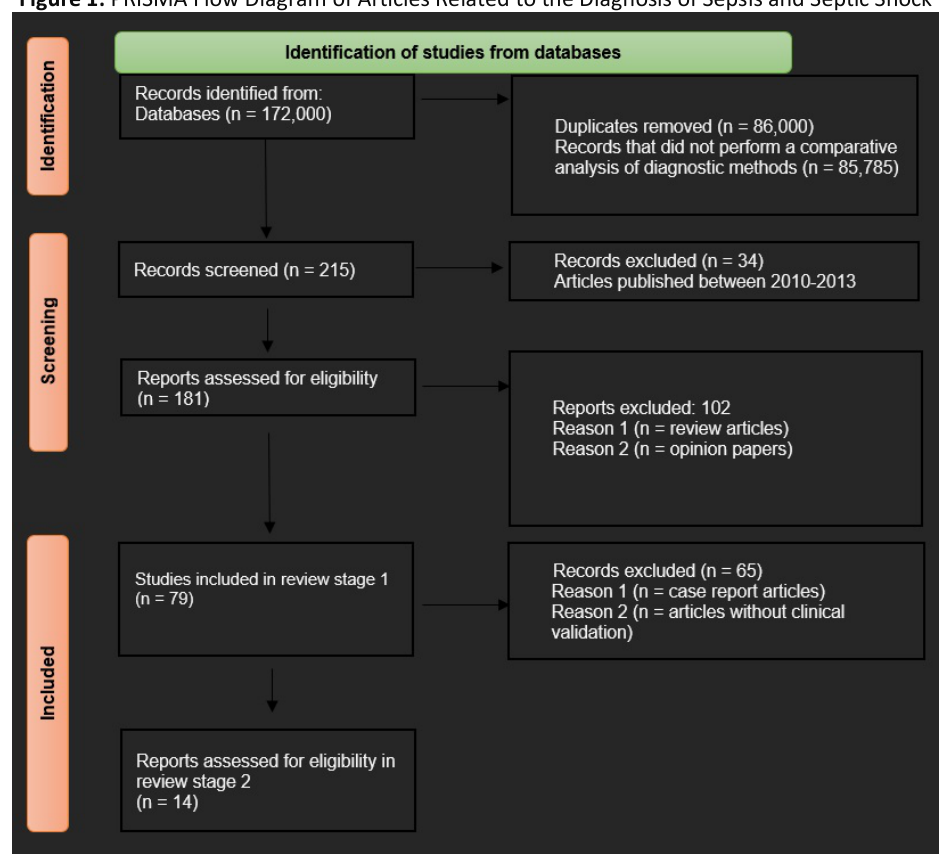
In Figure 1, we can see that the study identification process from the databases began with the selection of two main databases. In the course of this process, a total of 172,000 studies were identified. Of these, 86,000 records were eliminated as duplicates, as well as a further 85,785 records that did not perform a comparative analysis of diagnostic methods. Following these initial exclusions, 215 records remained for screening.
Of these, 34 were excluded after the selection process. These were articles published before 2014. We chose a period of 10 years rather than 14 because the literature on sepsis is constantly changing and the period 2010-2013 seemed outdated for today’s requirements. A total of 181 reports were assessed for eligibility. At this stage, reports were excluded for several reasons, including review articles, and opinion pieces.
In the end, 79 were included in the phase 1 review, with studies without clinical validation and case reports being discarded. 14 studies were selected for inclusion in stage 2 of the review.
Two distinct groups of modern and conventional methods were generated. The conventional methods included: basic immunophenotyping, cardiac function monitoring and histopathology, manual assessment of CRT, serum lactate, MAP, vasopressor use, standard intravenous fluid administration, ICD-9 coding for sepsis, clinical scores (e.g., SOFA, APACHE II, SAPS II/III), standard biomarkers (CRP, PCT, lactate), and blood clutches and antibiogram. Modern methods included: PAR2 receptor inhibition with 1-PPA, proteomic analysis (2D-nanoUPLC-UDMSE), restrictive intravenous fluid administration, SOFA score and albumin combination, NLR, PLR, MLR, PLT/MPV ratio, AR stimulation (PediSepsisAR), remote photoplethysmography (rPPG) and aCRT, T2Bacteria® panel and T2MR®, continuous monitoring with biosensors (PO, NIRS, ST), advanced biomarkers (e. (e.g. IL-6, suPAR, irisin), ML (machine learning) algorithms.
In Table 1, we present a detailed analysis of 14 studies, each examining innovative interventions, biomarkers, and technologies used in the diagnosis and management of sepsis and septic shock. Data were extracted from recently published articles and structured according to study design, type of intervention, methodology, and key results.
| Author(s) and Year | Study Design | Sample | Intervention | Intervention Duration | Conventional Methods | Modern Methods | Key Results | Conclusions |
|---|---|---|---|---|---|---|---|---|
| Meyhoff et al., 2022 [18] | International, randomized, open-label study (CLASSIC trial) | 1554 ICU patients with septic shock | Restriction of IV fluids vs. standard fluids | Until ICU discharge (max. 90 days) | Standard IV fluid administration according to guidelines | Restrictive IV fluid administration | Similar mortality between groups: 42.3% (restrictive) vs. 42.1% (standard). Similar incidence of adverse events: 29.4% (restrictive) vs. 30.8% (standard). Similar life support-free days and out-of-hospital days between groups | Fluid restriction did not improve survival rates compared to standard therapy. Fluid restriction did not reduce the incidence of severe adverse events. Restrictive intervention showed no significant benefits over standard intervention in the ICU. |
| Liberski, Szewczyk, & Krzych, 2020 [19] | Retrospective case-control study | 138 ICU patients | Evaluation of NLR, PLR, MLR, PLT/MPV ratios vs. CRP, PCT, and lactate | On ICU admission | CRP, PCT, lactate | NLR, PLR, MLR, PLT/MPV | High NLR has predictive value for septic shock (AUROC = 0.66); combining NLR + CRP improves septic shock prediction (AUROC = 0.88) | NLR can identify patients with septic shock but must be interpreted alongside CRP/PCT; no index predicts ICU mortality |
| Toto et al., 2021 [20] | Randomized controlled feasibility study | 50 paediatric participants | Simulation of septic shock with and without AR (PediSepsisAR) | Short-term simulation (per exercise) | Traditional mannequin simulation | AR simulation (PediSepsisAR) | Fluid administration time and volume were measurable in both groups; no significant differences in patient status recognition or fluid administration. | PediSepsisAR is feasible for simulation; improved perception of perfusion in most participants, but no impact on response times. |
| Wang et al., 2023 [21] | Retrospective bioinformatics study | 98 sepsis patients (GSE26440) and 32 control; external test: 51 sepsis patients, 22 control | Diagnostic model using PCD-associated genes | Retrospective, pre-existing data | SOFA score and traditional inflammatory biomarkers | ML algorithms (RF, SVM, DNN) for gene-based diagnosis | ML models based on 10 genes (e.g., ITGAM, KIF1B) achieved AUC=0.7951 (internal) and AUC=0.9627 (external); analysis of immune cell infiltration in sepsis | Gene-based ML models show high diagnostic capacity for sepsis; potential to improve diagnosis and identify therapeutic targets |
| Lungu et al., 2024 [22] | Longitudinal observational study | 121 neonates (39 late-onset sepsis, 35 early-onset sepsis, 47 control) | Multimodal monitoring (pulse oximetry – PO, near-infrared spectroscopy – NIRS, skin temperature – ST) with biosensor signal integration through ML algorithm | Max 72 hours of continuous monitoring | Standard biomarkers (CRP, PCT), cultures | Continuous monitoring with PO, NIRS, ST, ML algorithm | The model had 87.67% accuracy and detected sepsis 6-48 hours before clinical diagnosis; NIRS and ST had the highest predictive accuracy (0.90 and 0.85) | Non-invasive monitoring methods (NIRS, PO, ST) significantly improve early neonatal sepsis detection, complementing conventional tests and reducing the potential for clinical deterioration; require validation in varied clinical settings |
| Pipitò et al., 2024 [23] | Retrospective study | 15,373 sepsis patients admitted to hospitals in Sicily between 2016-2020 | Retrospective data collection from standard discharge forms for all sepsis cases in hospitals | 5 years | ICD-9 for coding and identifying sepsis and septic shock | Temporal trend analysis through regression | Overall in-hospital mortality was 36.3%, higher in septic shock cases (66.7%) and ICU patients (74%). Rates increased over the analyzed years. | Sepsis and septic shock significantly contribute to in-hospital mortality; and require a focus on infection prevention, antimicrobial stewardship, and improved diagnostic coding. |
| Luka et al., 2024 [24] | Prospective observational study | 67 sepsis and septic shock patients, ED, Cluj-Napoca, Romania | Evaluation of 6 biomarkers (IL-6, suPAR, AZU1, hsCRP, sTREM-1, PCT) combined with severity | 28 days | Severity scores: SOFA, APACHE II, SAPS II/III, NEWS, CCI, GCS, qSOFA, SIRS, MEDS | Advanced biomarkers (IL-6, suPAR, AZU1) combined with clinical scores | Mortality was 49.25%; IL-6 was the most accurate biomarker, and SAPS II/III were the most predictive scores for mortality | IL-6 and SAPS II/III are the best predictors of 28-day mortality in ED sepsis cases; using biomarkers with clinical scores improves prognostic accuracy |
| Klibus et al., 2024 [25] | Prospective observational study | 20 patients with bacterial septic shock or COVID-19-associated sepsis, ICU, Latvia | Evaluation of microcirculation via remote photoplethysmography (rPPG) and automated capillary refill time (aCRT) analysis in infusion | Various stages during the protocol | MAP, manual CRT, serum lactate levels, skin temperature | rPPG, aCRT | rPPG and aCRT detected perfusion changes more sensitively than manual CRT, highlighting significant differences between bacterial and COVID-19-associated sepsis | rPPG and aCRT are promising tools for microcirculation monitoring in intensive care, providing more precise assessments than conventional methods, useful for sepsis patient management |
| Bonura et al., 2024 [26] | Retrospective observational study | 85 patients with septic shock or sepsis-induced hypotension, ICU | Evaluation of T2 Magnetic Resonance (T2MR®) technology for early ESKAPE pathogen detection using T2Bacteria® | First 6 hours after sepsis onset | Blood cultures and antibiogram | T2Bacteria® Panel for rapid bacterial identification | 81% concordance rate between T2Bacteria® and blood cultures; T2Bacteria® detects pathogens in 5.15 hours vs. 94.62 hours for traditional cultures | T2Bacteria® Panel provides rapid and concordant ESKAPE pathogen detection, allowing faster decisions on antibiotic escalation or de-escalation in severe sepsis cases |
| Ayenew Mekuria et al., 2024 [27] | Retrospective cohort study | 386 ICU septic shock patients | Septic shock management in ICU | 2019-2023 | Vasopressors (adrenaline, dopamine) | ICU surveillance, continuous monitoring | Mortality rate of 58.29%; predictive factors: age >60 years, delayed ICU admission, low MAP, comorbidities, unidentified pathogen | ICU mortality for septic shock remains high; need for early recognition and treatment protocols, in line with sepsis survival guidelines |
| Karampela et al., 2024 [28] | Prospective observational study | 102 critical patients with sepsis or septic shock, 102 healthy control | No specific intervention, comparative analysis | 28 days | CRP, procalcitonin as standard biomarkers | Serum irisin determination via ELISA | Patients with low circulating irisin had significantly higher 28-day mortality; irisin was negatively associated with sepsis severity and APACHE II and SOFA scores. | Circulating irisin decreases at sepsis onset and could be a promising biomarker for prognosis and diagnosis; needs confirmation in larger studies. |
| Alves et al., 2024 [29] | Observational proteomic study | 5 septic shock patients, 10 healthy control | No specific intervention | N/A (not applicable) | Monocyte immunophenotyping | Proteomic analysis via 2D-nanoUPLC-UDMSE | Identified 67 proteins with altered expression in septic shock patients’ monocytes, linked to immune dysfunction, hypotension, vasodilation, and endothelial damage | Identified proteins could serve as biomarkers for diagnosis, prognosis, and treatment of septic shock, offering new insights into this condition’s pathophysiology. |
| Kim et al., 2024 [30] | Retrospective observational study | 5805 septic shock patients from 12 EDs in South Korea | No specific intervention | N/A (not applicable) | Initial SOFA assessment | Combination of SOFA with serum albumin level | 28-day mortality inversely proportional to albumin level; SOFA with albumin improved mortality prediction (AUC 0.71 vs. 0.68 SOFA alone) | Combining initial SOFA score with albumin level may enhance prognostic accuracy, providing a risk stratification tool in septic shock |
| Luisetto, Scarpa, Villano, Martini, et al., 2024 [31] | Experimental study, in vitro and in vivo | Mouse model of LPS-induced endotoxemia | Administration of 1-PPA molecule to inhibit PAR2 receptor | 1 and 3 hours post-LPS injection (early and delayed administration) | Survival monitoring, cardiac function analysis, histopathological assessments | Real-time PCR, Western blot, cardiac ultrasound, flow cytometry | 1-PPA administration reduced mortality and sepsis symptoms, improved cardiac function, and decreased inflammation via PAR2 inhibition | 1-PPA demonstrates efficacy in reducing sepsis effects by blocking PAR2, preventing pro-inflammatory pathway activation, and reducing multiorgan dysfunction |
ICU: Intensive Care Unit; CRP: C-Reactive Protein, an inflammatory marker; PCT: Procalcitonin – Procalcitonin, a specific biomarker for bacterial infections; NLR: Neutrophil-to-Lymphocyte Ratio; PLR: Platelet-to-Lymphocyte Ratio; MLR: Monocyte-to-Lymphocyte Ratio; PLT/MPV: Platelet to Mean Platelet Volume Ratio; AR: Augmented Reality; PediSepsisAR: AR simulation for paediatric septic shock recognition; PCD: Programmed Cell Death; ML: Machine Learning; RF: Random Forest classification algorithm; SVM: Support Vector Machine classification algorithm; DNN: Deep Neural Network; AUC: Area Under the Curve; PO: Pulse Oximetry; NIRS: Near-Infrared Spectroscopy; ST: Skin Temperature; ICD-9: International Classification of Diseases, 9th Revision; AUROC: Area Under the Receiver Operating Characteristic; IL-6: Interleukin-6, an inflammatory biomarker; suPAR: Soluble Urokinase Plasminogen Activator Receptor; AZU1: Azurocidin 1 – Protein associated with inflammation and immune response; sTREM-1: Soluble Triggering Receptor Expressed on Myeloid Cells-1 – Triggering Receptor on Myeloid Cells-1; MAP: Mean Arterial Pressure – Mean Arterial Pressure; CRT: Capillary Refill Time; rPPG: Remote Photoplethysmography; aCRT: Automated Capillary Refill Time; T2MR®: T2 Magnetic Resonance; CCI: Charlson Comorbidity Index; GCS: Glasgow Coma Scale; NEWS: National Early Warning Score; qSOFA: Quick Sequential Organ Failure Assessment; SIRS: Systemic Inflammatory Response Syndrome; MEDS: Mortality in Emergency Department Sepsis; 2D-nanoUPLC-UDMSE: Two-dimensional Ultra Performance Liquid Chromatography-Ultimate Data-Independent Mass Spectrometry Enhancer – Advanced proteomic technology for monocyte analysis; ELISA: Enzyme-Linked Immunosorbent Assay – Enzyme-Linked Immunosorbent Assay, used for irisin determination; PAR2: Protease-Activated Receptor 2 – Protease-Activated Receptor 2, associated with inflammation.
The analyzed studies included ICU patients who were assessed and monitored for sepsis and septic shock using both conventional and modern methods. These studies comprised randomized, observational, retrospective, and prospective designs, with data covering clinical variables such as mortality, incidence of adverse events, length of hospital stay, and response to various interventions.
The interventions analyzed included techniques for intravenous fluid administration, the use of inflammatory biomarkers (NLR, PLR, MLR, CRP, PCT, lactate), machine learning algorithms for continuous monitoring (e.g., photoplethysmography, capillary refill time analysis), and gene expression-based models for diagnostics (e.g., using a panel of PCD genes in machine learning algorithms). Each study employed specific statistical analysis methods and regression models to evaluate the effect of these interventions on mortality and clinical outcomes of patients.
For biomarkers and continuous monitoring, predictive analysis methods were used, combining clinical scores (SOFA, APACHE II, SAPS II/III, qSOFA) with advanced biomarkers (IL-6, suPAR, sTREM-1). Additionally, rapid molecular technologies for pathogen identification, such as the T2Bacteria® panel using magnetic resonance, were utilized to enable quick identification of infectious agents.
The analysis also included proteomic diagnostic technologies that identified altered proteins in septic shock, used as potential biomarkers for diagnosis and prognosis. Experimental studies also involved animal models to assess the efficacy of interventions such as blocking inflammatory receptors (e.g., PAR2) with specific molecules aimed at reducing sepsis effects by preventing organ dysfunction.
In Table 1, we also observe that recent studies emphasize the importance of personalized approaches and advanced monitoring in sepsis and septic shock, incorporating both conventional clinical interventions and innovative methods. Although fluid restriction and standard biomarkers have shown limitations in predicting and managing sepsis effectively, emerging technologies like monitoring through machine learning algorithms, rapid diagnostics with molecular panels, and the use of specific biomarkers, such as irisin, offer promising perspectives for improving diagnostic and prognostic accuracy. However, further studies are recommended to validate these methods across various clinical settings and to implement them into intensive care protocols.
In terms of conventional methods, the most frequently used are clinical scores (e.g. SOFA, APACHE II, SAPS II/III) and standard biomarkers (CRP, PCT, lactate). These are each mentioned four times across studies, which serves to underscore their central role in traditional clinical practice.
Other conventional methods, such as blood cultures and antibiograms, appear twice, while standard intravenous fluid administration, ICD-9 coding for sepsis, vasopressor use, and cardiac function monitoring are each mentioned only once.
The high frequency of clinical scores (e.g., SOFA, APACHE II, SAPS II/III) and standard biomarkers (CRP, PCT, lactate) in traditional clinical practice is because these methods are well-validated, accessible, and easy to apply across various clinical settings. These tools are an integral part of international guidelines for the diagnosis and monitoring of sepsis and septic shock, with widely recognized utility in assessing patient severity and risk stratification [32,33].
Conversely, less frequently used conventional methods, such as blood cultures and antibiograms, standard intravenous fluid administration, ICD-9 coding for sepsis, vasopressor use, and cardiac function monitoring, are employed less often for various reasons. Blood cultures and antibiograms are useful for identifying pathogens but require a long time to yield results, making them less practical in emergencies. ICD-9 coding is important for epidemiological data collection but has a limited impact on immediate patient care.
Therefore, the more frequent use of clinical score assessment and standard biomarkers is due to their ability to provide rapid and reliable information about the patient’s condition, making them suitable for initial assessment and real-time monitoring of patient progress.
On the other hand, among modern methods, the use of advanced biomarkers (e.g., IL-6, suPAR, irisin) has the highest frequency (3 mentions), followed by machine learning algorithms and continuous monitoring with biosensors (e.g., PO, NIRS, ST), each with two mentions. Other modern methods, such as molecular diagnostic panels (T2Bacteria® and T2MR®), remote photoplethysmography, AR simulations, and PAR2 receptor inhibition, were used less frequently, each mentioned only once, suggesting that they are either emerging technologies or applied only in specific contexts.
The high frequency of advanced biomarkers (e.g., IL-6, suPAR, irisin), machine learning algorithms, and continuous monitoring with biosensors (e.g., PO, NIRS, ST) as modern methods in the diagnosis and monitoring of sepsis and septic shock are due to their enhanced capacity for early detection and precise patient assessment. Advanced biomarkers are valued for their increased sensitivity in identifying inflammation and organ dysfunction associated with sepsis, and their inclusion in clinical practice is supported by growing evidence showing their predictive value.
Machine learning algorithms and continuous monitoring with biosensors are also highly attractive to researchers and clinicians, as they can analyze complex data and provide real-time alerts, enabling faster and more personalized interventions. In particular, machine learning algorithms can integrate information from multiple sources (biomarkers, vital signs) to improve risk stratification and allow continuous, proactive monitoring of patients.
On the other hand, modern methods with lower usage frequency, such as molecular diagnostic panels (T2Bacteria® and T2MR®), remote photoplethysmography, AR simulations, and PAR2 receptor inhibition, are relatively new and are typically used only in specific contexts or experimental studies. These technologies are still in the evaluation phase for widespread implementation and require additional studies to validate their effectiveness and cost-efficiency across various clinical settings. Additionally, the higher costs and infrastructure requirements for some of these emerging technologies limit their broad use in everyday clinical practice.
Thus, there is a continued preference for conventional methods in clinical practice, alongside a gradual trend towards the integration of more advanced modern methods, which have the potential to provide faster and more accurate detection of sepsis and septic shock.
A total of 23,822 patients were reviewed across the studies included in this systematic analysis. These patients come from various observational, randomized, and retrospective studies, each with different designs and intervention methods aimed at evaluating and monitoring sepsis and septic shock.
The results of this systematic analysis demonstrate that the treatment of sepsis and septic shock can be enhanced by combining conventional interventions with modern methods, including advanced biomarkers, digital monitoring, and artificial intelligence (AI) techniques. The studies reviewed cover a wide range of therapeutic approaches, from fluid therapy strategies and inflammatory biomarkers to continuous monitoring technologies and predictive genetic analyses.
A central aspect of the analysis is the impact of conventional and modern interventions. For example, the study by Meyhoff et al. (2022) shows that intravenous fluid restriction does not offer significant advantages over standard therapy in terms of mortality or reduction of severe adverse events [18]. Although fluid restriction may reduce the risk of volume overload, the results of this study indicate that there are no significant differences between restrictive intervention and the conventional approach regarding the survival of patients with septic shock. This suggests that the optimization of fluid volume should be evaluated based on the individual characteristics of each patient.
Similarly, the study by Liberski et al. (2020) highlights the role of biomarkers such as NLR (neutrophil-to-lymphocyte ratio) in assessing the risk of septic shock [19]. NLR has shown predictive value for identifying patients prone to septic shock, but its combination with conventional biomarkers like CRP and PCT significantly increases predictive accuracy. This suggests that advanced biomarkers may contribute to the early identification of high-risk patients, facilitating faster interventions. However, since no single biomarker directly predicted mortality, their optimal use remains as a complement to standard clinical measures, for more effective risk stratification.
Another essential aspect is the inclusion of modern monitoring technologies, such as near-infrared spectroscopy (NIRS) and remote photoplethysmography (rPPG). The study by Lungu et al. (2024) indicates that continuous monitoring using NIRS, PO, and skin temperature can detect sepsis 6–48 hours before clinical diagnosis, providing an important advantage in preventing the rapid progression of the disease [22]. NIRS and PO demonstrated the highest predictive accuracy, highlighting the potential of these non-invasive methods for continuous monitoring and early detection of neonatal sepsis. Microcirculation monitoring via photoplethysmography (rPPG) showed greater sensitivity than conventional methods for assessing perfusion, which could have important implications for managing critically ill patients with septic shock, according to the study by Klibus et al. (2024) [25]. The use of these technologies offers a more sensitive way to monitor subtle changes in tissue perfusion, which could precede overt clinical deterioration.
AI-based methods also bring innovative contributions to the diagnosis and prognosis of sepsis. The study by Wang et al. (2023) highlights the capability of machine learning (ML) algorithms to identify sepsis-associated genes, such as ITGAM and KIF1B, with significant accuracy [21]. These models achieved high-performance scores (AUC), indicating that ML-based approaches can support diagnosis and risk stratification by identifying specific genetic profiles. Using AI to analyze genetic profiles paves the way for personalized treatments and improved identification of therapeutic targets.
Additionally, the administration of the molecule 1-PPA, investigated by Luisetto et al. (2024), demonstrated positive effects by reducing mortality and sepsis symptoms in animal models [31]. This molecule inhibits the PAR2 receptor, reducing systemic inflammation and protecting cardiac function, suggesting that interventions targeting specific molecular pathways could offer new therapeutic solutions for patients with septic shock. Although these results are preliminary and obtained from in vitro and in vivo animal studies, they show promising potential for developing targeted therapies capable of blocking inflammatory cascades at the molecular level.
Overall, the results of this analysis underscore the need for an integrated approach that combines conventional interventions, such as fluid administration and vasopressors, with modern diagnostic and monitoring methods. Continuous monitoring, advanced biomarkers, and AI algorithms have the potential to improve prognosis and reduce mortality in sepsis, although their widespread applicability depends on validation in extensive clinical studies. While some methods, such as fluid restriction, have shown limited results, others, like biomarkers or digital monitoring, have significant potential in risk stratification and early identification of patient deterioration.
Thus, the combination of conventional and modern methods allows for better adaptation of treatment to the individual specificities of each patient, while also offering opportunities to improve survival and quality of care in intensive care units.
This comparative study of conventional and modern methods for diagnosing and monitoring sepsis and septic shock highlights the importance of adopting advanced technologies in the care of critically ill patients. While traditional methods, such as blood cultures and standard biomarkers, remain fundamental, the results of the reviewed studies suggest that modern technologies – including rapid molecular tests, continuous monitoring through biosensors, and machine learning algorithms – offer greater accuracy in early diagnosis and superior risk stratification capabilities. These advanced tools enable faster and more informed interventions, thereby contributing to improved prognosis and reduced mortality in sepsis and septic shock.
The comparative analysis between conventional and modern methods of diagnosis and monitoring for sepsis and septic shock reveals several practical implications for clinical practice. Conventional methods, such as the use of standard biomarkers (CRP, PCT, lactate) and clinical scores (SOFA, APACHE II, SAPS II/III), remain essential due to their accessibility and the familiarity healthcare professionals have with them. These methods provide a solid foundation for the initial assessment of patients and risk stratification in intensive clinical settings.
However, integrating modern methods, such as machine learning algorithms, continuous monitoring with biosensors, and the use of molecular diagnostic panels (e.g., T2Bacteria®), has the potential to significantly transform clinical approaches. These advanced technologies can improve diagnostic accuracy, enable early detection of sepsis, and facilitate faster and more informed decision-making. For instance, rapid molecular panels can identify pathogens within hours, thereby reducing the time needed to initiate appropriate antibiotic therapy, which is crucial for improving patient prognosis.
Implementing these modern methods in hospitals requires initial investments in infrastructure and medical staff training, but the potential benefits are substantial, including reduced mortality, shortened hospital stays, and optimized resource utilization in intensive care units. The use of advanced biomarkers and machine learning algorithms could also facilitate continuous monitoring of patients with sepsis and septic shock, providing real-time alerts for patient deterioration and supporting early intervention.
In the long term, these innovations may contribute to the standardization of more effective clinical protocols and the personalization of treatments for sepsis patients, tailoring interventions to the specifics of each patient. Furthermore, the gradual integration of these modern technologies could help raise the quality of medical care and improve the overall efficiency of the healthcare system.
To fully integrate these technologies into clinical practice, further clinical studies are needed to validate their effectiveness across a variety of clinical settings. It is essential to develop standardized protocols that include rapid molecular tests and machine learning algorithms for early detection and personalized monitoring of patients. Additionally, future research should explore the potential of new biomarkers and non-invasive monitoring technologies to support rapid clinical decision-making and facilitate integrated sepsis management in intensive care units.
This systematic analysis included studies with varied designs (randomized, observational, and retrospective studies), which may impact the direct comparability of results. Differences in study design, patient populations, and clinical settings (pediatrics, adults, ICU) make generalizing conclusions challenging, as each type of study may have its methodological limitations and biases. The present study encompasses a diverse range of patient populations, including neonates, children, adults, and the elderly. It is therefore evident that the newborn with sepsis has almost no defense mechanisms, whereas the middle-aged population demonstrates the most effective response to sepsis through early secretion of various mediators, a robust response to systemic inflammation, and a high capacity for regeneration. The elderly are included in the category of individuals who are considered to be frail, and as a result, may demonstrate a reduction in their ability to respond effectively to an encounter with a pathogen. Consequently, sepsis can be identified even in its most advanced stages in these patients. Furthermore, the capacity for regeneration is diminished in this population, resulting in more pronounced manifestations and consequences of sepsis and septic shock. Furthermore, patients with at least one additional health condition (such as autoimmune, cardiovascular, respiratory, or renal disease) are at significantly elevated risk of developing more severe forms of sepsis, including septic shock. Consequently, developing a diagnostic methodology for sepsis in the general population is challenging, necessitating the use of specific diagnostic techniques and combinations of traditional and modern methods adapted to the individual’s age, associated diseases, and other factors.
The authors declare no conflict of interest. No artificial intelligence automatically generated text was inserted in this manuscript, and no image was previously published in another journal or is under consideration of being published elsewhere. This research received no external funding.
Conceptualization, G.P.G. and A.N.D.; methodology, R.M.S and L.P; software, A.B. and I.S.C.; validation, V.T.G and D.R.T.; formal analysis, D.C, D.O.C. and E.F.L.; investigation, G.P.G, A.N.D and A.B.; data curation, V.T.G. and E.F.L; writing—original draft preparation, A.B and R.M.S.; writing—review and editing G.P.G, D.O.C. and D.C.; visualization, L.P. and I.S.C.; supervision, G.P.G and D.R.T.; project administration, G.P.G and D.C. All authors have read and agreed to the published version of the manuscript.
Not applicable.
Not applicable.