
The rise of computing power and the development of machine learning algorithms allowed extensive data mining, which led to new possibilities for research from large unused data sources such as electronic medical records. This fact might provide some surprising interactions between patient’s features. Along with this trend of high throughput data mining in medicine, new ethical issues appeared since there is a risk of data leakage, loss of anonymization, and in some cases, unscrupulous use of such information [1].
The AB0 blood group systems consist of four antigens (0, A, B, and AB), discovered by Karl Landsteiner [2,3]. The AB0 antigens were found in the protein and lipid membrane components of various cells (most importantly, erythrocytes) and soluble blood group substances [4]. The scientific literature shows important evidence of the involvement of the ABO blood group system in certain diseases, increasing the risk of developing bleeding or thrombotic events, influencing the susceptibility to different pathogens implicated in infectious diseases with different locations (digestive, urinary, etc.), or the association of a certain AB0 blood type with a certain malignancy [5–8]. The mechanisms by which the AB0 blood group plays a role in development and progression can be a dysregulation of the enzymatic activity of the AB0 glycosyltransferases or the association between polymorphisms at the AB0 gene locus and circulating levels of tumor necrosis factor-alpha, soluble intercellular adhesion molecule, E-selectin and P-selectin contributing to alterations in the host inflammatory system [9].
Several studies describe the association between the individual`s blood group and the risk of developing certain malignancy risk, like leukemia, gastrointestinal cancer, pancreatic cancer, head, and neck cancer. Different blood groups are associated with different risks for head and neck cancer, and people with blood group A are at higher risk of developing head and neck cancer, followed by those with blood groups B, AB, and 0.
In patients with acute leukemia, and sometimes in aplastic anemia, A and B antigens commonly decrease until they are undetectable; as the patient’s condition improves, the antigens increase again to their former levels, this loss of antigens may not be due to deficiency in transferase synthesis or activity, but instead may be due to an inhibitory factor related to antigen-antibody binding, or an abnormal distribution or density of antigen sites in the RBC membrane.
Patients with leukemia had significantly lower expression of A, B, or H antigens, between 17% and 37%, when compared to healthy controls; of A, B, or AB patients with myeloid malignancies, 55% had reduced expression of A or B antigens, and 21% of 0 patients had reduced H antigens when compared with healthy controls of the same AB0 genotype. The incidence of cancers of the gastrointestinal tract was statistically significantly different among different AB0 blood types. Compared with blood type A, individuals with non-A blood types were at an approximately 20% lower risk of cancer of the gastrointestinal tract [10–14].
Colorectal cancer ranks third in terms of incidence, and second in terms of mortality, linked to risk factors like obesity, diet, lack of physical activity, tobacco use, moderate-to-heavy alcohol use, and diabetes mellitus [15–17]. The cornerstones of therapy are surgery, neoadjuvant radiotherapy (for patients with rectal cancer), adjuvant chemotherapy (for non-metastatic rectal cancer), and a “wait and see” approach in case of complete remission after neoadjuvant therapy (inferior rectal cancer). 5-year relative survival ranges from greater than 90% in patients with stage I disease to slightly greater than 10% in patients with stage IV disease [18–20].
Blood transfusion in surgery for rectal cancer, along with other factors, can be associated with the risk of developing postoperative infectious complications and tumor recurrence. Few studies evaluate the risk of rectal cancer among different blood groups; therefore, we analyzed to check if there is a susceptibility of the AB0 blood group type that can be associated with the risk of developing, progression, or protection against rectal cancer [21–23].
In a retrospective study, we analyzed electronic records of cancer patients admitted at “Prof. Dr. Alexandru Trestioreanu” Oncological Institute of Bucharest between 2013 and 2021.
The mining script searched all the entries in the hospital’s electronic database using proprietary coding for each patient. These codes weren’t saved in the final data set. We extracted blood group type, age, gender, and cancer diagnosis. From these records, we pooled rectal cancer patients and compared them with the general oncologic population for blood group differences. Statistical analysis was performed in Excel and R Studio (“ggplot2”, “mosaic”, and base libraries) using contingency tables, Chi-square test, and mosaic plots. For statistical significance, we chose p-value < 0.05.
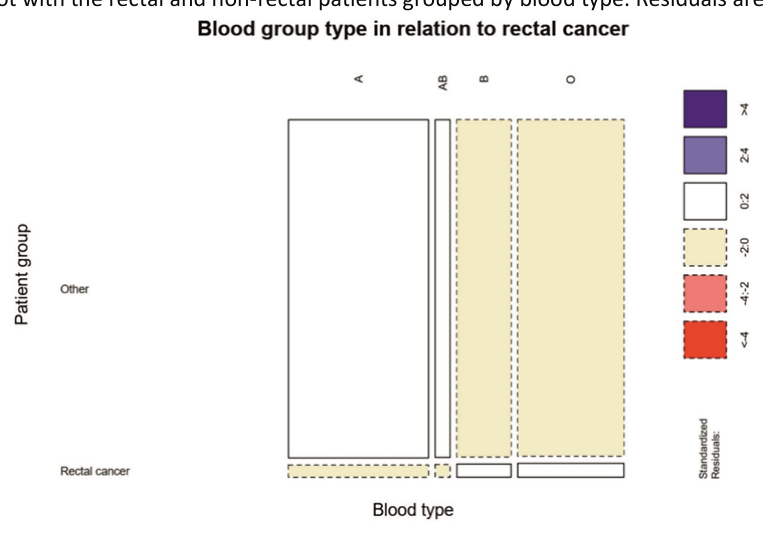
We analyzed the records of 18 734 patients, 5152 males (27.5%) and 13582 females (72.5%), with a mean age of 65 (23-101), a mean age for males of 67 (23-100), and 65 (23-101) for females. Regarding blood type, the most frequent was type A (44.4%), followed by 0 (33.7%), B (17.2%), and AB (4.7%) for the entire cancer-analyzed population. We observed 690 rectal cancer patients (3.8%). In contingency Table 1, we summarize the frequencies for each blood type in relation to rectal cancer patients and other types of cancer. (Table 1).
| Blood group | Other cancer type (%) | Rectal cancer (%) | Total (%) |
|---|---|---|---|
| A | 8033 (44.5) | 287 (41.6) | 8320 (44.4) |
| AB | 854 (4.7) | 32 (4.6) | 886 (4.7) |
| B | 3101 (17.2) | 121 (17.5) | 3222 (17.2) |
| 0 | 6056 (33.6) | 250 (36.2) | 6306 (33.7) |
| Total | 18044 | 690 | 18734 |
The differences between the proportions of the two groups were not significant irrespective of blood type and the lack of evidence for the null hypothesis rejection was shown using the χ2 test statistic (χ2=49.94, d.f. 39, p = 0.11). The residuals are shown in Figure 1.
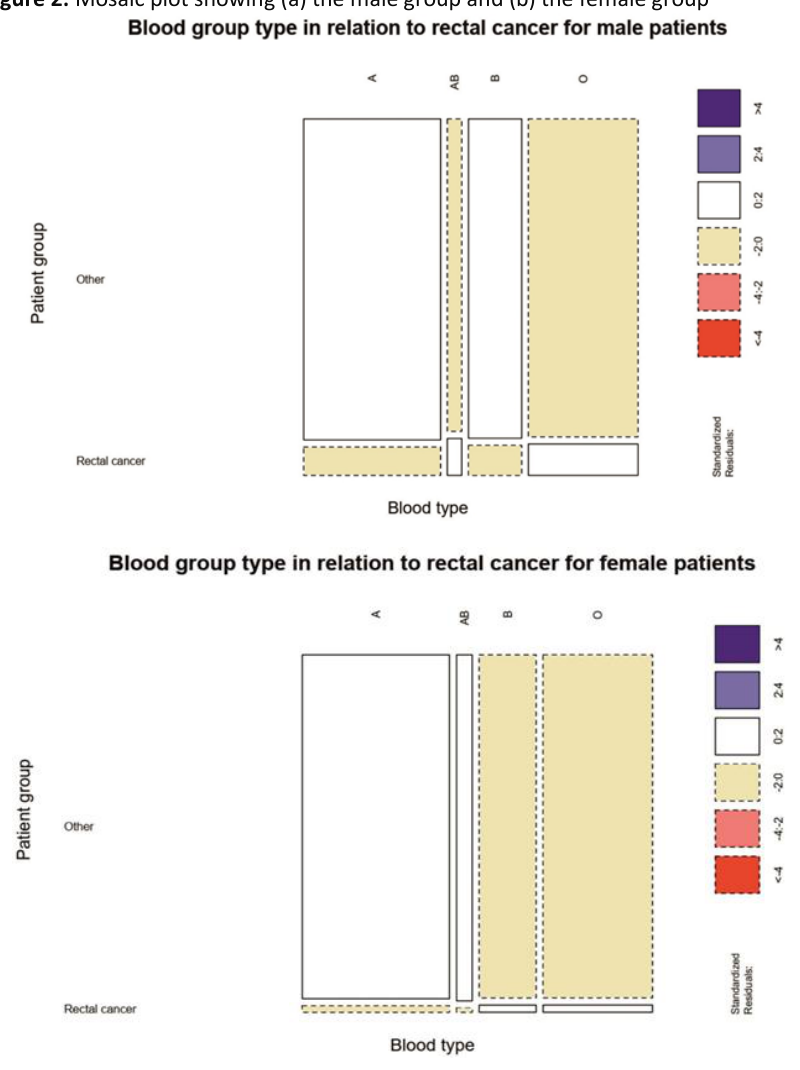
Similarly, no differences were found in the male and female subgroups (χ2 = 2.1, d.f. 3, p = 0.55 for males and χ2 = 2.9, d.f. 3, p = 0.4 for females). From Figure 2, we can see that the number of patients per group differs a lot, while the residuals are similar between the two groups.
AB0 blood group type has been associated with the risk and survival for several malignancies. Regarding head and neck cancers, there is a relative risk of various HNSCCs amongst different blood groups [24,25].
A voluminous literature has accumulated on the role of blood type A and gastric cancer. Gastric cancer is one of the most common malignant tumors of the digestive system. Substance A in the saliva and gastric juices can act on the gastric mucosa, leading to an increased likelihood of a malignant change in the gastric mucosa. The individuals with blood group 0 showed a significantly reduced risk of gastric cancer compared with non-0 blood groups. The susceptibility of blood group A individuals to gastric cancer may be partially attributed to an increased risk of H. pylori infection. Impaired with the healthy population, the frequency distribution of gastric cancer patients with the A blood group was significantly increased, whereas the frequency distribution of gastric cancer patients with the AB blood group was significantly decreased. However, there was no significant difference in the distributions of the B blood group and 0 blood group. The risk of gastric cancer in people with the A blood group was higher, whereas the risk of gastric cancer in people with the AB blood group was lower. There was no significant difference in the risk of gastric cancer between type B and type 0 patients). The AB0 blood group was not related to pathological factors, including the size of the gastric tumor or the T stage or N stage of the disease. Univariate analysis results showed that the degree of differentiation, tumor size, T stage, lymph node metastasis, and type 0 blood were factors affecting the 5-year survival rate of gastric cancer patients. Multivariate analysis results showed that tumor size, T stage, lymph node metastasis, and 0 blood group were independent prognostic factors. The 5-year survival rate for gastric cancer was significantly better in patients with type 0 blood [26–29].
The prospective cohort study found that participants with blood groups A, AB, and B were more likely to develop pancreatic cancer compared with participants with blood group 0. A recent genome-wide association study (GWAS) among pancreatic cancer cases and controls (PanScan) found that several single nucleotide polymorphisms (SNPs) at the AB0 gene locus were among the most statistically significant associations with pancreatic cancer risk. AB0 blood group alleles might provide additional risk information and provide supportive evidence for the role of AB0 glycosyltransferase specificity in pancreatic tumorigenesis. AB0 blood group alleles represent a common, partially penetrant genetic determinant for pancreatic cancer. Chronic inflammation is a predisposing factor for pancreatic carcinogenesis; pancreatic cancer induces a strong desmoplastic reaction that acts as an abundant source of inflammatory mediators, supporting tumor growth and metastases. Interestingly, two recent GWAS suggest that AB0 blood group antigens may affect the systemic inflammatory state. NPs at the AB0 locus were associated with two serum markers of inflammation, tumor necrosis factoralpha (TNF-α) and soluble intercellular adhesion molecule 1 (sICAM-1). TNF-α is a pro-inflammatory cytokine known to modulate rates of pancreatic ductal cell apoptosis, while plasma levels of sICAM-1 are associated with the risk of incident diabetes a known predisposing factor for pancreatic cancer. These results raise the possibility that blood group antigens may alter the systemic inflammatory state, thereby influencing the risk of developing pancreatic cancer [30].
Blood groups AB and B were associated with a borderline significant increased incidence of ovarian cancer, the magnitude of the association was similar for blood group AB and blood group B, suggesting that the B antigen may influence ovarian carcinogenesis. While the mechanism for an association between blood group and ovarian cancer risk is unknown, several possible explanations exist.
Blood group antigens are expressed even on the surface of gastrointestinal, bronchopulmonary, skin, and urogenital epithelial cells, including some cells of the ovarian surface epithelium and ovarian inclusion cysts. Alterations in glycosyltransferase specificity may be particularly important for ovarian cancer, supporting the role of the immune response in the association between blood group and ovarian cancer risk. Metabolic reprogramming represents an important characteristic of cancer cells that helps them survive in nutrient- and oxygen-deprived environments, proliferate, and metastasize in different body sites [31]. The observed interaction with BMI also suggests a possible immune-mediated mechanism, as the stronger positive associations with blood groups AB and B among overweight women may be related to higher levels of systemic inflammation in these women. It is possible that the AB0 gene may be in linkage disequilibrium with another gene that influences ovarian cancer risk [32]. Blood type B is associated with the risk of prostate and bladder cancer and could be evaluated as a determinant in the negative association with longevity [33].
Although blood group antigens can increase the risk of developing many forms of malignancies, this is not the case in breast, liver, or lung cancer. There are no significant associations between self-reported blood type and incidence of all (invasive plus in situ) cancers, invasive cancers, ductal cancers, and ER+/PR+ cancers, and there was no clear evidence of an association for the less common subtypes; in addition, there was no significant association for Rh factor or presence versus absence of the A or B antigen and incidence of all breast cancers. No significant differences were found among genotypes AA, B0, BB, and AB, or blood groups B and AB, used meta-analysis to explore the relationship between AB0 blood groups and the risk of liver cancer, the proportion of type 0 in patients with liver cancer was lower than that of healthy subjects, but no significant differences between patients with liver cancer and patients with hepatitis or cirrhosis were observed.
Smoking and male gender were significantly associated with lung cancer risk, whereas no significant association between AB0 blood type and lung cancer risk was observed, except for the known etiological and risk factors that are associated with lung cancer development, no association was observed between those that were examined [34–36]. Similar to other malignancies not associated with the blood type group, individuals with rectal cancer have no statistically significant relation with blood group type. The studies of Slater G. et al. and Khalili H.et al. conducted on consistent populations of patients diagnosed with rectal cancer demonstrate that there is no difference in the association between rectal and blood group type [37,38].
Some studies suggested the involvement of AB0 blood type antigens in the development and metastasis of colorectal cancer, cell surface H blood group of a highly tumorigenic clone contribute to tumor progression, and that the motility and proliferation of tumor cells are closely associated with antigen A expression, and so have importance in colorectal tumor malignancy. The molecular mechanism of deletion/reduction vs. continuous expression of A antigen in a tumor is a crucial determinant of human tumor malignancy. Deletion of A transcript in A- cells was not due to gene deletion, since Southern blot analysis showed an equal presence of genomic DNA regardless of A- vs. A+ (SW480 or HT29) or B+ (KATOIII) tumor cells. Two transcriptional control mechanisms leading to differences in A expression in SW480 cells are indicated. Luciferase assay in A- and A+ SW480 cells showed that promoter activities of segments of the 5′ flanking sequence of the AB0 gene reflected transcript levels in these cell lines. The enhancing activity of a 43 bp tandem repeat unit located between -3899 and -3618 was reduced in A- compared to A+ cells. ii. Distinct differences in the pattern of CpG dinucleotide methylation were found in A- vs. A+ cells. Therefore, the methylation process of A promoter DNA may be another important factor controlling A activity in SW480 tumor cells. Since proliferation and motility of tumor cells are associated closely with A expression, the transcription control mechanism for the expression of A transferase, as described above, may be of crucial importance in defining human tumor malignancy. The expression of carbohydrate ABH blood group antigens is regulated through oncologic progress, and their presence in tumor cells constitutes a prognostic factor. However, it is not clear whether they directly affect tumor behavior. Using a rat model of colon carcinoma, an association between the presence of H blood group antigens and tumorigenicity in syngeneic animals was observed. Through immunoprecipitation experiments was demonstrated that cell surface H blood group antigens of a highly tumorigenic clone (PROb) are essentially carried by splice variants of the CD44 molecule containing exon V6. PROb cells were then transfected with an antisense fragment of the gene coding for a rat alpha (1-2) fucosyltransferase. This enzyme allows the synthesis of H antigens from various beta-galactoside precursors. Transfected subclones of PROb cells were obtained, which had significantly decreased enzymatic activity and H antigenic cell surface levels. In contrast, no such changes were observed in control cells transfected with either the empty vector or with a sense fragment of the gene. Compared to controls, the antisense-transfected cells were far less tumorigenic in syngeneic animals. These results show that H blood group antigens at the surface of PROb colon carcinoma cells contribute to tumor progression. The presence of the fucosylated structures on CD44 could modulate the functions of this adhesion molecule [39,40].
Despite this rationale, in our large prospective study cohort of 18734 aged between 23 and 101, from which 690 cases are with rectal cancer, we did not find a consistent association between blood group type and overall risk of rectal cancer. Regardless of gender, blood type A is the most frequently common in patients with rectal cancer, followed by blood type 0, but comparing other cancers with rectal cancer, we noticed no differences in taking into account the blood group type. These findings are consistent with the notion that even if ABO blood type is a risk factor for many types of cancer, there is no specific association between rectal cancer and blood group type.
These findings contrast with our previous analysis of the AB0 blood group and risk of head and neck cancer using these same population cohorts in which we demonstrated that blood group B is associated with an increased incidence of hypopharyngeal cancer, whereas for the oral cavity was associated lower incidence and blood antigen A is associated with a higher risk of oral cavity cancer development, independent of B blood antigen.
Therefore, patients with blood group 0 diagnosed with laryngeal carcinoma had almost 10% shorter 3-, 5-, and 10-year OS rates compared to the median OS of the patient population [41]. Assessing the potential risks of the AB0 blood groups for the development of various head and neck cancers through odds ratio, it was found that blood group A had the highest potential of developing oral cancer. The probable reason behind this could be that in people belonging to A and B blood Groups, the precursor H antigen is converted to A and B antigen, increasing the risk for the development of oral cancer since H antigens are a protective factor for oral cancer. In 0 blood group individuals, it remains in its original form, and thus, people with blood group 0 have the highest amount of H antigen, which affords protection against oral cancer. Another genetic factor found consistently associated with oral cancers is the p56 gene mutation. The altered antigen pattern on the surface is a tumor-associated change resulting in malignancy. It is also possible that the observed associations are not due to the blood group antigens themselves but to the effects of genes closely associated with them. These results have been subsequently supported by findings from other head and neck cancer cohorts. The relative risk of various head and neck cancers among different blood groups: an analytical study [42,43]. Nonetheless, further research is needed, into a potential, more modest effect of AB0 blood group type on rectal cancer.
Most recent studies indicate a correlation between AB0 blood type and colorectal cancer risk [44–46]. Some large cohort studies have evaluated the influence of AB0 blood groups on the prognosis of colorectal cancer patients. The results indicate significant differences in survival rates based on blood type, highlighting its potential role in patient outcomes [45–47]. Many other recent studies have found links between cancer risk and the AB0 group. Bahardoust et al. demonstrated a significant association between blood group A and increased colorectal cancer risk [48]. Similarly, Al-Sawat et al. reported that individuals with blood group 0 had a lower risk of colorectal cancer [46]. Furthermore, insights from Rashid et al. regarding genetic predispositions linked to blood types underscore the biological mechanisms that may contribute to these observed risks [49]. Jodat et al. highlighted the impact of lifestyle factors, suggesting that environmental influences may further modify the risk associated with specific blood groups [50].
In the current study, we relied on patient-informed consent, which is the norm for our institution. However, this poses some risks because each entry from a patient file is now available in their electronic record. In an oncology setting, this can offer the possibility of having better follow-up and electronic graphs with trends for each blood parameter, type of treatment, dose, and so on. The cost is the risk of data leakage and loss of anonymity, and we believe that we should make new forms of consent in which we inform about these risks and offer the possibility to opt-out at any time from potential studies
The current literature data suggest that AB0 blood type is a risk factor for developing and has an impact on survival in many forms of cancers. However, few studies evaluate the relationship between the AB0 blood group and rectal cancer. The results of our study show that different blood groups, both in female and male populations, are not raising the risk of developing rectal cancer.
We propose that current informed consent for research be updated with information regarding the risk of using such data records in research with the possibility of opt-out.
The authors declare that there are no conflicts of interest, financial or otherwise, related to the materials presented herein. The authors declare no conflicts of interest.
The current manuscript does not contain previously published materials or self-generated AI text.
Conceptualization, M.T.G. and A.D.M..; methodology, D.E.G. and S.S.I.I.; writing—original draft preparation, I.A.V..; writing—review and editing, A.G. and B.D.G..; supervision, B.S.A; correspondence, A.C. and A.M.
The study was conducted in accordance with the Declaration of Helsinki, and approved by the Ethics Committee of “Bucharest Oncology Institute” number 5665/25.04.2021 for studies involving humans.