
ST-segment elevation myocardial infarction (STEMI) remains the most acute manifestation of coronary atherothrombosis. Globally, more than three million individuals present with STEMI each year, and despite advances in reperfusion systems, the condition continues to exact a disproportionate toll in cardiovascular mortality — particularly in low- and middle-income countries [1–5]. In the United States, age-adjusted STEMI hospitalization rates fell by approximately 50% between 2004 and 2020, driven by improved primary prevention, widespread statin use, and declining smoking prevalence [6,7]. Yet this progress has not been uniform across socioeconomic strata, and even in contemporary primary PCI–treated cohorts, the first 90 days after infarction carry substantial excess mortality relative to the age- and sex-matched general population, with risk converging only thereafter [8]. The Fourth Universal Definition of Myocardial Infarction has further refined diagnostic precision, but the fundamental therapeutic imperative remains unchanged: every modifiable determinant of early outcome — antiplatelet therapy foremost among them — retains direct prognostic relevance [4].
The biological rationale for antiplatelet therapy is rooted in the convergent platelet activation pathways that sustain coronary thrombosis after plaque disruption. Exposure of subendothelial collagen, tissue factor, and von Willebrand factor triggers platelet adhesion and recruitment through thromboxane A2–dependent amplification, ADP-driven P2Y12 signaling, and thrombin-mediated protease-activated receptor stimulation [9–11]. Optical coherence tomography studies have revealed that plaque erosion — rather than rupture — accounts for approximately one-quarter to one-third of STEMI cases, with distinct platelet-rich thrombus composition that may respond differently to antiplatelet strategies, though this has not yet been translated into differentiated treatment algorithms. Because mechanical reperfusion does not extinguish this thrombotic milieu — platelet activation persists during and after stenting, driving distal embolization, microvascular obstruction, and acute stent thrombosis — pharmacological suppression of platelet function is indispensable [1,3,12]. Dual antiplatelet therapy (DAPT) with aspirin and a P2Y12 receptor inhibitor constitutes the pharmacological backbone of STEMI care.
The field has evolved through three overlapping phases. The first established DAPT itself, with aspirin and clopidogrel reducing ischaemic events in the landmark CLARITY and COMMIT trials [13,14]. The second introduced potent P2Y12 inhibitors — prasugrel and ticagrelor — which were driven by the recognition that CYP2C19-dependent response variability left a substantial minority of clopidogrel-treated patients inadequately protected [15–17]. The third, and current, phase focuses not on maximal platelet inhibition but on calibrated therapy: matching agent, dose, and duration to each patient’s composite ischaemic and bleeding risk profile [1,2].
The question of when to initiate P2Y12 inhibitor loading — before or after coronary anatomy is defined — remains actively debated. The ATLANTIC trial found no benefit of prehospital ticagrelor administration, though with a median time advantage of only 30 minutes [56]. Registry data from the Bern-PCI and CREA-ARIAM cohorts have provided conflicting signals, and current ESC guidelines assign only a class IIb recommendation to routine pretreatment [1,57,58]. Adding complexity, opioid analgesics — administered to the majority of STEMI patients for chest pain — delay gastric absorption and attenuate the antiplatelet effect of oral P2Y12 inhibitors by up to several hours, as demonstrated in the IMPRESSION trial [59]. Strategies to mitigate this interaction include crushed or chewed tablets and cangrelor bridging [60,61]. This review synthesizes the evidence across the full clinical arc, from pharmacological mechanisms through comparative efficacy, duration modulation, special populations, and emerging precision approaches.
Aspirin’s role in STEMI rests on irreversible acetylation of platelet cyclooxygenase-1, suppressing thromboxane A2 synthesis. Its efficacy was established definitively by ISIS-2, which demonstrated a 23% reduction in five-week vascular mortality [18]. The Antithrombotic Trialists’ Collaboration subsequently confirmed a 25% reduction in serious vascular events across high-risk populations [61]. Current guidelines recommend aspirin loading (150–300 mg oral or 250–500 mg intravenous) as early as possible, followed by indefinite low-dose maintenance (75–100 mg daily) [1,2]. Notably, accumulating evidence for P2Y12 monotherapy after short DAPT has begun to raise the question of whether aspirin remains necessary beyond the acute periprocedural phase — a conceptual shift that would have seemed heretical a decade ago.
Clopidogrel is a second-generation thienopyridine prodrug requiring hepatic CYP2C19-mediated bioactivation. Its onset is delayed (2–6 hours), and inter-individual variability is substantial: approximately 25–30% of Europeans and a higher proportion of East Asian populations carry loss-of-function CYP2C19 alleles that impair conversion to the active metabolite, translating into higher rates of stent thrombosis and recurrent ischaemic events [15,19]. The CLARITY trial demonstrated that adding clopidogrel to aspirin and fibrinolytic therapy in STEMI significantly improved infarct-artery patency [13], and COMMIT confirmed a modest but significant reduction in death, reinfarction, and stroke with clopidogrel in over 45,000 patients with acute MI [14]. Despite being superseded by potent agents for most STEMI indications, clopidogrel remains the preferred P2Y12 inhibitor in patients requiring concomitant oral anticoagulation, and retains a central role in genotype-guided de-escalation strategies after the acute phase [1,2].
Prasugrel is a third-generation thienopyridine with more efficient hepatic conversion, achieving faster and more consistent platelet inhibition than clopidogrel. The pivotal TRITON-TIMI 38 trial demonstrated a significant reduction in the composite of cardiovascular death, myocardial infarction, and stroke compared with clopidogrel in ACS patients undergoing PCI (HR 0.81, 95% CI 0.73–0.90), with particular benefit in the STEMI subgroup, where prasugrel additionally reduced myocardial reinfarction (HR 0.70) and cardiovascular death (HR 0.61) at 30 days [16,20]. However, this came at the cost of increased major bleeding (HR 1.32), and three subgroups — patients with prior stroke or transient ischaemic attack (net harm), age ≥75 years, and body weight <60 kg — had attenuated or absent net benefit. A meta-analysis of 12 randomized trials including over 14,000 STEMI patients confirmed the superiority of prasugrel over clopidogrel in mortality (RR 0.56) and MACE (RR 0.71) without a significant excess in TIMI major bleeding [62]. Prasugrel is contraindicated in prior cerebrovascular disease and requires dose reduction (5 mg maintenance) in elderly and low-weight patients [1,2].
Ticagrelor is a direct-acting, reversible P2Y12 inhibitor belonging to the cyclopentyltriazolopyrimidine class that does not require hepatic bioactivation. The PLATO trial, enrolling over 18,000 ACS patients, showed superiority over clopidogrel for the composite of vascular death, myocardial infarction, or stroke (HR 0.84, 95% CI 0.77–0.92), with a notable and statistically significant all-cause mortality reduction (HR 0.78) — a finding not replicated by any other oral P2Y12 inhibitor [17]. However, in the STEMI subgroup (n=7,544) the primary composite endpoint did not reach statistical significance (HR 0.87, p=0.07), though stent thrombosis and total mortality were individually reduced. Ticagrelor additionally increases adenosine plasma levels through inhibition of cellular uptake, a pleiotropic effect that may contribute to its mortality signal but also explains the dyspnoea observed in 15–20% of patients [22].
| Property | Aspirin | Clopidogrel | Prasugrel | Ticagrelor | Cangrelor | Selatogrel* |
|---|---|---|---|---|---|---|
| Chemical class | Salicylate | Thienopyridine (2nd gen) | Thienopyridine (3rd gen) | Cyclopentyltriazolopyrimidine | ATP analogue | 2-phenylpyrimidine-4-carboxamide |
| Target | COX-1 (TXA2 synthesis) | P2Y12 receptor | P2Y12 receptor | P2Y12 receptor | P2Y12 receptor | P2Y12 receptor |
| Route | Oral / IV | Oral | Oral | Oral | Intravenous | Subcutaneous |
| Prodrug | No | Yes (CYP2C19-dependent) | Yes (CYP-dependent) | No (active parent + metabolite) | No (active compound) | No (active compound) |
| Binding | Irreversible | Irreversible | Irreversible | Reversible | Reversible | Reversible |
| Onset of action | 20 min oral, 5 min IV | 2–6 hours | 30 min – 4 hours | 30 min – 2 hours | ~2 minutes | 15–30 minutes |
| Offset of action | 7–10 days | 5–10 days | 7–10 days | 3–5 days | 30–60 minutes | ~24 hours |
| Loading dose | 150–300 mg oral or 250–500 mg IV | 600 mg | 60 mg | 180 mg | 30 µg/kg bolus | 16 mg SC |
| Maintenance dose | 75–100 mg daily | 75 mg daily | 10 mg daily (5 mg if ≥75 y or <60 kg) | 90 mg twice daily | 4 µg/kg/min infusion | Single dose (no maint.) |
| CYP dependency | No | Major (LOF → resistance) | Minor | None | None | None |
| Renal dose adjustment | No | No | No | No | No | No (fecal >92%) |
| Key contraindications | Active peptic ulcer, aspirin-exacerbated resp. disease | CYP2C19 poor metabolisers (relative) | Prior stroke/TIA (absolute), ≥75 y, <60 kg (caution) | Prior ICH, active pathological bleeding | Active bleeding | Under investigation |
| Pivotal STEMI evidence | ISIS-2 (1988) | CLARITY, COMMIT | TRITON TIMI 38 (STEMI subgroup) | PLATO (STEMI subgroup) | CHAMPION PHOENIX | Phase II (Sinnaeve 2020), SOS-AMI (phase III ongoing) |
| Head-to-head data | Universal foundation | Inferior to prasugrel & ticagrelor | Superior to ticagrelor (ISAR-REACT 5) | Superior to clopidogrel (PLATO) | Superior to clopidogrel (CHAMPION) | |
| Pre-CABG discontinuation | Not required | ≥5 days | ≥7 days | ≥3 days | ~1 hour | NA (SC bypasses GI) |
| Opioid interaction | Minimal | Yes (delayed absorption) | Yes (delayed absorption) | Yes (delayed absorption) | None | No (SC bypasses GI) |
| Unique advantage | Universal, lowest cost, anti-inflammatory | Low cost, preferred with OAC; genotype-guided reversal | Most potent oral; lowest stent thrombosis | Reversible mortality signal; no prodrug | Instant onset; titratable; surgical bridging | Self-injectable; pre-hospital; no IV needed |
* Selatogrel is investigational (point estimates from phase II / ongoing SOS-AMI phase III trial).
SC = subcutaneous; IV = intravenous; LOF = loss-of-function; OAC = oral anticoagulation; TXA2 = thromboxane A2; CYP = cytochrome P450; ICH = intracranial haemorrhage; PFT = platelet function test.
Premature discontinuation due to side effects has been associated with adverse outcomes in registry data, highlighting adherence as a clinically relevant limitation of ticagrelor therapy [21].
Cangrelor is the only available intravenous P2Y12 inhibitor, providing near-complete platelet inhibition within two minutes of bolus administration and offset within 30–60 minutes after discontinuation. The CHAMPION PHOENIX trial, enrolling over 11,000 patients undergoing urgent or elective PCI, demonstrated a significant reduction in periprocedural ischaemic events compared with clopidogrel (OR 0.78, 95% CI 0.66–0.93), driven primarily by a reduction in periprocedural MI and stent thrombosis [23]. A pooled analysis of all three CHAMPION trials confirmed these findings with consistent benefit across stable and ACS presentations. Its clinical niche is patients unable to absorb oral agents — those presenting with cardiogenic shock, mechanical ventilation, active vomiting, or severe opioid-induced gastroparesis. The ongoing DAPT-SHOCK-AMI trial is prospectively comparing cangrelor with crushed ticagrelor as the initial P2Y12 strategy specifically in cardiogenic shock complicating acute MI [51]. An important pharmacological consideration is that cangrelor competitively inhibits the binding of thienopyridine active metabolites to the P2Y12 receptor; therefore, clopidogrel or prasugrel loading should be deferred until the end of cangrelor infusion, whereas ticagrelor — which binds a distinct site on the receptor — can be administered at any time during or after infusion without pharmacodynamic interaction [24,25].
The ISAR-REACT 5 trial directly compared ticagrelor with prasugrel in 4,018 ACS patients, of whom approximately 41% presented with STEMI. At one year, the composite of death, myocardial infarction, and stroke was significantly lower with prasugrel (6.9% vs 9.3%, HR 1.36, favoring prasugrel), an effect primarily driven by reduced nonfatal MI, with a numerically lower all-cause mortality. Importantly, major bleeding (BARC ≥3) was similar between groups [26]. The STEMI subgroup showed a consistent numerical advantage for prasugrel (7.9% vs 10.1%), though this did not reach statistical significance (p=0.10). These results have influenced guideline positioning, with ESC 2023 guidelines now favoring prasugrel as the preferred P2Y12 inhibitor in PCI-bound ACS patients [1]. However, ISAR-REACT 5 carries several methodological limitations that temper definitive interpretation: it was open-label; drug administration timing differed between arms (prasugrel at angiography, ticagrelor at diagnosis); approximately 20% of patients crossed over between treatments; and adherence in the ticagrelor arm was lower than expected [27,28]. A network meta-analysis of over 52,000 patients from 12 randomized trials confirmed superior ischaemic protection with both potent agents over clopidogrel, with prasugrel showing the most favorable net clinical benefit [29]. Nationwide registry data from Denmark, Sweden, and other countries following the shift from ticagrelor to prasugrel have provided broadly supportive real-world evidence, though residual confounding remains a concern in these observational analyses. The most relevant data on antiplatelet agents are represented in Table 1.
For much of the past two decades, DAPT after STEMI was conceptualized as a uniform 12-month course. Contemporary evidence has revealed that ischaemic and bleeding risks follow divergent temporal trajectories: thrombotic events — particularly stent thrombosis and spontaneous MI — concentrate in the first weeks after PCI, whereas bleeding accumulates steadily over time and independently worsens prognosis [1,2]. This temporal mismatch provides the biological rationale for three modulation strategies: de-escalation, shortened DAPT with monotherapy, and extended DAPT. The choice among these strategies depends on each patient’s composite risk profile, which can be estimated using validated tools including the ARC-HBR criteria for bleeding risk [41], the PRECISE-DAPT score [44], and the DAPT score for ischaemic benefit of prolonged therapy [43].
De-escalation involves switching from a potent P2Y12 inhibitor to clopidogrel after the acute high-risk window. This can be guided by platelet function testing, as in TROPICAL-ACS, where PFT-guided de-escalation from prasugrel to clopidogrel at 14 days was non-inferior for ischaemic events with a trend toward reduced bleeding [30]; or by CYP2C19 genotyping, as in POPular Genetics, which demonstrated that genotype-guided therapy in primary PCI patients was non-inferior for ischaemic outcomes while significantly reducing bleeding (HR 0.78) [31]. Unguided de-escalation has also been validated in multiple trials: TOPIC demonstrated benefit of empiric switching from any potent P2Y12 inhibitor to clopidogrel at one month [32]; HOST-REDUCE-POLYTECH-ACS showed that halving the prasugrel dose at one month reduced bleeding without ischaemic harm [33]; and TALOS-AMI confirmed safety and bleeding reduction with ticagrelor-to-clopidogrel switching at one month, including in patients with high ischaemic risk features [34,36]. A network meta-analysis of these strategies confirmed consistent benefit across guided and unguided approaches [35]. Critically, no evidence supports de-escalation within the first 30 days — a boundary that should be considered non-negotiable given the high early thrombotic risk [1].
Shortened DAPT (1–3 months) followed by P2Y12 inhibitor monotherapy represents an alternative strategy for patients at high bleeding risk. The concept rests on pharmacodynamic evidence that in the presence of potent P2Y12 blockade, aspirin adds relatively little incremental antithrombotic effect while contributing substantially to gastrointestinal bleeding. The double-blind TWILIGHT trial demonstrated that ticagrelor monotherapy after 3 months of DAPT significantly reduced BARC 2, 3, or 5 bleeding (HR 0.56) without increasing ischaemic events in high-risk PCI patients [37]. TICO confirmed similar findings in a Korean ACS population with ticagrelor monotherapy after 3 months [39], while STOPDAPT-2 tested an even shorter 1-month DAPT followed by clopidogrel monotherapy [38]. MASTER DAPT further validated abbreviated DAPT in ARC-HBR patients. An individual patient data meta-analysis of over 24,000 patients from these and other trials confirmed that P2Y12 monotherapy reduces bleeding by approximately 40% with preserved ischaemic protection, solidifying this approach as a viable alternative to standard 12-month DAPT [40]. The ARC-HBR criteria provide a structured framework for identifying candidates: patients meeting at least one major or two minor criteria (including age ≥75 years, oral anticoagulant use, severe CKD, anemia, thrombocytopenia, active malignancy, and recent major surgery) qualify as high bleeding risk and may benefit from shortened DAPT [41].
Conversely, patients with high residual ischaemic risk and acceptable bleeding profiles may benefit from extended DAPT beyond 12 months. The PEGASUS-TIMI 54 trial enrolled over 21,000 patients with prior MI (1–3 years earlier) and demonstrated that ticagrelor 60 mg twice daily added to aspirin significantly reduced the composite of cardiovascular death, MI, and stroke (HR 0.84, 95% CI 0.74–0.95), at the cost of increased TIMI major bleeding (HR 2.32) without an increase in fatal or intracranial haemorrhage [42]. Identifying which patients derive net benefit from prolonged therapy requires formal risk stratification. The DAPT score integrates clinical and procedural variables to predict benefit from extended therapy, with scores ≥2 identifying patients in whom ischaemic risk reduction outweighs bleeding hazard [43]. The PRECISE-DAPT score complements this by identifying patients at high bleeding risk (score ≥25) who should be considered for shortened rather than prolonged DAPT [44]. Together, these tools operationalize the principle that DAPT duration should be a personalized decision rather than a default prescription.
The “average STEMI patient” enrolled in landmark trials does not capture the complexity of everyday practice. Several subpopulations require individualized management that extends beyond guideline defaults.
These characteristics share a common consequence: they narrow the therapeutic window of potent P2Y12 inhibitors. The TRITON-TIMI 38 trial identified prior stroke or transient ischaemic attack as a setting of net harm with prasugrel, age ≥75 years as a modifier of attenuated benefit, and body weight <60 kg as a risk factor for excess bleeding [16]. A reduced maintenance dose of prasugrel (5 mg daily) is recommended in elderly and low-weight patients by both ESC and ACC/AHA guidelines, although the evidence for this adjustment derives from pharmacokinetic modeling rather than a dedicated outcome trial [1,2]. Ticagrelor does not carry the same label contraindication in prior cerebrovascular disease, making it the preferred potent P2Y12 inhibitor in this subgroup. However, its twice-daily dosing and dyspnoea profile may be particularly burdensome in elderly patients with comorbid pulmonary disease, and adherence tends to decline with age. In frail elderly patients with high bleeding risk and limited anticipated ischaemic benefit from potent therapy, clopidogrel — ideally informed by CYP2C19 genotyping to confirm adequate metabolizer status — remains an entirely reasonable choice [1,2,41].
Chronic kidney disease intensifies both ischaemic and bleeding risk through overlapping mechanisms: uraemic platelet dysfunction, accelerated vascular calcification, more diffuse coronary disease, concomitant anemia, and systemic inflammation. Patients with eGFR below 30 mL/min/1.73 m² or on dialysis were excluded from, or minimally represented in, the trials that established the superiority of prasugrel and ticagrelor over clopidogrel [16,17]. No dedicated outcome trial has been completed exclusively in this population. In practice, clinicians face a dual uncertainty: potent antiplatelet therapy may amplify an already elevated bleeding risk, yet CKD patients derive greater absolute benefit from ischaemic event prevention given their higher baseline event rates. Ticagrelor does not require renal dose modification; prasugrel pharmacokinetics are not altered by CKD per se, but the combination of renal impairment with advanced age or low weight magnifies risk. CKD should be viewed as a marker of prognostic complexity requiring careful individualization rather than a simple contraindication to potent therapy [1,2].
Patients with STEMI and atrial fibrillation represent one of the most challenging antithrombotic scenarios, as they require simultaneous prevention of AF-related stroke and stent thrombosis. Triple therapy (OAC plus DAPT) carries bleeding rates approaching 10% per year, which are unacceptable beyond a very brief periprocedural window. The evidence has evolved through a series of landmark trials: WOEST first demonstrated the feasibility of dropping aspirin [45]; PIONEER AF-PCI, RE-DUAL PCI, and ENTRUST-AF PCI tested DOAC-based dual therapy [46–48]; and AUGUSTUS, the only trial with a 2×2 factorial design (4,614 patients), definitively showed that apixaban plus a P2Y12 inhibitor without aspirin resulted in significantly less bleeding and fewer hospitalisations without an increase in ischaemic events [49]. A four-way analysis confirmed that DOAC-based dual therapy yields the best composite outcome [50]. Current guidelines recommend limiting triple therapy to ≤1 week peri-procedurally, then continuing DOAC plus clopidogrel for up to 12 months [1,2]. Clopidogrel is the preferred P2Y12 inhibitor in this context because the combination of a DOAC with prasugrel or ticagrelor has not been prospectively validated.
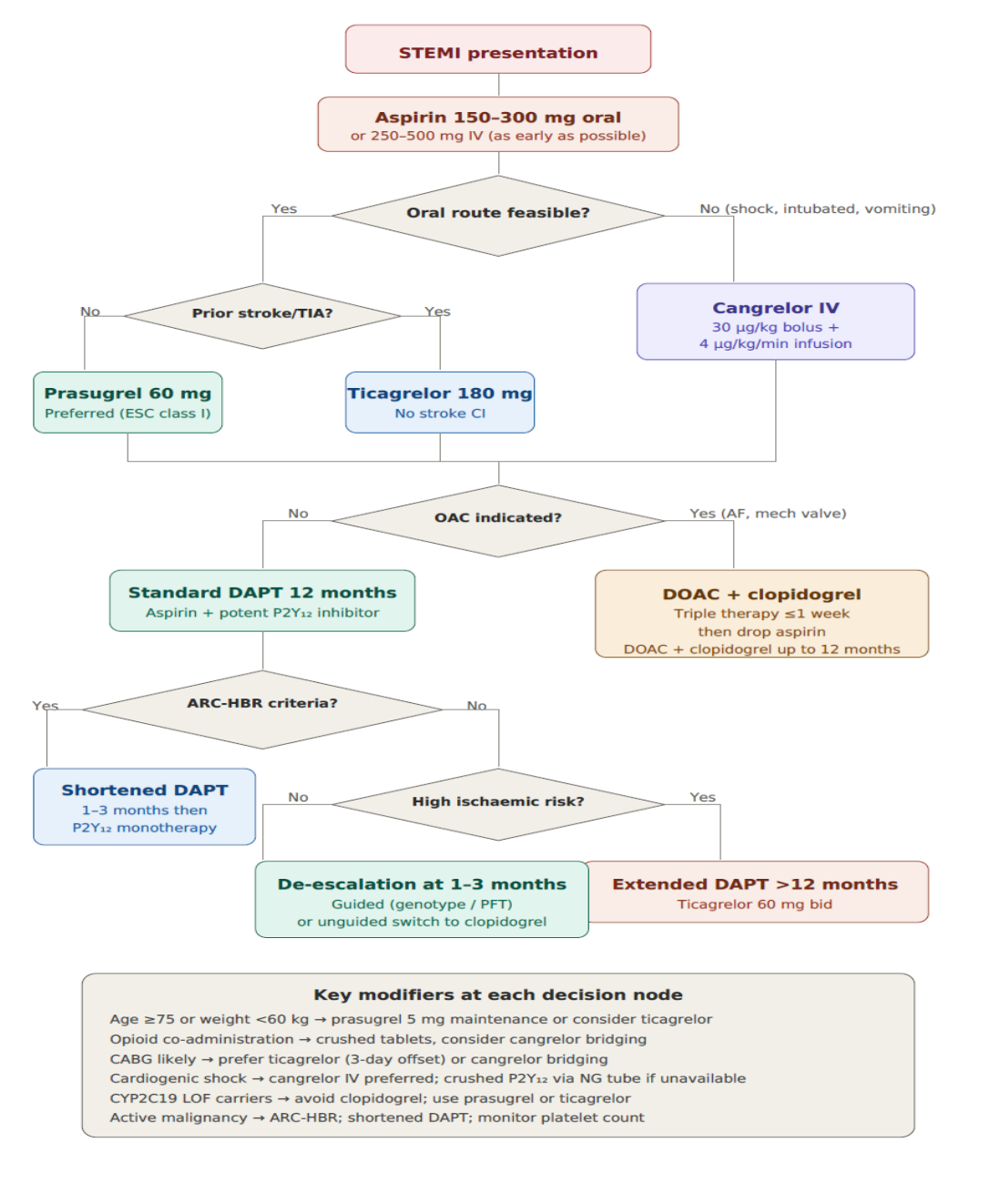
In 5–10% of STEMI patients, coronary anatomy necessitates CABG rather than PCI. In this scenario, the differences in offset times among P2Y12 inhibitors become clinically decisive: current recommendations advise discontinuation of ticagrelor at least 3 days, clopidogrel at least 5 days, and prasugrel at least 7 days before elective surgery [1,2]. Cangrelor provides an alternative bridging strategy with a 60-minute offset, and the BRIDGE trial demonstrated that cangrelor bridging maintained platelet suppression without increasing CABG-related bleeding [25]. When there is uncertainty about coronary anatomy, the choice of P2Y12 inhibitor should incorporate the patient’s potential surgical trajectory — a practical argument against indiscriminate pretreatment.
Cardiogenic shock complicates 5–8% of STEMI presentations and fundamentally alters the pharmacokinetic landscape for oral medications. Splanchnic hypoperfusion, vasopressor-driven vasoconstriction, mechanical ventilation, and opioid use collectively impair gastric absorption to a degree that renders oral P2Y12 inhibitor loading unreliable — even with crushed tablets. This is the clinical scenario in which intravenous cangrelor has the strongest theoretical and practical justification: it bypasses the gastrointestinal tract entirely and provides immediate, titratable, and rapidly reversible P2Y12 blockade. The ongoing DAPT-SHOCK-AMI trial is prospectively comparing cangrelor with crushed ticagrelor as the initial P2Y12 strategy in this population [51]. Until these results are available, clinical practice is guided by expert consensus favoring cangrelor where available, or crushed potent P2Y12 inhibitors via nasogastric tube, with the recognition that platelet inhibition may be delayed and unpredictable regardless of the oral agent chosen [1].
The management of antiplatelet therapy in these special populations cannot be reduced to a simple algorithm. What unites these subgroups is that they demand a level of clinical judgment, risk balancing, and therapeutic flexibility that exceeds what any single trial or guideline recommendation can provide. Sex-specific considerations further complicate ACS management, as women present later, receive less aggressive antiplatelet regimens, and are underrepresented in clinical trials [63]. These disparities underscore the need for personalized secondary prevention strategies that consider sex-related differences and associated comorbidities, an approach increasingly recognized across cardiovascular and other medical disciplines, including the management of patients with preexisting conditions that may predispose them to adverse outcomes [63,64]. The consistent theme is one of deliberate individualization: choosing the agent, dose, and duration that best fit the patient’s composite risk profile rather than reflexively applying the strategy optimized for the average trial participant.
Antiplatelet therapy remains one of the most decisive modifiable determinants of outcome in STEMI, while delays from symptom onset to reperfusion continue to critically influence myocardial salvage and overall clinical prognosis [65]. Aspirin continues to serve as the universal acute-phase foundation, while the evolution from clopidogrel to prasugrel and ticagrelor has materially improved ischaemic protection. Cangrelor fills a critical niche when the oral route fails, and the pharmacokinetic challenges imposed by opioids and hemodynamic compromise are now well recognized and increasingly addressable.
Yet the most important evolution has been conceptual rather than pharmacological. Contemporary management is no longer defined by maximal platelet inhibition alone, but by calibrated inhibition — potent and timely when ischaemic risk is greatest; modified, shortened, or de-escalated when bleeding risk predominates; and tailored to age, frailty, genotype, renal function, surgical trajectory, and anticoagulation needs. The 2023 ESC and 2025 ACC/AHA guidelines embody this shift toward individualized decision-making, providing frameworks that accommodate standard-duration DAPT, shortened DAPT with P2Y12 monotherapy, guided or unguided de-escalation, and extended therapy as parallel options calibrated to individual risk [1,2].
Several emerging paradigms may further reshape the field. Selatogrel, a subcutaneous P2Y12 inhibitor achieving near-complete platelet inhibition within 15–30 minutes, is being evaluated in the phase III SOS-AMI trial (~14,000 patients) for patient self-administration at suspected MI recurrence — a concept that represents the logical endpoint of the pretreatment debate [52,53]. Strategies targeting the platelet collagen receptor GPVI and neutrophil extracellular traps offer the theoretical possibility of antithrombotic efficacy without hemostatic impairment [54,55]. Genotype-guided therapy, already validated in dedicated STEMI populations, is likely to transition from niche to standard practice as point-of-care platforms become faster and cheaper [31].
In practical terms, the contemporary clinician managing a patient with STEMI must navigate a decision matrix that begins with aspirin loading and agent selection (prasugrel preferred unless contraindicated; ticagrelor as alternative; cangrelor when oral absorption is compromised), continues through the acute phase with attention to opioid interactions and potential CABG, and extends into the maintenance phase with individualised duration decisions informed by bleeding and ischaemic risk scores. The management of concomitant oral anticoagulation, advanced age, renal impairment, and cardiogenic shock each introduces additional layers of complexity that no single algorithmic pathway can fully capture. The central challenge for the next era is not simply to develop stronger antiplatelet drugs but to deploy existing and emerging agents with greater biological and clinical precision. The transition from potency to precision is the defining trajectory of the field.
Authors declare no conflict of interest. This research received no external funding.
Not applicable.
Conceptualization, I.C.D., and S.I.D..; methodology, I.P.; software, S.T.; validation, A.E.M., A.E.M., and S.I.D..; formal analysis, I.C.D.; investigation, R.I.; resources, A.C.; data curation, L.I.; writing—original draft preparation, I.C.D.; writing—review and editing, S.I.D.; visualization, F.P supervision, A.E.M.; project administration, B.V. All authors have read and agreed to the published version of the manuscript.