
The efficacy of healthcare is closely linked to the patient’s trust in their physicians [1], and there exists an apprehension that the constant modifications in the healthcare system may adversely impact this trust [2]. The expression of a patient’s trust in a physician is characterized by a strong sense of belief shared by individuals and able to be relied upon [3]. Patients’ trust in a physician may affect their satisfaction and also the outcomes of healthcare services [4]. This trust was directly related to the patient’s recommendation of treatment to others, further follow-up of the patient during the treatment, and the patient’s decision not to seek a second physician’s opinion [3]. Good communication between doctor and patient plays an essential role in health care. It is the basis for the patients’ improvement. “Trust” is also the most important factor of communication and has a positive effect on improving patients and increasing the impact of treatment. Trust will increase the patient’s satisfaction with the treatment, better compliance with the doctor’s orders, and continuity in health follow-up. In the past decades, the cost of medical services (due to their progress and diversity) has increased significantly, which is not only a serious and vital threat to the patient’s trust in the doctor and the continuation of treatment but also causes a decrease in trust-building ethics, an increase in wrong treatments and Unnecessary treatments and therapeutic abuses [4].
Trust is one of the most significant aspects of the relationship between patients and physicians. Yet, despite its acknowledged significance, efforts to assess patients’ trust in their physicians in Iran have been relatively insufficient [4]. In a study conducted in Iran [5], a self-administered written questionnaire, developed by the author, was used to assess patients’ trust in their physicians. The result revealed a score of 3.76 (SD=0.574), which was significantly higher than the maximum score of 5 in another study [4]. Using the wake forest questionnaire developed by Hall, M.A [6], the score was 39.69 (SD=6.7) out of a maximum score of 50. The difference in the patients’ trust in their physician’s scores across diverse studies is primarily attributable to disparities in research methods, including various interviewers and questionnaires, and the absence of valid and reliable tools to assess this trust. To measure patients’ trust in their physicians, the researchers have used various scales. Among these, the TIPS questionnaire is widely used in different studies and countries [7-10]. Considering the lack of valid and reliable measurement tools regarding patients’ trust in their physicians in Iran, this study aims to estimate the patients’ trust score in patients referred to the hospital emergency department of Kashan Beheshti Hospital while examining the validity and reliability of the Persian version of the TIPS questionnaire.
We conducted a cross-sectional study to provide the Persian version of The TIPS questionnaire.
The owner of the questionnaire, David H Thom has granted written authorization to utilize it for research purposes and to provide a Persian version of the questionnaire in Iran. Then, the questionnaire was translated from English to Persian through forward-backward translation. Two experienced translators familiar with medical texts and questionnaires translated the original English version into Persian. Subsequently, they compared the translations and matched the questions regarding their meaning and concept. Finally, a Persian version of the TIPS questionnaire was prepared by choosing the optimal alternatives. To ensure that the Persian version and the original text corresponded, the Persian version was translated into English by two individuals who were proficient in English and had not previously seen the TIPS questionnaire. Respectively, no significant differences were observed between the two questionnaires.
As per the guidelines on validity and reliability, it is essential to obtain 10 samples for every query [11]. This study was conducted on a population of 310 individuals. A random sampling method was employed. There were 65 beds available in the emergency department and we accessed it on different days and times of the day. Our participants were randomly selected from a table of numbers. After obtaining our samples, patients were informed that the selection was randomized and the results of the questionnaire were ineffective in guiding the treatment process. Therefore, they were designated for university research, thereby avoiding the requirement to mention their names in the questionnaires. They were requested to read and respond to the questions carefully. Subsequently, questionnaires were gathered and inquired about the inclusion and exclusion criteria. The questionnaires that were not qualified were excluded from the study.
Literacy to complete the questionnaire, consent to participate in the study, and an age range of more than 18 years.
Patients who exhibit severe distress and emergency status, patients who have cognitive and dementia issues or mental illness, and those who fail to complete all questionnaire questions.
TIPS questionnaire is a self-report tool with 11 items. Each question was scored on a Likert scale ranging from 1=almost never to 5=almost always, and total scores ranged from a minimum of 11 to a maximum of 55. The Cronbach’s alpha in Anderson and Dedrick’s study [12] is 0.90, while it is 0.89 in Thom’s study for the total scale [13].
This scale consists of 33 items and 6 subscales, including the patient-centered focus (6 questions), macro level policies (6 questions), professional expertise (4 questions), quality of care (9 questions), communication and information provision (6 questions), and quality of cooperation among providers (2 questions). Each component of the test is scored based on a Likert scale respectively. The Cronbach’s alpha is 0.8 in Straten GFM’s [14] study, while for the Persian version of this questionnaire in Iran, it was 0.83 [15].
The ethical committee of the University of Medical Sciences granted permission for this study. These results were reviewed and approved by the Research Ethics Committees of Kashan University of Medical Sciences with approval ID: IR.KAUMS.REC.1400.039. (2021- 9 – 15). The Declaration of Helsinki was followed to adhere to the ethical principles of the research. The data collection was conducted in a manner that ensured anonymity and confidentiality. The study participants were guaranteed that they would receive the study results upon request. The objective of the study was communicated to the participants, and they subsequently provided written consent.
We used Cronbach’s alpha coefficient to assess the reliability of the TIPS questionnaire. The intra-class correlation coefficient (ICC) was calculated using a test-retest method on a sample of 30 patients referred to the emergency room of Shahid Beheshti Hospital in Kashan after 14 days. If the obtained ICC value is 0.7 or higher, it can be said that the tool has a reliable characteristic. Cronbach’s alpha ranges from zero to one. According to Bland and Altman’s theory, scales with a Cronbach’s alpha greater than 0.7 are suitable for research purposes [16].
To guarantee face validity among a group of five experts, and to identify the degree of difficulty, inconsistency, ambiguity of expressions, or inadequacy in the meanings of words, their opinions were incorporated as brief modifications in the questionnaire.
The questionnaire was evaluated for content validity by five experts (two psychiatrists, an epidemiologist, and two internal medicine specialists). Furthermore, the experts were provided with a checklist comprising four options. For each question, the experts selected one of the options based on their scores: a) No relation (with a score of 1), b) Slightly related (with a score of 2), c) Very relevant (with a score of 3), and d) Completely related (with a score of 4). The experts then explained the correlation between the question and measuring patients’ trust in their physicians. Finally, the experts’ opinions were asked about other items related to the patient’s trust in their physicians that are not mentioned in this questionnaire. The checklists were collected and analyzed.
To examine construct validity, exploratory factor analysis (EFA), principal component analysis (PCA), and varimax rotation were used. Kaiser-Meyer-Olkin(KMO) and Bartlett’s tests were used to perform the exploratory factor analysis. The 0.6 and higher scores of the KMO test, demonstrate the adequate size of the sample for EFA.
To assess the reliability of the scale, we used the test-retest method. Spearman rank correlation coefficient and the intraclass correlation coefficient (ICC) were calculated. In addition, to determine validity, an explanatory factor analysis was performed, and convergent validity was designed. To evaluate the correlation between the two scales, we used convergent validity. All of the analysis was performed using STATA 14 and SPSS 16 software.
325 questionnaires were distributed, and 310 of them were fully answered. There were 157 (50.61%) male participants, 153 (49.4%) female participants, and their average age was 56.6± 20.6 years. In this study, 110 (35.5%) were university graduates and 21 (6.8%) were illiterates. The number of patients with acute and chronic disorders was 178 (57.4%) and 132 (42.6%), respectively. The majority of physicians, 202 (65.2%), were male, while 108 (34.8%) were female, and their average age was 50.14 ± 10.8 years. The average work experience of physicians was 15.4± 8 years (Table 1).
| Variable | N (%) | |
|---|---|---|
| Patients’ sex | male | 157(50.6) |
| female | 153(49.4) | |
| Patients’ age (year)(𝑿±SD) | 56.6± 20.6 | |
| Duration of disease | acute | 178(57.4) |
| chronic | 132(42.6) | |
| Patients’ education | illiterate | 21(6.8) |
| primary | 76(31.3) | |
| high school | 103(33.3) | |
| university graduates | 110(35.5) | |
| Physicians’ sex | male | 202(65.2) |
| female | 108(34.8) | |
| Physicians’ age (𝑿±SD) | 50.14± 10.8 | |
| Average work experience of physicians (Years) | 15.4± 8 | |
The mean and standard deviation of the overall score obtained from the TIPS questionnaire was 42.67 ± 7.53, whereas the mean and standard deviation of the overall score obtained from the general trust questionnaire was 95.59 ± 13.8. The Cronbach’s alpha coefficient for the total scale in this study was 0.875, and despite the elimination of each item, no significant alteration in Cronbach’s alpha was observed.
In the retest-test method conducted on 30 participants after 14 days, an ICC of 0.75 was obtained with a confidence interval (0.75-0.65), thereby confirming the repeatability of this test.
| Kaiser-Meyer-Olkin Measure of Sampling Adequacy | 0.933 | |
|---|---|---|
| Bartlett’s Test of Sphericity | Approx. Chi-Square | 1606.204 |
| Df | 55 | |
| Sig. | 0.000 | |
| Question | Component | |
|---|---|---|
| 1 | 2 | |
| Q1 | 0.816 | |
| Q2 | 0.795 | |
| Q3 | 0.780 | |
| Q4 | 0.770 | |
| Q5 | 0.775 | |
| Q6 | 0.740 | |
| Q7 | 0.732 | |
| Q8 | 0.718 | |
| Q9 | 0.710 | |
| Q10 | 0.702 | |
| Q11 | 0.948 | |
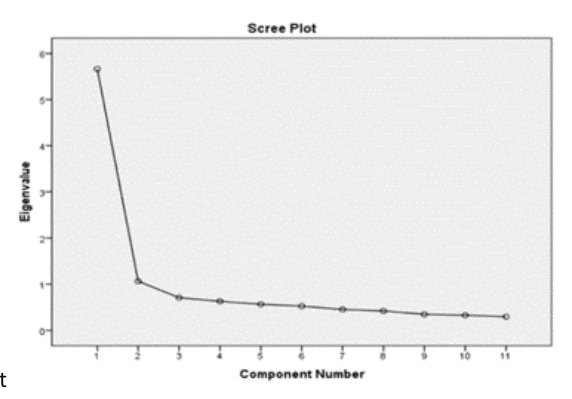
As can be observed in the scree plot diagram for the first factor, the diagram exhibits a steep gradient, followed by a constant and fixed pattern (Figure 1).
This study aims to evaluate the validity and reliability of the Persian version of the TIPS questionnaire. This questionnaire is important for changing the policy and management of health services, as well as providing tools for other researchers. The findings have demonstrated that the TIPS questionnaire has high validity and reliability for conducting studies in the Persian-speaking community. Until now, there has been no study conducted for the TIPS questionnaire in Iran, and this is the first study. The present study employed the forward-backward translation method to create a Persian version of the TIPS questionnaire from the original version prepared by Dr. Thom, David H. In similar studies, including Aloba’s study in Nigeria in 2014 [13] and Marcinowicz’s in the Netherlands in 2017 [15], the same translation method was used for the Nigerian and the Dutch versions of the questionnaire, respectively.
The internal reliability of the questionnaire was assessed using Cronbach’s alpha and it was found to be 0.9 and 0.89 in both the first study conducted by Anderson and Dedrick and the subsequent study conducted by Thom, respectively [13,18]. In our study, it was 0.87, which is close to the original version. This indicates the good internal reliability of the Persian version of the TIPS questionnaire.
Three experts evaluated and confirmed the face and content validity of the questionnaire. In fact, at this stage, it is necessary to use the opinion of experts rather than the scientific method of data collection. The original version employed this approach to ensure both face and content validity, which was deemed acceptable. The ICC was 0.75, which indicates that the questionnaire is reliable and desirable. There was no prior investigation conducted on the TIPS questionnaire to evaluate ICC.
The Pearson correlation coefficient was measured between the TIPS questionnaire and the Public Trust of Health Care Providers Scale. A linear correlation between two sets of data is measured by this coefficient, indicating that an increase or decrease in one variable affects the other one. In a study on cancer patients, Spearman’s correlation was calculated and there was no relationship between the stage of cancer at the time of diagnosis and the usual provider continuity (UPC) score and TIPS [19]. Furthermore, in one study among Nigerian psychiatric patients, using Pearson’s correlations, there was no significant correlation between the duration of disease and patients’ trust in their physicians, but there was a positive relation between the period of illness and the patients’ trust in their physicians [7]. In the exploratory factor analysis, it was found that the questions of this questionnaire are in one dimension, accounting for 61% of the total variance indicating the favorable internal validity of this questionnaire. However, the Nigerian study used a twofactor construct to explain the questionnaire, with doubt accounting for 28.82% of the total variance and trustworthiness accounting for 19.23% of the total variance [7]. Exploratory and confirmatory factor analysis yielded the same result for 1756 hospitalized patients in the United States [20].
It is suggested that in future studies, this tool should be used to measure patients’ trust in their physicians because there are no tools to measure this important aspect of the therapeutic relationship in Iran. Furthermore, considering that patients will know more about their doctors and that the interpersonal trust will change, we suggest that in future studies the trust score should be tested on the first day of patient hospitalization and a few days later. More comprehensive population-based studies are required to verify this novel generic tool’s predictive accuracy and consistency for application within the broader Iranian community.
One of the limitations of this study was that the patients who had recently been referred to the hospital were not familiar with their physician. Therefore, we recommend that in the future, the trust score should be assessed within the first day of patient hospitalization and a few days later. The study is limited by the small sample size. This research only included participants from the emergency department, which may have skewed the final outcome. As a result, additional research with a bigger group of participants is recommended.
The Persian version of the TIPS questionnaire exhibits high validity and reliability, making it a suitable choice for conducting research in the Persian-speaking community.
The authors declare no conflict of interest. No artificial intelligence automatically generated text was inserted in this manuscript, and no image was previously published in another journal or is under consideration of being published elsewhere.
The authors would like to express their gratitude to the patients who cooperated in completing the questionnaires, and to the main author of the questionnaire Dr. Thom, D.H. who provided it to us.
This study was based on Dr. Anita Zia’s thesis under the guidance of Dr. Saber and Dr. Asgarian.
This work was approved by the Research Ethics Committees of Kashan University of Medical Sciences with approval ID: IR.KAUMS.REC.1400.039.