
Communication is an essential skill in clinical environments, especially in medical professions [1]. Effective interaction and communication between healthcare professionals, particularly nurses, and patients can play a significant role in the process of patient care and treatment [2]. Additionally, adequate and appropriate communication with patients can enhance the quality of health care services and increase patient satisfaction with medical staff and provided services [3, 4].
In some circumstances, professionalism and acquiring necessary communication skills with patients may be influenced by factors such as the nursing profession, environment, and the patient [5]. Studies indicate that proper and effective communication with patients correlates with increased patient satisfaction and well-being [6, 7]. Conversely, inadequate communication may lead to medication errors and unintended harm [2]. Given the importance of interaction and communication between patients and nurses, there is a need for special attention to communication competence in the nursing profession [4].
Recent studies have shown that although healthcare professionals receive training in communication with patients, the application of these skills in clinical settings when dealing with patients is minimally reported [8, 9].
Perhaps one reason for the weakness in “nurse–patient” communication is the lack of awareness of this interaction and ignorance of the extent of the relationship, partly due to the shortage of measurement tools. Currently, there are some questionnaires for assessing the communication styles or attitudes of “nurse– patient” communication, some of which have been evaluated in Persian [10, 11].
However, until now, there has been no questionnaire specifically designed to measure the therapeutic relationship between nurses and patients. Therefore, the aim of this study is to determine the validity and reliability of the Therapeutic Communication Questionnaire for nurses working with patients in the hospitals of Kashan city in Iran.
This cross-sectional study assesses the validity and reliability of the Therapeutic Communication Questionnaire for nurses interacting with patients in hospitals located in Kashan city in 2023. After obtaining approval and necessary coordination with the administrative and managerial departments of the hospitals, the research was initiated. The research sample included nurses and paramedics (Bachelor of Science in Operating Room Technology and Bachelor of Science in Anesthesia) in the hospitals of Kashan city. Using the convenience method, samples were selected from available nurses and paramedics. Individuals unwilling to participate were excluded from the study. The questionnaire was in English. The questionnaire was translated into Persian in several stages, including (a) using bilingual translators with a psychological background who were familiar with both cultures; (b) translation from English to Persian by two translators and back-translation from Persian to English by two separate translators with a management background; and (c) peer review of the original English, Persian, and translated versions to assess clarity, discrepancies, and semantic errors. The questionnaire was sent to 350 people, of whom 347 responded completely. The questionnaire was designed in electronic form (Porsline) and consisted of three sections: demographic information, the Therapeutic Communication Questionnaire for nurses with patients, and a questionnaire on barriers to effective “nurse–patient” communication. It was distributed to the target group through common messaging apps. Access to each nurse was facilitated through communication with the department heads, who shared the questionnaire link along with written instructions with their respective teams. Each participant’s link was unique, and the time to complete the questionnaires was also removed. Duplicate responses were also removed. This study was approved by Kashan University of Medical Sciences (IR.KAUMS.NUHEPM.REC.1401.028). The Persian version consists of 49 items. The factors were called dimensions that included the following elements: 1) professional (1–20); 2) contextual and situational (21–34); and 3) patient (35– 49).
The Therapeutic Communication Questionnaire for “nurse–patient” was obtained after searching databases, reviewing the questionnaire, and ensuring there was no existing Persian version. Contact was made with the responsible author of the research via email, explaining our request. The questionnaire was then provided to us.
Therapeutic Communication Questionnaire for “nurse–patient”: This tool was developed by Verónica V. Marquez-Hernándeza [3]. The final version of the questionnaire consists of 49 items, each rated on a scale from 1 to 4. The questionnaire is divided into three sections, with factors 1, 2, and 3 comprising 20, 14, and 15 items, respectively. The questionnaire assesses professional (items 1-20), contextual and situational (items 21-34), and patient-related (items 35-49) aspects. A Likert scale of 1 – 4 was used, where 1 indicates not important at all, and 4 indicates very important. Some questions were reverse-scored based on the original author’s opinion. These questions include 21, 24, 25, 36, 39, 42, and 49. The higher scores indicate better therapeutic communication.
The original English version was translated into Persian, reviewed by two Persian translators experienced in English text translation, and further examined by a group of Persian language experts proficient in English. The translated Persian version was then translated back into English by the two bilingual experts. The final Persian translation was obtained after comparing the original and translated expressions and incorporating suggestions.
To assess content validity, the questionnaire was reviewed by three experts. If the content validity index (CVI) was less than 0.7, the item was rejected. If it ranged between 0.7 and 0.79, it needed modification, and if it was above 0.79, it was considered acceptable [12].
The data collection tool is a two-part questionnaire that includes the personal information of patients and questions related to the nurses’ perspectives on communication barriers. The questionnaire consists of 30 multiple-choice questions, which are evaluated in four areas: individual and social factors (8 items), job characteristics (9 items), clinical conditions of the patient (4 items), and environmental factors (9 items). At the end, an open-ended question is asked. The options range from a maximum score of 5 (completely agree) to a minimum score of 1 (completely disagree). The questionnaire’s face and content validity were determined using the opinions of experts and the content validity index (CVI) (0.81). The Cronbach’s alpha coefficient for this questionnaire was found to be 0.96, indicating high reliability [13].
External reliability was determined by having 30 nurses complete the questionnaire, and test-retest reliability was measured over a 10-day interval. A correlation of 0.7 or higher indicated that the tool had reliable properties (14). Internal reliability (Cronbach’s alpha) was calculated using a scale from 0 to 1, and a coefficient above 0.7 was considered[15].
Convergent validity was assessed using the Therapeutic Communication Questionnaire for nurses with patients and the Pearson correlation coefficient.
Exploratory factor analysis was employed to examine the structural validity, and the construction validity of questionnaire items was examined using exploratory factor analysis. The Principal Axis Factoring extraction method with Promax (oblique) rotation(κ=4) was applied. Sampling adequacy and correlation among items were evaluated using the Kaiser-Meyer-Olkin measure and Bartlett’s test of sphericity.
In summary, this research employed a thorough approach to ensure the translation, validation, and reliability testing of the Therapeutic Communication Questionnaire for nurses with patients in the hospitals of Kashan city.
The findings indicate that out of the total 347 participants, 123 individuals (35.47%) were male and 224 individuals (64.53%) were female, who completed the questionnaire. The participants’ average age was 27.07 ± 3.97 years, and the lowest and highest ages in the study were 24 and 47 years old, respectively. Average and standard deviation of nurses’ work experience: 3.55±3.10 years. The minimum and maximum work experience were 2 and 19 years, respectively.
The obtained results from the average scores of each domain indicate that in the questionnaire on barriers of effective nurse-patient communication, the highest score, relative to the number of items, pertains to the clinical factors domain (12.5 out of 20 points), whereas the lowest score is related to job-related characteristics (21.45 out of 45 points). In the nurse-patient therapeutic communication questionnaire, the highest score is associated with professional (66.19 out of 80 points), and the lowest score is related to the contextual and/or situational domain (41.70 out of 45 points) (Table 1).
| Barriers to Effective Nurse-Patient Communication | Mean score | Standard Deviation |
|---|---|---|
| Individual and social factors | 23.72 | 5.28 |
| Job characteristics | 21.45 | 6.53 |
| Clinical conditions of the patient | 12.50 | 3.08 |
| Environmental factors | 21.51 | 6.73 |
| Total score of the Questionnaire | 79.19 | 17.12 |
| Nurse–Patient Therapeutic Communication Questionnaire | Mean score | Standard Deviation |
| Professional(1–20) | 66.19 | 9.15 |
| Contextual and situational(21–34) | 41.70 | 5.16 |
| Patient(35–49) | 42.36 | 4.38 |
| Total score of the Questionnaire | 150.53 | 16.93 |
At the item level, floor effects were minimal across all items (<20%). Ceiling effects were observed for several items, with up to 50% of respondents selecting the highest response option. However, at the scale level, no floor or ceiling effects were detected, as the observed total score means ranged from 1.5 to 3.7, with no respondents achieving the minimum or maximum possible scores. The factor loadings of the final three-factor solution were obtained using principal axis factoring with Promax rotation. Only factor loadings with absolute value≥ 0.30 are retained (Table2).
| Item No. | Mean | SD | Final Factor | Loading| | | SD | Ceiling % | Floor % | Corrected Item-Total Correlation |
|---|---|---|---|---|---|---|---|---|
| 1 | 3.27 | 0.710 | Factor 1 | 0.470 | Retained | 40.7 | 1.4 | 0.433 |
| 3 | 3.27 | 0.707 | – | 0.212 | Removed | 40.4 | 1.7 | 0.565 |
| 4 | 3.52 | 0.715 | Factor 1 | 0.449 | Retained | 61.6 | 2.6 | 0.528 |
| 5 | 3.41 | 0.783 | Factor 1 | 0.581 | Retained | 55.6 | 4 | 0.507 |
| 6 | 3.42 | 0.694 | Factor 1 | 0.564 | Retained | 52.1 | 1.4 | 0.571 |
| 7 | 3.36 | 0.676 | Factor 1 | 0.651 | Retained | 45.8 | 1.4 | 0.553 |
| 8 | 3.09 | 0.750 | Factor 1 | 0.611 | Retained | 37.5 | 1.4 | 0.582 |
| 9 | 2.70 | 1.061 | Factor 1 | 0.337 | Retained | 28.9 | 16.3 | 0.321 |
| 10 | 3.44 | 0.687 | Factor 2 | 0.334 | Retained | 53.6 | 1.4 | 0.483 |
| 11 | 3.23 | 0.798 | Factor 1 | 0.693 | Retained | 41.8 | 4 | 0.532 |
| 12 | 3.53 | 0.681 | Factor 1 | 0.416 | Retained | 61.9 | 1.7 | 0.510 |
| 13 | 3.29 | 0.763 | Factor 1 | 0.857 | Retained | 45 | 2.3 | 0.567 |
| 14 | 3.40 | 0.711 | Factor 1 | 0.642 | Retained | 51 | 1.7 | 0.526 |
| 15 | 3.43 | .0625 | Factor 1 | 0.690 | Retained | 49.3 | 0.9 | 0.662 |
| 16 | 3.29 | 0.802 | Factor 2 | 0.360 | Retained | 47 | 3.2 | 0.629 |
| 17 | 3.28 | 0.764 | Factor 2 | 0.357 | Retained | 44.4 | 2.3 | 0.549 |
| 18 | 3.46 | 0.713 | Factor 1 | 0.774 | Retained | 55.6 | 2.6 | 0.688 |
| 19 | 3.33 | 0.693 | Factor 1 | 0.848 | Retained | 43.8 | 1.4 | 0.601 |
| 20 | 3.21 | 0.726 | Factor 1 | 0.558 | Retained | 37.5 | 1.4 | 0.666 |
| 21 | 2.61 | 1.010 | Factor 2 | 0.418 | Retained | 22.6 | 16 | 0.312 |
| 22 | 2.93 | 0.880 | Factor 3 | 0.662 | Retained | 30.1 | 4.9 | 0.487 |
| 23 | 3.14 | 0.708 | Factor 2 | 0.557 | Retained | 30.7 | 2 | 0.683 |
| 25 | 2.61 | 0.935 | Factor 1 | 0.422 | Retained | 18.9 | 12.6 | 0.213 |
| 26 | 3.21 | 0.626 | – | 0.179 | Removed | 31.2 | 0.9 | 0.583 |
| 27 | 3.33 | 0.742 | Factor 3 | 0.530 | Retained | 46.4 | 2.3 | 0.538 |
| 28 | 2.98 | 0.868 | Factor 1 | 0.420 | Retained | 30.4 | 6 | 0.484 |
| 29 | 3.24 | 0.743 | Factor 1 | 0.428 | Retained | 40.4 | 1.7 | 0.565 |
| 30 | 3.23 | 0.777 | Factor 2 | 0.723 | Retained | 41.5 | 2.3 | 0.551 |
| 32 | 3.27 | 0.718 | Factor 1 | 0.394 | Retained | 41.3 | 1.4 | 0.625 |
| 33 | 3.09 | 1.019 | Factor 1 | 0.444 | Retained | 45.8 | 10.3 | 0.503 |
| 34 | 3.29 | 0.696 | – | 0.210 | Removed | 41.3 | 1.4 | 0.675 |
| 36 | 2.55 | 0.937 | Factor 2 | 0.639 | Retained | 17.8 | 13.5 | 0.359 |
| 37 | 3.01 | 0.843 | Factor 2 | 0.577 | Retained | 27.5 | 8 | 0.595 |
| 38 | 3.20 | 0.820 | Factor 2 | 0.566 | Retained | 41.5 | 4 | 0.488 |
| 39 | 3.05 | 0.906 | – | 0.216 | Removed | 35.5 | 8 | 0.298 |
| 40 | 3.25 | 0.851 | Factor 3 | 0.628 | Retained | 45.8 | 5.4 | 0.486 |
| 41 | 3.14 | 0.867 | Factor 3 | 0.423 | Retained | 39.5 | 5.7 | 0.513 |
| 42 | 2.51 | 0.992 | Factor 1 | 0.421 | Retained | 18.1 | 18.3 | 0.173 |
| 43 | 3.02 | 0.839 | Factor 3 | 0.769 | Retained | 30.4 | 5.7 | 0.478 |
| 44 | 2.92 | 0.967 | Factor 3 | 0.451 | Retained | 31.8 | 10.9 | 0.216 |
| 45 | 3.00 | 0.887 | Factor 2 | 0.702 | Retained | 34.1 | 4.9 | 0.505 |
| 46 | 3.09 | 0.768 | Factor 3 | 0.543 | Retained | 30.9 | 3.2 | 0.582 |
| 47 | 2.88 | 0.878 | Factor 2 | 0.555 | Retained | 25.5 | 7.4 | 0.574 |
| 48 | 3.22 | 0.735 | Factor 3 | 0.589 | Retained | 38 | 1.4 | 0.594 |
| 49 | 3.17 | 0.826 | Factor 2 | 0.600 | Retained | 38.3 | 5.5 | 0.555 |
The questionnaire, after undergoing the translation process, was assessed by nurses for its clarity, and the obtained results indicated the face validity of the questionnaire.
The content validity of the questionnaire was calculated to be 0.94. Cronbach’s alpha coefficients for the three extracted factors were 0.927, 0.856, and 0.027, respectively. After examination, the third factor showed poor internal consistency, suggesting that the corresponding items may represent a heterogeneous construct and require further refinement. The overall reliability of the full questionnaire was α=0.89 and ICC (3,1) =0.80, 95% CI = 0.89, 0.92, indicating acceptable stability. McDonald’s omega coefficients were also computed, yielding similar results to Cronbach’s alpha (ω_total=0.88). The MDC95 values of test-retest reliability were 2.11.
The convergent validity between the Therapeutic Communication Questionnaire and the Barriers to Effective Communication Questionnaire was examined using Pearson correlation. A small but statistically significant negative correlation (r = –0.23, 95% CI (0.135-0.314), P<0.001) was observed between therapeutic communication and perceived barriers, consistent with the expectation that higher communication competence is associated with fewer barriers. (Table 3).
| Correlation | Questionnaire of Therapeutic Communication Between the Nurse and Patient | |
|---|---|---|
| Questionnaire on Barriers to Effective Nurse-Patient Communication | r | (-0.225) |
| Sig | (P<0.001) |
**. Correlation is significant at the 0.01 level (2-tailed).
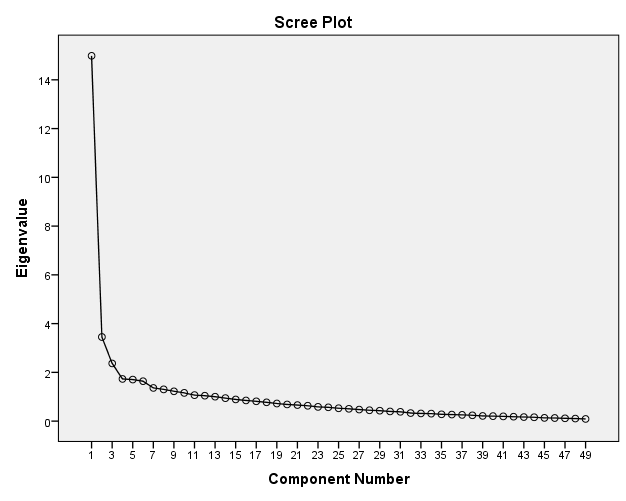
Based on the exploratory factor analysis (Principal Axis Factoring with Promax rotation), three factors were retained according to the scree plot and parallel analysis, which together explained 42.46% of the total variance (Table 4). Factors with eigenvalues greater than one were initially extracted (13 components > 1), but the scree plot clearly supported a three-factor solution consistent with the theoretical structure of the original questionnaire (Figure 1). (Only factors 1 and 2 had acceptable reliability). The statement that the overall questionnaire has “good reliability” is misleading unless it is qualified to exclude Factor 3 (Figure1).
| Component | Initial Eigenvalues | Extraction sums of squared loadings | ||||
|---|---|---|---|---|---|---|
| Total | % of variance | Cumulative % | Total | % of variance | Cumulative % | |
| 1 | (14.99) | (30.59) | (30.59) | (14.60) | (29.79) | (29.79) |
| 2 | (3.45) | (7.04) | (37.63) | (3.02) | (6.16) | (35.95) |
| 3 | (2.37) | (4.83) | (42.46) | (1.98) | (4.05) | (40) |
The Kaiser-Meyer-Olkin (KMO) value was 0.86, and Bartlett’s test of sphericity was significant (χ2=10368.72; df=1176; P<0.001), confirming sampling adequacy and correlation among items (Table 5).
| Indices | Measurement |
|---|---|
| Sample adequacy measurement | (0.86) |
| Bartlett’s test | (10368.72) |
| degrees of freedom | (1176) |
| Significance level | (P<0.001) |
The main purpose of this study is to provide a suitable tool for assessing the therapeutic relationship between nurses and patients in Persian-speaking nurses. The results indicate that this questionnaire is satisfactory in terms of validity, reliability, and acceptability, making it a suitable tool for use in scientific research by other researchers. Considering that no study related to the questionnaire of the therapeutic relationship between nurses and patients has been conducted in Iran so far, to our knowledge, this study is the first of its kind.
To assess the internal reliability of the questionnaire, Cronbach’s alpha test was used. The Cronbach alpha coefficient for the entire questionnaire was 0.89, indicating a high level of internal consistency. This is consistent with other studies, such as the one by Manuel González-Cabrera and colleagues, where the Cronbach’s alpha was reported as 0.82 in the design and validation of a questionnaire on delivering bad news in nursing, published in 2020 [16]. Additionally, Mojtaba Fattahi Ardakani et al. reported a Cronbach’s alpha of 0.86 in their study on the psychometric properties of the health action process approach in the effective “nurse–patient” relationship in 2019 [11].
The research findings in this area are inconsistent across different cultures, with part of them related to methodology and research. In this test, there was no significant problem, and the sample group had no major issue in understanding the questions. Almost all questions were comprehensible to them, indicating the face validity of the test. To examine the reliability of the questionnaire, the ICC test was used. The overall ICC result for the test was 0.80, indicating satisfactory reliability of the questionnaire, similar to the study conducted by Najafi M and colleagues [17].
The content validity of the questionnaire was obtained by distributing the questionnaire among three experts, of which 94% of the total questionnaire questions were deemed closely or highly relevant. Some questions and sentences were modified, but no questions were removed. The amount of content validity is also similar to the study conducted by Najafi M and colleagues [17].
To identify the factors of this questionnaire and assess its structural validity, factor analysis was used. The findings indicated that 13 items account for 42.46% of the total variance of the questionnaire. This signifies the desirable internal validity of the questionnaire. In similar studies in the field of designing and validating questionnaires on delivering bad news in nursing, an experimental study published in 2020 by Manuel González-Cabrera revealed that out of 28 items, 11 items had eigenvalues greater than 1, explaining 71.60% of the questionnaire’s variance [16].
In the current research, exploratory factor analysis was employed to assess the structural validity of the questionnaire. Three factors were identified for the questionnaire items, indicating that the questionnaire is three-dimensional. The elements referred to as dimensions encompassed the following factors: 1) professional (1–20); 2) contextual and/or situational (21–34); and 3) patient (35– 49). The identified factors corresponded conceptually to professionalism, contextual/occupational, and patient-related dimensions, explaining 42.46% of the total variance (only factors 1 and 2 had acceptable reliability). The third factor does not meet the minimal reliability criteria (α≈0.03) and therefore should not be used as a separate subscale; the instrument should be interpreted primarily in terms of the total score and the two reliable domains. The statement that the overall questionnaire has “good reliability” is misleading unless it is qualified to exclude Factor 3.
The internal consistency of the first two dimensions was strong (α=0.93 and 0.86), whereas the third dimension showed low reliability (α=0.03), possibly due to few or heterogeneous items but acceptable McDonald’s ω. The negative correlation with the communication barrier questionnaire (r=-0.23) confirmed that both tools measure related but opposite constructs, providing evidence for concurrent validity. The current research confirms the suitability of the used items.
In this study, the Bartlett’s test statistic was obtained as χ²= (10368.72); df= (1176), as reported in other similar studies. In Manuel González-Cabrera’s study of designing and validating a questionnaire on delivering bad news in nursing, published in 2020, Bartlett’s test was significantly meaningful as well [16]. Also, in María del Carmen Giménez-Espert’s study on developing and validating a psychometric tool for assessing nurses’ attitudes toward patient communication, published in 2018, Bartlett’s test showed a significant value as χ²=10352.40; df=820 [16]. In Genoveva Granados-Gámez’s study, published in 2009, on developing and validating a questionnaire for analyzing nurse–patient relationship, significant values were also obtained [3].
One limitation of this study was the focus solely on nursing staff and the exclusion of nursing students. It is recommended that future research examine the perspectives of nursing students as future nurses. The study sample is not representative of all Iranian nurses (e.g., by age, region, and experience), and external validity should be interpreted with caution.
The questionnaire for assessing the therapeutic relationship between “nurse–patient” demonstrated high levels of content validity, reliability, and structural validity in the Persian-speaking population. The study underscores the need for reliable tools that are culturally appropriate, and the presented questionnaire can serve as a valuable instrument for research in the field of “nurse–patient” relationships in the Iranian context.
The authors declare no conflict of interest
This research received no external funding.
Acknowledgments
No artificial intelligence tools were used to write the article.
Conceptualization, M.M, F.S.A.; methodology, M.S.; software, M.S., M.M., F.S.A.; validation, M.S.; formal analysis, M.S.; investigation, M.S.; resources, M.S.; data curation, M.S., M.M., F.S.A.; writing—original draft preparation, M.S.; writing—review and editing, M.S., M.M., F.S.A; visualization, M.S.; supervision, M.M., F.S.A.; All authors have read and agreed to the published version of the manuscript.
Ethics approval and consent to participate
This study has received the ethics code IR.KAUMS.NUHEPM.REC.1401.028 from the Research Ethics Committee of Kashan University of Medical Sciences. Informed consent was obtained from all participants.