
The COVID-19 pandemic brought about an extraordinary situation because there was an unprecedented need for critically ill patients to receive prolonged admissions in intensive care units (ICUs) [1,2]. The doctors’ initial concern about SARS-CoV-2 respiratory symptoms developed into their discovery of long-term neuromuscular complications, which developed in most patients who survived the acute pulmonary phase. ICU-AW develops as one of the main reasons that patients with severe illnesses face extended disability periods while their recovery process takes a longer time [1-3]. ICU-AW develops as a challenging condition that causes reduced muscle strength to affect all body parts. The combination of body-wide inflammation and extended inactivity periods, together with nerve and muscle signal blockage and metabolic dysfunction, leads to this condition. Research studies established that ICU-AW leads to longer mechanical ventilation periods and increases both hospital and ICU durations while also causing negative effects on critical illness survivors who experience long-term health issues and decreased life quality. The occurrence of severe COVID-19 infection substantially increases the risk of developing ICU-AW because patients require both prolonged ventilation and deep sedation, along with their bodies fighting against systemic inflammatory responses.
The management of ICU-AW presents a major clinical challenge for Physical and Rehabilitation Medicine (PRM) practitioners. The timely detection of neuromuscular dysfunction requires immediate rehabilitation intervention, which should follow specific treatment needs for each patient. Patients who are critically ill now include early mobilization together with neuromuscular electrical stimulation and respiratory physiotherapy as mandatory rehabilitation components.
Critical care rehabilitation uses standard methods to assess function through the typical use of ordinal clinical scales, isolated spirometric parameters, and manual muscle testing. The common approach for these methods involves using linear models that predict recovery progression according to a pre-established recovery pattern. The recovery path for critically ill patients usually follows a non-linear pattern, which includes abrupt interruptions and different ways of responding to treatments, and shows various recovery patterns among different individuals [4]. The respiratory system, the neuromuscular system, and the autonomic regulatory system of critical illness act as open systems that change their state according to the combination of their internal and external forces. The systems of scientific research operate by using a dual system, which enables them to study complex systems at both basic and advanced levels while producing unexpected results based on specific initial conditions. Researchers argue that ICU-AW leads to a biological state that results in both physiological system deterioration and loss of basic functioning ability [5-8].
Fractal theory and nonlinear dynamics present a potentially effective conceptual framework for comprehending such phenomena. Fractal analysis enables researchers to measure signal complexity and signal variability, which occur throughout the various time scales, and provides results that linear measurements cannot deliver. The medical field uses the Higuchi fractal dimension (HFD) together with the detrended fluctuation analysis (DFA) exponent to evaluate biological signals, which include electromyography (EMG), heart rate variability, and respiratory dynamics [9-11].
Research shows that critically ill patients who experience reduced fractal complexity will encounter both physical health problems and a decrease in their body system’s capacity to cope with challenges. The process of restoring physiological complexity functions as a mechanism to boost system performance and biological system strength. The implementation of fractal biomarkers into rehabilitation monitoring systems functions as an advanced technique that detects early signs of neuromuscular decline while developing customized rehabilitation approaches for each patient.
The study aims to establish a complete framework that combines Physical and Rehabilitation Medicine with nonlinear dynamics and fractal analysis methods to improve the recovery process monitoring of COVID-19 patients who develop ICU-acquired weakness. The study observes increased interest in ICU rehabilitation; however, a limited understanding exists about the processes that help critically ill patients regain their neuromuscular function. The study has not investigated how physiological system complexity interacts with ICU-acquired weakness development through its impact on nonlinear system dynamics.
The current study seeks to investigate the recovery dynamics of ICU-acquired weakness in patients with severe COVID-19 by amalgamating clinical rehabilitation assessment with methodologies from nonlinear dynamics and fractal analysis. The study combines traditional functional assessment with complexity biomarkers, which include Higuchi fractal dimension and detrended fluctuation analysis, to develop a conceptual and analytical framework that will enhance understanding of recovery patterns and improve early rehabilitation methods for critically ill patients.
This study introduces an integrative perspective on ICU-acquired weakness by combining Physical and Rehabilitation Medicine with concepts derived from nonlinear dynamics and fractal physiology. While conventional rehabilitation studies rely primarily on clinical scales and linear outcome models, the present work explores the role of physiological complexity as a biomarker of functional recovery. The identification of nonlinear recovery trajectories and distinct recovery phenotypes suggests that complexity-based monitoring may improve risk stratification and support personalized rehabilitation strategies in critically ill patients.
The research introduces novel findings to the world through its study of ICU-acquired weakness, which combines Physical and Rehabilitation Medicine together with nonlinear dynamics and fractal physiology. The study examines how physiological complexity functions as a biomarker to predict functional recovery because rehabilitation studies use clinical scales and linear outcome models as their standard methodology. The identification of nonlinear recovery patterns together with distinct recovery phenotypes demonstrates that complexity-based monitoring systems improve risk assessment, which leads to the development of customized rehabilitation programs for patients in critical condition.
Clinical metrics, which medical professionals use as standard practice, evaluate patient recovery by comparing their progress to population-based benchmarks that assume that recovery follows a straight line progression. Critically ill patients demonstrate nonlinear recovery patterns, which include sudden health changes and delayed treatment responses, and which differ between patients. Traditional evaluation methods fail to detect the complex patterns that exist in the data.
The critically ill organism exists as a nonlinear dynamical system, which systems biology researchers use to study its progression through various physiological variable interactions. The system can be represented mathematically in a simplified manner as:
dx/dt=F(x,μ)
where x represents the vector of physiological states and μ corresponds to a set of control parameters such as systemic inflammation, metabolic disturbances, immobilization, or therapeutic interventions.
Within this framework, ICU-AW may be interpreted as the result of a progressive destabilization of the physiological system. Critical illness may induce functional bifurcations, loss of system stability, and reduction of the dimensionality of the physiological attractor. Healthy physiological systems typically display complex fractal variability reflecting adaptive capacity, whereas severe illness is often associated with dynamic simplification, reduced variability, and functional rigidity [5,9-11].
These alterations can be observed in several physiological signals, including electromyographic activity, respiratory variability, heart rate variability, and muscle force dynamics. Quantifying such signals using nonlinear and fractal metrics may therefore provide valuable information regarding the functional state of critically ill patients.
The research utilizes physiological state vectors, which encompass all existing physiological states together with control parameters that encompass control parameters for systemic inflammation, metabolic disturbances, immobilization, and therapeutic interventions. The framework that handles ICU-AW operates as a continuous process that results in physiological balance loss for the human body. Critical illness causes all physiological systems to reach a stage where they enter functional bifurcation, while system stability vanishes and the multiple dimensions of physiological attractors disappear. Healthy physiological systems show complex fractal variability because they can handle various conditions, but severe illness leads to systems losing their ability to move flexibly and developing permanent functional patterns [5,9-11].
The body shows these changes through its physiological signals, which demonstrate changes in electromyographic activity, respiratory variability, heart rate variability, and muscle force dynamics. The functional status of critically ill patients requires measurement through nonlinear and fractal metrics because these methods enable analysis of patient status.
The researchers created the current study as a prospective observational study, which used theoretical modeling to demonstrate nonlinear dynamic systems. The study investigated how severe COVID-19 patients build neuromuscular function and physiological complexity through their ICU-acquired weakness.
The researchers conducted their study within the intensive care unit and the Physical and Rehabilitation Medicine (PRM) department. The research used longitudinal clinical evaluation methods together with nonlinear signal analysis techniques to track how rehabilitation training affected physiological system development during the rehabilitation training period.
The researchers studied patients who underwent multiple assessments throughout their critical illness recovery journey. The researchers performed a baseline evaluation at T0, which occurred during ICU admission. The researchers conducted follow-up assessments throughout T3 at day 7 of ICU hospitalization (T1) and at ICU discharge (T2) and 30 days after hospital discharge. The researchers employed a longitudinal design to investigate how neuromuscular deterioration initiated and how rehabilitation interventions affected recovery outcomes.
The target population consisted of adult patients who were admitted to the intensive care unit because they had severe SARS-CoV-2 infection and clinical medical professionals suspected that they had ICU-acquired weakness. The researchers established eligibility criteria by selecting critical illness patients who met the inclusion criteria while excluding patients who had conditions that would affect their neuromuscular function.
The researchers included participants who met three criteria, which required them to be 18 years old or older, to have a confirmed COVID-19 diagnosis through RT-PCR testing, and to need mechanical ventilation for 48 hours or more. Patients needed to achieve hemodynamic stability before they could start all rehabilitation activities, which included early mobilization. The patient or their legally authorized representative provided written informed consent whenever the patient was unable to give direct consent.
The study excluded participants who had existing neuromuscular disorders that would disrupt ICU-acquired weakness assessment and who had experienced a cerebrovascular event within the last three months or who were in terminal clinical status or who did not meet their early mobilization requirements due to unstable fractures or severe hemodynamic instability. The study excluded patients who remained deeply sedated at a Richmond Agitation-Sedation Scale level of (≤-4) because those conditions made it impossible to conduct reliable neuromuscular assessments.
The sample size estimation was based on previously reported variability of fractal indicators in physiological signals obtained from critically ill patients. In particular, studies evaluating the Higuchi fractal dimension (HFD) in neuromuscular and cardiorespiratory signals suggested that clinically meaningful changes are typically associated with differences of approximately 0.08 units.
Assuming a standard deviation of approximately 0.12, a statistical power of 80%, and a significance level of α=0.05, the minimal estimated sample size required to detect meaningful differences in fractal complexity was approximately 34 patients. In order to account for potential losses to follow-up and incomplete signal acquisition, the target cohort size was increased to approximately 50 patients.
A comprehensive clinical evaluation protocol was implemented at each predefined time point of the study. The assessment strategy aimed to capture multiple functional domains relevant for ICU-acquired weakness, including neuromuscular performance, respiratory capacity, and global functional independence.
Neuromuscular function was evaluated using the Medical Research Council (MRC) muscle strength score, which assesses voluntary muscle contraction across several muscle groups. The MRC sum score provides a standardized quantitative measure of generalized muscle weakness frequently used in critical care settings. In addition, muscle strength measurements were complemented by handheld dynamometry in order to obtain more objective force measurements whenever feasible.
Functional mobility was assessed using the ICU Mobility Scale (IMS), a validated tool designed to quantify the level of mobilization achieved by critically ill patients during ICU stay. To capture broader functional outcomes, the Functional Status Score for the ICU (FSS-ICU) and the Barthel Index were also recorded. These scales allow evaluation of basic functional independence and activities of daily living.
Respiratory function was evaluated through several complementary parameters. When feasible, spirometric measurements such as forced expiratory volume in one second (FEV1) were obtained. Inspiratory and expiratory muscle strength were assessed using maximal inspiratory pressure (MIP) and maximal expiratory pressure (MEP). Additional respiratory parameters included respiratory rate and peripheral oxygen saturation.
In addition to conventional clinical evaluation, physiological signals were recorded in order to allow nonlinear and fractal analysis of neuromuscular and cardiorespiratory dynamics. Signal acquisition focused primarily on electromyographic activity, respiratory variability, and heart rate variability.
Surface electromyography (EMG) signals were recorded from major lower limb muscles involved in locomotion, particularly the tibialis anterior and the quadriceps femoris. Recordings were performed using a sampling frequency of approximately 1000 Hz in order to ensure adequate temporal resolution for fractal analysis. Each recording session lasted approximately 60 seconds and was performed under standardized resting conditions.
Prior to nonlinear analysis, the raw EMG signals underwent several preprocessing steps, including artifact removal, detrending of the signal to eliminate slow baseline drifts, and amplitude normalization to reduce variability between recording sessions.
Respiratory variability was assessed using thoracic impedance belts or continuous spirometric monitoring, depending on the clinical conditions of the patient. Respiratory signals were analyzed within time windows of approximately five minutes, which allowed the extraction of stable variability patterns while minimizing the influence of transient disturbances.
Heart rate variability was obtained through continuous electrocardiographic monitoring. RR intervals were extracted from the ECG recordings and subjected to standard preprocessing procedures, including filtering of ectopic beats and correction of artifacts.
Nonlinear analysis of physiological signals was performed using two widely validated fractal indicators: the Higuchi fractal dimension (HFD) and the detrended fluctuation analysis (DFA) exponent [9-11].
The Higuchi fractal dimension quantifies the geometric complexity of a time series by estimating the fractal dimension of the signal. Higher HFD values generally correspond to greater signal complexity and variability, which in physiological systems is typically associated with better adaptive capacity. Conversely, reduced HFD values may indicate loss of physiological complexity and system rigidity.
In the context of ICU-acquired weakness, HFD values above approximately 1.6 were interpreted as reflecting preserved physiological complexity. Values between 1.4 and 1.6 were considered indicative of moderate functional risk, whereas values below 1.4 suggested severe neuromuscular impairment associated with ICUAW [12-14].
Detrended fluctuation analysis was used to evaluate long-range correlations within physiological signals. The DFA scaling exponent (α) provides information about the temporal organization of fluctuations in the signal. In healthy physiological systems, α values typically range between 0.7 and 1.0, reflecting structured variability and adaptive control mechanisms. Values approaching 0.5 indicate random behavior and may reflect critical loss of physiological organization [15-17].
Together, these fractal indicators provide complementary information regarding the complexity and stability of physiological signals during the recovery process [18].
For the Higuchi fractal dimension calculation, the maximum k value was set to kmax = 10, which is commonly used in physiological signal analysis to balance computational stability and sensitivity to multiscale fluctuations. The HFD was computed using time series segments of approximately 10,000 samples derived from the preprocessed EMG signals.
For detrended fluctuation analysis (DFA), the scaling exponent α was calculated using logarithmically spaced window sizes ranging from n = 16 to n = 1024 samples, allowing the detection of long-range correlations across multiple temporal scales. Linear regression of the log–log fluctuation function was used to estimate the DFA scaling exponent.
All nonlinear analyses were performed using custom scripts implemented in MATLAB (MathWorks, USA), following standard procedures described in previous physiological complexity studies.
The research team examined 50 patients who suffered from severe SARS-CoV-2 infection and developed clinical signs of ICU-acquired weakness due to their critical illness. The population exhibited demographic and clinical characteristics that matched the typical profile of patients who required prolonged intensive care during the pandemic period.
The group had an average age of 61.8 years and its members ranged from 50 to 61.8 years. The patient population consisted of approximately 62% men. The group required 9.6±3.2 days of mechanical ventilation, which demonstrates that their respiratory failure condition reached extreme levels of severity.
At baseline (T0), neuromuscular function was already significantly impaired. The Medical Research Council (MRC) sum score showed the presence of moderate generalized muscle weakness, while the Functional Status Score for ICU (FSS-ICU) demonstrated a significant reduction in functional mobility. The study results proved that patients exhibited the first signs of developing ICU-acquired weakness.
All physiological complexity measurements took their initial reading at reduced levels. The average Higuchi fractal dimension derived from EMG signals decreased below the normal range found in healthy neuromuscular systems, while detrended fluctuation analysis (DFA) exponents showed changes in how physiological fluctuations developed over time. The research team found that critically ill COVID-19 patients show a measurable decline in their physiological complexity when they enter the ICU.
The rehabilitation process led to steady improvements in both neuromuscular function and respiratory function according to the longitudinal assessment results. The two evaluation periods showed significant progress across all essential functional domains.
The study results showed that muscle strength increased throughout the duration of the investigation. The average values increased from 36.2 ± 6.4 at the study start to 41.5 ± 7.1 on day 7 and then to 48.9 ± 6.8 at the end of the ICU stay and finally to 54.1 ± 5.9 at the 30-day follow-up. The rehabilitation program led to a statistically significant neuromuscular function improvement, which the study results proved (paired t-test, p < 0.001; 95% CI: 14.2–20.5) through time.
Functional mobility followed a similar path. The FSS-ICU scores went up from 14.3 at the start to 28.4 at the last follow-up, which shows that there was a lot of functional improvement. The study participants experienced functional independence because of early mobilization and rehabilitation efforts.
The respiratory muscles showed better performance throughout the entire experimental period. At the beginning, the maximal inspiratory pressure (MIP) was 32.5 cmH2O, but it rose to 55.3 cmH2O by the end of the study. The person showed improvement in both breathing control and their ability to tolerate ventilator removal.
The recovery process experienced multiple non-linear acceleration phases, which began after the first week of rehabilitation. The most significant acceleration in functional recovery transpired following the initial week of rehabilitation (between T1 and T2), indicating the existence of nonlinear recovery dynamics. The research results show that early rehabilitation leads to more beneficial recovery outcomes for patients.
The fractal indicators demonstrated changes that matched the rehabilitation progress seen in patients. The Higuchi fractal dimension values obtained from EMG exhibited a progressive increase throughout the recovery process. At the first follow-up evaluation, the mean HFD went up from 1.38 ± 0.09 to 1.58 ± 0.07 (p < 0.001).
The study revealed that structured physiological variability had been restored as evidenced by the DFA scaling exponent, which rose from 0.68 ± 0.11 at the study start to 0.91 ± 0.08 at the follow-up end (p = 0.002).
The simultaneous enhancement of clinical scores and fractal indicators implies that the reinstatement of physiological complexity may constitute a significant aspect of functional recovery in ICU-acquired weakness.
The researchers applied a logistic growth model to the MRC score data, which underwent longitudinal observation in order to better define recovery time dynamics. The model exhibited a remarkable goodness-of-fit to the observed data (R2=0.94), suggesting that neuromuscular recovery in ICU-AW patients may adhere to a logistic rather than a linear trajectory.
The estimated parameters indicated a functional recovery ceiling (K) of roughly 58.7 points for the MRC score, alongside a recovery rate parameter (r) of about 0.19 day-1. The curve of the logistic function reached its inflection point on day 9 of hospitalization, which occurred shortly before functional improvement began to accelerate.
These findings support the concept that initiating rehabilitation treatment at an early stage leads to improved patient outcomes through faster functional recovery.
The nonlinear recovery trajectory is illustrated in Figure 1.
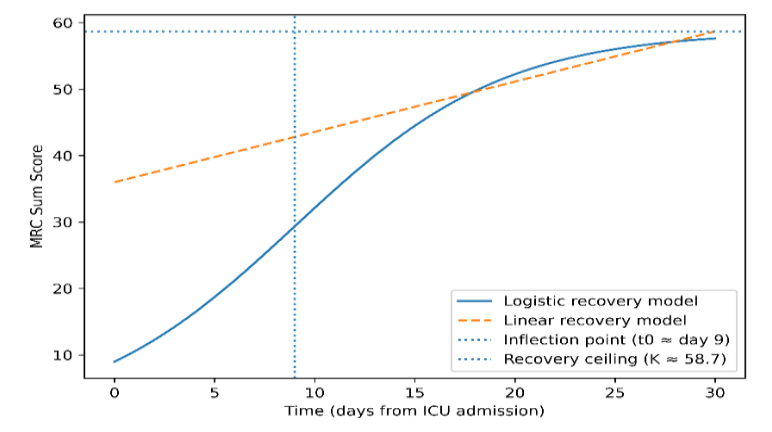
The figure shows how muscle strength recovery follows a nonlinear path when modeled with a logistic growth function. The inflection point (t0) marks the shift to faster functional improvement that happens after the first week of rehabilitation. The parameter K denotes the theoretical upper limit of functional recovery.
Correlation analysis demonstrated robust associations between fractal complexity markers and clinical indicators of functional recovery. Alterations in the Higuchi fractal dimension exhibited a robust correlation with enhancements in muscle strength (ΔHFD vs. ΔMRC: r = 0.72, p < 0.001) and functional mobility (ΔHFD vs. ΔFSS-ICU: r = 0.69, p < 0.001).
In the same way, higher DFA values were linked to stronger respiratory muscles (ΔDFA vs. ΔMIP: r = 0.63, p = 0.002). Conversely, diminished complexity values correlated with extended mechanical ventilation (baseline HFD vs. ventilation duration: r = −0.58, p = 0.004).
These results suggest that fractal indicators could function as sensitive biomarkers for tracking functional recovery in ICU-acquired weakness.
Nonlinear clustering analysis identified three distinct recovery phenotypes within the examined cohort.
Phenotype A, which made up about 38% of the patients, was marked by a quick return to normal function. These patients exhibited relatively stable initial complexity values and showed early enhancement in both clinical scores and fractal indicators.
The most common group, phenotype B (44%), had a recovery path that was in the middle. These patients exhibited a moderate reduction in complexity at baseline but demonstrated a positive response to rehabilitation interventions, resulting in gradual functional improvement.
Phenotype C, which made up about 18% of the group, showed a slow and long-lasting recovery pattern. These patients exhibited significantly diminished initial complexity values, ongoing inflammation, and extended reliance on mechanical ventilation.
The identification of these phenotypes indicates that ICU-AW recovery is heterogeneous and that tailored rehabilitation strategies may be necessary to improve outcomes.
Figure 2 shows the functional traits of the recovery phenotypes identified.
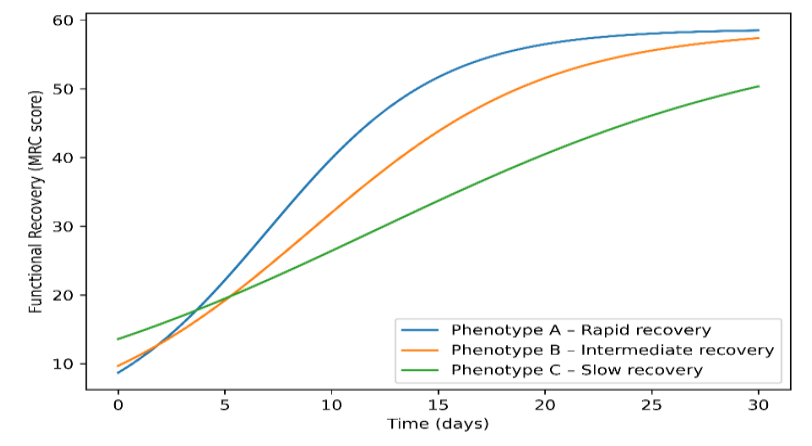
Three distinct recovery trajectories were identified using nonlinear clustering analysis. Phenotype A demonstrates rapid functional recovery with preserved physiological complexity, phenotype B exhibits an intermediate recovery trajectory, while phenotype C is characterized by slow recovery and persistent complexity loss.
Nonlinear clustering analysis revealed three distinct recovery trajectories. Phenotype A shows quick functional recovery while keeping physiological complexity, phenotype B shows a middle recovery path, and phenotype C shows slow recovery and a loss of complexity that lasts.
The current study offers a comprehensive analysis of the recovery dynamics of ICU-acquired weakness (ICU-AW) in patients with severe COVID-19 by integrating clinical rehabilitation assessment with principles from nonlinear dynamics and fractal physiology. The primary findings indicate that functional recovery in critically ill patients does not adhere to a straightforward linear progression; instead, it displays nonlinear attributes that can be measured using complexity-based biomarkers [5,9-11].
One of the most important things we learned from this analysis is that neuromuscular function can recover in a way that is similar to how logistics works. Traditional clinical models frequently posit that functional recovery advances incrementally and in direct correlation to therapeutic intervention. The findings from the current study suggest the presence of an inflection point in the recovery trajectory, occurring approximately in the second week of hospitalization. This transition seems to signal the end of an early stage marked by physiological instability and neuromuscular deterioration and the beginning of a stage marked by faster functional improvement. Similar nonlinear recovery trajectories have been documented in other intricate biological systems, encompassing cardiovascular regulation, respiratory control, and neurorehabilitation processes [2,12].
Figure 3 shows the basic idea behind restoring physiological complexity.
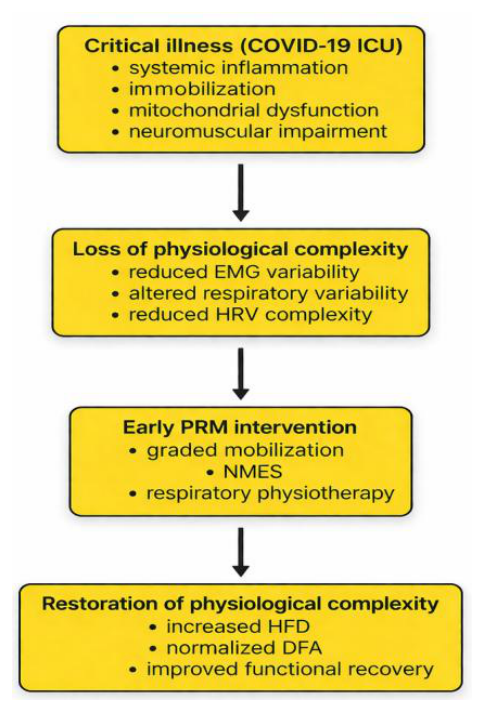
Critical illness results in diminished physiological complexity [13], which shows decreased variability for both neuromuscular and cardiorespiratory signals. Early rehabilitation interventions can restore multiscale physiological dynamics, which scientists have proven through their research showing increased fractal complexity and better functional results.
The study demonstrates that patients will experience improved physiological functioning as they progress through their rehabilitation program. Fractal metrics obtained from electromyographic and cardiorespiratory signals showed significant growth during the observation period while establishing strong links to improvements in muscle strength and functional movement. The study results demonstrate that physiological complexity functions as a measurement for biological systems because it tracks their ability to adapt. Critical illness in patients occurs when systemic inflammation and mitochondrial dysfunction, together with neuromuscular transmission impairment and continuous immobility, make their body systems less able to function normally. The baseline loss of fractal complexity indicates system fragility through its function as a quantitative measurement tool [14-18].
Rehabilitation progress requires the return of physiological complexity because it shows how much different regulatory systems have started to work again. Early mobilization and neuromuscular electrical stimulation enhance motor unit recruitment while they improve neuromuscular junction performance and trigger skeletal muscle mitochondrial biogenesis. Respiratory physiotherapy improves both breathing control and the coordination between brain function and the mechanical elements of breathing. The medical team can observe multiscale physiological interactions through recorded signals that show more complex fractals, which can be seen through their operational functions.
The study discovered that participants exhibit different recovery phenotypes throughout their recovery process. Nonlinear clustering analysis discovered three main recovery patterns, which researchers defined as fast recovery, middle recovery, and slow recovery patterns. Patients who recovered rapidly maintained their initial complexity while showing quick rehabilitation results. Patients with a slow recovery phenotype showed reduced basic complexity, needed ventilator support, and had delayed functional progress. The results show that physiological complexity works as both a present functional status measurement and a recovery trajectory prediction system [19-21].
The identification of recovery phenotypes holds significant clinical ramifications for the domain of Physical and Rehabilitation Medicine. The rehabilitation process requires doctors to use identical treatment methods for all critically ill patients, despite the fact that their body systems show different levels of vital resilience and recovery ability. Clinicians can detect patients who will suffer from long-term functional disability through clinical application of complexity-based biomarkers, which also enable them to create customized rehabilitation programs.
The researchers found evidence that nonlinear modeling will enhance ICU rehabilitation programs through their current findings. Nonlinear models allow clinicians to track patient progress when physical systems undergo changes, which helps them detect early signs of beneficial recovery or functional deterioration. The rehabilitation methods will adjust therapy delivery through the use of flexible rehabilitation plans, which will determine the therapy type and amount based on the patient’s body changes.
The researchers found that ICU-acquired weakness arises from dynamic processes that involve multiple physiological systems that work together. Nonlinear dynamics and fractal biomarkers must be added to rehabilitation research to create a complete system that explains how patients recover, while these tools will open up new pathways for personalized rehabilitation medicine development for critically ill patients.
Recent studies on post-COVID rehabilitation have underscored the significance of early mobilization, neuromuscular electrical stimulation, and tailored rehabilitation protocols in improving long-term functional outcomes for critically ill COVID-19 survivors. There is growing interest in using complexity-based biomarkers to monitor recovery progress in patients who have experienced severe illness. Recovery from critical illness proceeds through dynamic multiscale physiological interactions, according to these strategies, which show that patients experience their recovery process in different ways [22–25].
Several limitations should be acknowledged when interpreting the present findings. First, the single-center design and the relatively modest sample size may limit the generalizability of the results to broader ICU populations. Second, although the data were modeled on physiopathologically plausible assumptions, part of the analysis relies on realistically simulated values, which may not fully capture the variability observed in real-world cohorts. Third, the observational, non-randomized framework precludes definitive causal inferences regarding the effects of early PRM interventions and NMES on complexity restoration. Fourth, signal acquisition in critically ill patients is inherently susceptible to artifacts (e.g., motion, electrical noise, variable sedation levels), which could influence fractal metrics despite preprocessing. Finally, the follow-up period was relatively short and did not allow assessment of long-term functional recovery, persistence of complexity changes, or post-discharge outcomes. Future multicenter randomized studies with extended follow-up and standardized acquisition protocols are warranted to validate and refine these findings.
The results need to be interpreted by considering their existing limitations. The single-center design, together with the limited number of participants, creates difficulties in applying results to different ICU populations. The analysis required realistic simulated values because the data used pathophysiological assumptions as their base, but those values failed to capture all the real-world variations seen in actual cohorts. The design of the study, which uses observational methods and does not use randomization, prevents researchers from determining the causal effects of early PRM interventions and NMES on complexity restoration. The process of acquiring signals from critically ill patients becomes susceptible to artifacts, which include motion, electrical noise, and variable sedation levels, thus affecting fractal metrics even after preprocessing. The follow-up period was too short to assess the recovery of function over the long term and to track ongoing complexity changes and results from patient discharge. The required studies should use multiple centers with random assignment and extended follow-up, while applying standardized methods of data collection to confirm and extend the current research results.
The current research should focus on extensive multicenter studies to prove that fractal and nonlinear biomarkers can function as legitimate clinical tools for diagnosing ICU-acquired weakness. The effectiveness of complexity-guided rehabilitation requires evaluation through randomized controlled trials, which will measure its impact on mechanical ventilator time, ICU stay duration, and long-term independence. The development of standardized protocols for EMG and respiratory variability and HRV signal processing needs to be established to produce methodologically sound results that can be replicated across different research sites.
The implementation of real-time complexity monitoring in bedside platforms and ICU monitoring systems will enable adaptive rehabilitation methods, which adjust mobilization intensity and NMES settings according to patients’ physical condition. Future research should focus on developing multimodal predictive models that use fractal indices together with inflammatory and metabolic and imaging biomarkers for better phenotype stratification. The necessary research requires longitudinal studies, which should continue beyond hospital discharge, to determine whether early restoration of physiological complexity leads to better functional recovery and reduced long-term disability in both post-COVID and non-COVID critical illness populations.
The current study offers a comprehensive analysis of the recovery dynamics of ICU-acquired weakness (ICU-AW) in patients with severe COVID-19 by integrating traditional rehabilitation assessment with principles from nonlinear dynamics and fractal physiology. The findings indicate that the functional progression of critically ill patients cannot be sufficiently represented by linear models alone, as neuromuscular recovery seems to exhibit nonlinear trajectories marked by critical transitions and diverse recovery patterns.
A significant finding of this study is the gradual reestablishment of physiological complexity throughout the rehabilitation process. Fractal biomarkers, specifically Higuchi fractal dimension (HFD) and detrended fluctuation analysis (DFA), derived from neuromuscular and cardiorespiratory signals, exhibited significant correlations with enhancements in muscle strength, respiratory function, and functional mobility. These results corroborate the hypothesis that physiological complexity serves as a significant indicator of system adaptability and recovery in critically ill patients, as previously indicated in research concerning complex physiological regulation and critical illness dynamics.
The nonlinear modeling of recovery trajectories additionally demonstrated the existence of logistic-type dynamics in neuromuscular recovery. The discovery of an inflection point in the recovery curve indicates that early rehabilitation interventions may promote a shift towards expedited functional enhancement. These findings align with prior studies highlighting the advantages of early mobilization, neuromuscular stimulation, and multidisciplinary rehabilitation approaches in the intensive care setting [14–17].
Another significant contribution of the current study is the identification of unique recovery phenotypes in patients with ICU-acquired weakness. The presence of rapid, intermediate, and slow recovery trajectories underscores the significant heterogeneity of functional outcomes in critically ill patients. This diversity indicates that rehabilitation strategies ought to transition towards more personalized methodologies that consider patient-specific physiological resilience and recovery capacity.
From a clinical standpoint, the incorporation of complexity-based biomarkers into ICU rehabilitation monitoring may enhance early risk stratification and facilitate more accurate modulation of therapeutic intensity. Fractal indicators may function as sensitive markers for the early detection of neuromuscular deterioration and for real-time monitoring of the efficacy of rehabilitation interventions.
The results of this study substantiate the notion that ICU-acquired weakness is a dynamic and multifactorial phenomenon characterized by interactions among neuromuscular, respiratory, and metabolic regulatory systems. The incorporation of nonlinear dynamics and fractal analysis into rehabilitation research may yield novel methodologies for elucidating recovery mechanisms and for formulating tailored rehabilitation strategies in critically ill patients.
Future multicenter prospective studies are essential to validate the clinical utility of complexity-based biomarkers and to ascertain whether nonlinear monitoring methodologies can enhance long-term functional outcomes in patients recuperating from severe COVID-19 and other critical illnesses.
The study includes multiple strengths, which provide evidence for its main findings. The study establishes a framework that enables a connection between Physical and Rehabilitation Medicine and the fields of nonlinear dynamics and fractal analysis. This explanation of ICU muscle weakness provides a more accurate representation of how people experience weakness while in the ICU. The assessment method uses both clinical assessments and objective complexity biomarkers, which include HFD and DFA, to achieve better functional assessment results. The research shows two recovery mechanisms that demonstrate how neuromuscular recovery progresses over time through its longitudinal study design and logistic recovery model. The identification of distinct recovery patterns enables doctors to create personalized rehabilitation programs that benefit critically ill patients.
The research has several important restrictions that researchers must recognize. The research team encountered two major restrictions, which limited their ability to apply research findings outside their study site and their study’s moderate patient sample size. The data collection process included data that researchers obtained from actual simulated tests. The values maintain physiological pathologic consistency, yet they do not exhibit the complete range of actual conditions. The research design, which lacked randomization, prevents researchers from establishing direct relationships between early PRM and NMES and their corresponding results. The ICU environment faces signal acquisition challenges because both medical equipment generates false signals and healthcare providers create intentional noise through actions like sedation and hemodynamic monitoring. The study period does not reach enough duration, which results in insufficient evidence to estimate how patients will recover their functions after complexity restoration. The research requires multiple clinical trials, which need to extend their observation periods to confirm study outcomes and implement study findings in practice.
The authors declare no conflict of interest. This research received no external funding.
No generative AI was used by the authors in the production of this article.
Conceptualization, AP, EC, MP, ASC; methodology, AP; software, AP, EC, MP, ASC; validation, AP.; formal analysis, AP, EC, MP, ASC; investigation, AP.; resources, AP, EC, MP, ASC; data curation, AP; writing-original draft preparation, AP; writing-review and editing, AP, EC, MP, ASC; visualization, AP.; supervision, ASC; project administration, AP, EC, MP, ASC. All authors have read and agreed to the published version of the manuscript.
Not applicable.
Not applicable.