
The modern era of antimicrobial chemotherapeutics began with the discovery of sulfonamides and penicillin, and in the following decades the spectrum of antimicrobial substances was broadened by the discovery of new active substances capable of preventing and/or treating infections caused by pathogenic microorganisms. Thus, the introduction of antibiotics was a crucial moment that underpinned the saving of millions of patients, while at the same time leading to significant advances in medicine [1].
However, less than a decade after the clinical use of antibiotics, as a result of inappropriate prescribing or overuse of antibiotics both in humans and in veterinary and zootechnical medicine, without certainty of the infectious agent determined by laboratory tests or to promote animal husbandry [2], the gains from the development of this treatment are threatened by increasing rates of pathogen resistance to antibiotics, now leading to the Antimicrobial Resistance Crisis (AMR) [3].
The global increase in the incidence of infectious diseases that can no longer be eradicated with the substances developed to date represents the evolving response of microorganisms to the widespread administration of antibiotics. It has been declared by multiple organizations, such as the World Health Organization (WHO), to be a public health problem of concern. Therefore, the AMR crisis has led to the need to investigate and discover new potential antimicrobial agents [4,5,6].
A new research direction is to exploit the antimicrobial properties of large varieties of medicinal plants, which represent a natural reservoir providing many compounds useful in the fight against multidrug-resistant microorganisms [7,8].
Taraxacum officinale (dandelion), is a medicinal plant that has been used for centuries for its benefits in the treatment of conditions such as cholecystitis, improving hepatic function, lowering blood pressure and blood cholesterol levels, or for its diuretic effect. In addition, studies in the literature have shown that infusions made from this plant have beneficial effects on renal diseases [8].
Chelidonium majus (celandine), one of the oldest and most widely used plants in traditional medicine, presents manyfold benefits, being often used in the treatment of eczema and condyloma caused by Human Papilloma Virus (HPV) infection, hepatic and gastric diseases, as well as having anti-inflammatory and analgesic effects. [9,10,11,12,13,14,15].
The aim of this work is to study the antimicrobial activity of extracts of Taraxacum officinale (tincture), Chelidonium majus (tincture). The following objectives were proposed to achieve this aim: qualitative screening of the antimicrobial activity of plant extracts, quantitative determination of the antimicrobial activity of plant extracts and in vitro investigation of the anti-biofilm properties of plant extracts. [16,17,18].
Two plant extracts were analyzed in this study: Taraxacum officinale (dandelion) tincture and Chelidonium majus (tumbleweed) tincture.
Reference microorganisms were tested, two gram-negative bacterial strains: Escherichia coli ATCC 25922 and Pseudomonas aeruginosa ATCC 27853, two gram-positive strains: Staphylococcus aureus ATCC 25923 and Enterococcus faecalis ATCC 29212 and one fungal strain: Candida albicans ATCC 10231, according the American Type Culture Collection.
Qualitative evaluation of plant extracts was carried out by the drop method on solid agar medium by adapting the diffusimetric antibiogram method. Technique is: a 5µl volume of each plant extract was dropped onto the surface of a Plate Count Agar (PCA), non seleciv medium, inoculated with a standardized microbial suspension obtained from the strain to be tested by the cloth seeding technique. Sensitivity to a particular plant extract can be observed by inhibition of microbial growth around the deposited droplet. Interpretation of results: antimicrobial activity of the extracts was determined by assessing the formation of an inhibition zone around the deposited extract droplet and measuring its diameter using a millimeter ruler.
Quantitative determination of the antimicrobial activity of plant extracts was carried out by the microdilution method in liquid medium. Principle of the method: in 96-well ELISA microplates with liquid culture medium, 1/100 diluted microbial suspensions of the test strains are inoculated with an initial density of 0.5 McFarland in a gradient of plant extract concentrations. Minimum inhibitory concentration (MIC) and minimum bactericidal concentration (MBC) values are determined by drop seeding on agar medium the first 8 wells corresponding to 50%- 0.195% concentrations of each plant extract.
Interpretation of results: antimicrobial activity of the extracts was determined by evaluating the growth of microbial cultures on agar medium. The MIC value represents the concentration at which the plant extract inhibits the growth and multiplication of microorganisms, having a bacteriostatic effect, and the MBC value represents the concentration at which the plant extract has a lethal action on microorganisms, having a bactericidal effect.
Evaluation of the antibiofilm activity of plant extracts was tested by the 1% crystal violet microtitration method: following incubation of sterile 96-well ELISA microplates with liquid culture medium in which microbial suspensions are inoculated in a gradient of concentrations of the tested plant extracts, the in vitro antibiofilm activity of different concentrations of tinctures and alcoholic extracts is analyzed on the basis of absorbance values of the 1% crystal violet dye at 492 nm. Interpretation of the results: the antibiofilm activity of the plant extracts could be evaluated by determining the absorbance value from the spectrophotometric reading at 492 nm. The concentration of the plant extracts required to inhibit biofilm growth corresponds to the last well at which the absorbance value is less than half the absorbance value of the positive control corresponding to the same plant extract.
In this study we aimed to investigate the antimicrobial properties of some plant extracts of Taraxacum officinale (tincture) and Chelidonium majus (tincture). Qualitative evaluation of the antimicrobial activity of T. officinale plant extract determined an inhibition of microbial growth against E. faecalis ATCC 29212, P. aeruginosa ATCC 27853 and C. albicans ATCC 10231 strains, showing inhibition halo values of 9 mm, 8 mm with weak microbial growth within the microbial inhibition zone and 8 mm with the presence of a large number of colonies within the inhibition halo, respectively. Resistance to the action of the plant extract was recorded for strains of S. aureus ATCC 25923 and E. coli ATCC 25922, with the presence of T. officinale tincture not inhibiting their microbial growth.
Microbial growth of the fungal strain was inhibited in the presence of the plant extract from C. majus, resulting in an inhibition zone value of 7 mm. The same growth inhibition zone diameter was also recorded for the E.coli strain ATCC 25922, and a value of 11 mm was observed for the gram-positive strain E. faecalis ATCC 29212 (Table 1). This extract showed no antimicrobial activity against S. aureus ATCC 25923 and P. aeruginosa ATCC 27853 strains.
The qualitative determination study of the antimicrobial activity of S. marianum tincture on reference strains reveals that on both gram-negative strains, E. coli ATCC 25922 and P. aeruginosa ATCC 27853, and fungal strain, C. albicans ATCC 10231, the plant extract showed no antimicrobial activity (Table I). Inhibition of microbial growth could however be observed for the gram-positive strains S. aureus ATCC 25923 and E. faecalis ATCC 29212, with growth inhibition zone values of 9 mm and 8 mm respectively. Table 1. – Quality determination of antimicrobial activity.
| Strain tested | Growth inhibition zone diameter (mm) and CMI | |||||
|---|---|---|---|---|---|---|
| T. officinale (tincture) | CMI | Interpretation | C. majus (tincture) | CMI | Interpretation | |
| S. aureus ATCC 25923 | 0 | N/A | resistant | 0 | N/A | resistant |
| E. faecalis ATCC 29212 | 91 | 52µg/ µL | sensitive | 11 | 4298 µg/ µL | intermediate |
| E. coli ATCC 25922 | 0 | N/A | resistant | 71 | 87 µg/ µL | sensitive |
| P. aeruginosa ATCC 27853 | 81 | 66µg/ µL | sensitive | 0 | N/A | resistant |
| C. albicans ATCC 10231 | 82 | 66µg/ µL | sensitive | 71 | 87 µg/ µL | sensitive |
Legend: 1 weak/slight microbial growth within the inhibition zone. 2 presence of a large number of colonies within the inhibition zone.
Formula: CMI=Q/V Q=10000µL V=πR2G (1)
The method of quantitative determination of the antimicrobial activity allowed to highlight the concentrations of the plant extracts at which the growth and development of the tested reference strains are inhibited, as well as the concentrations determining the bactericidal action. (Fig. 1)
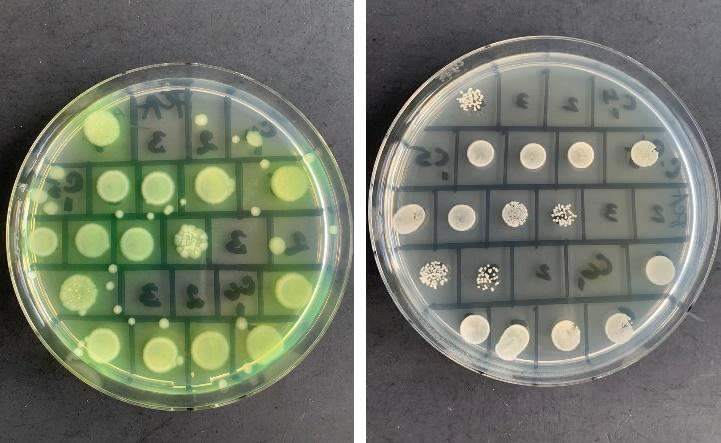
The plant extract of T. officinale shows a strong inhibitory effect on gram-negative P. aeruginosa ATCC 27853 and fungal strains, the bacteriostatic effect being achieved at a concentration of 3.13%, while on gram-positive strains and E. coli ATCC 25922, the concentration of the plant extract required to inhibit microbial growth is 12.5-25%. On gram-negative strains and E. faecalis strain ATCC 29212, the 12.5% concentration of C. majus extract has a bacteriostatic effect, thus a medium inhibitory effect was recorded, but a weak and a strong inhibitory effect of this extract was observed on C. albicans ATCC 10231 and S. aureus ATCC 25923 strains, with MIC values of 50% and 3.13% respectively.
The tinctures tested in the study showed lethal action on the reference microbial strains at an average concentration of 20.8%. For the plant extract of T. officinale, a concentration of 12.5% was required for bactericidal effect on S. aureus ATCC 25923, E. coli ATCC 25922 and C. albicans ATCC 10231 strains, and for E. faecalis ATCC 29212 and P. aeruginosa ATCC 27853, concentrations of 50% and 6.25%, respectively, were required. In the presence of C. majus tincture, the lowest CMB value recorded was 6.25% for S. aureus strain ATCC 25923. Bactericidal action on E. faecalis ATCC 29212 and P. aeruginosa ATCC 27853 strains was observed at a concentration of 12.5% of the plant extract, while concentrations of 25% and 50% were required for the gram-positive E. coli ATCC 25922 and fungal strains, respectively.
Analysis of spectrophotometric data revealed that T. officinale tincture shows little effect on Gram-positive strains, inhibiting biofilm growth at a concentration of 25%. The effect of this tincture was higher on gram-negative and fungal strains, with inhibition of biofilm growth observed at concentrations of 0.78%, 1.56% and 3.13% for C. albicans ATCC 10231, E. coli ATCC 25922 and P. aeruginosa ATCC 27853, respectively. The minimum concentration of C. majus tincture required to inhibit biofilm growth of C. albicans strain ATCC 10231 is 1.56%, while for E. faecalis ATCC 29212 and E. coli ATCC 25922 antibiofilm activity was achieved at a concentration of 12.5%, and for S. aureus ATCC 25923 and P. aeruginosa ATCC 27853 at 6.25%.
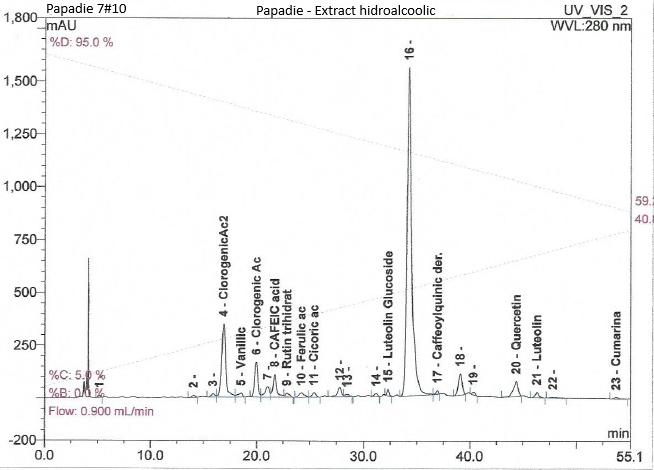
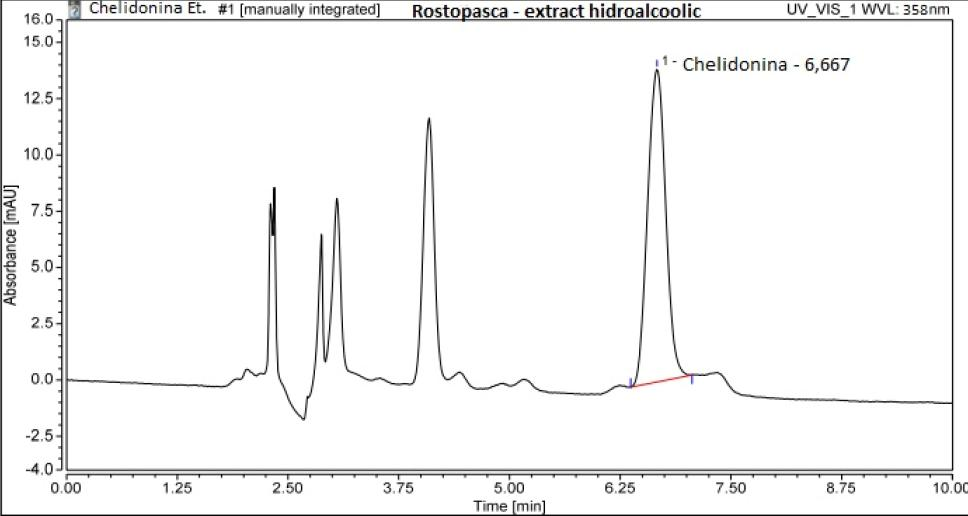
The chromatograms obtained in this study provide detailed information about the phytochemical composition of the extracts from Taraxacum officinale and Chelidonium majus. These analyses are essential for identifying the active compounds involved in the observed antimicrobial activity and for correlating them with the experimental results.
The attached figures present representative chromatograms for each extract, highlighting the main absorption peaks and specific compounds. This information contributes to a better understanding of the mechanisms through which the substances in the studied plants act against various microbial strains. The presence of active compounds is clearly demonstrated, supporting the qualitative and quantitative results obtained in the antimicrobial activity tests.
The chromatogram represents the analysis of hydroalcoholic extract of Taraxacum officinale, (Fig. 2) highlighting major phytochemical compounds such as luteolin glucoside (the main peak, indicating the dominant compound), caffeoyl derivatives, and luteolin. Additionally, chlorogenic acid and quercetin are present, known for their antioxidant and anti-inflammatory activities. This composition suggests a high therapeutic potential, supporting the antimicrobial activity observed in the study.
The chromatogram analyzes a hydroalcoholic extract of Chelidonium majus (Fig. 3), highlighting chelidonine as the main compound (retention time 6.667 minutes), suggesting a high concentration. Chelidonine is an alkaloid known for its antimicrobial and antitumor properties. The smaller peaks indicate the presence of other alkaloids, such as sanguinarine or berberine.
The present study investigated the antimicrobial properties of plant extracts tinctures from Taraxacum officinale and Chelidonium majus. The qualitative and quantitative evaluations of antimicrobial activity revealed differential effects of these plant extracts on different strains, shedding light on their potential therapeutic applications.
Taraxacum officinale L. is a flowering herbaceous perennial plant of the Asteraceae family. Interest in researching the biochemical characteristics as well as the pharmacological properties of this species increased considerably in the 1950s, and numerous active substances have now been identified, including flavonoid compounds, phenolic acids such as cyclonic, chlorogenic and caffeic acid, alkaloids, and terpenes. In modern medicine, this plant is marketed and used as an herbal treatment to relieve symptoms of conditions such as arthritis, hepatic disorders and to suppress oxidative stress [17,18, 19,20,21,22,23]. Dandelion exhibits a diverse array of pharmacological effects, making it a valuable medicinal plant with potential therapeutic applications. The study by Trinh et al. 2020, reported that ethanol-based plant extract from T. officinale exhibits bactericidal effect on S. aureus strain ATCC 25923 at a concentration of 20 mg/ml [24]. T. officinale extract tested in the study by Sangeetha and Ezhilarasan 2016, showed lethal action on E. faecalis strain ATCC 29212 at a concentration of 200mg/mL [25]. The study by Shah et al. (2011) [26] showed that S. marianum extracts did not exhibit antimicrobial activity against the tested gram-negative strains E. coli ATCC 25922 and P. aeruginosa ATCC 27853.
Chelidonium majus is a medicinal plant belonging to the Papaveraceae family that is found in the wild flora of Europe, Asia, North America, as well as in some regions of Africa. It is widely used in traditional herbal medicine to treat conditions including biliary and hepatic dysfunction, jaundice and to relieve pain caused by edema. It has antidiuretic, spasmolytic, sedative, and antimicrobial properties. The dried aerial part of C. majus is an official medicine in the pharmacology of European countries, but it is necessary to administer it under the supervision of authorized medical personnel due to the presence of a rich concentration of isoquinoline alkaloids. [27,28,29,30,31]
The antimicrobial activity of the studied plant extracts varied significantly depending on the microbial strain and the type of extract used. For instance, T. officinale exhibited inhibition against E. faecalis and P. aeruginosa strains but not against S. aureus and E. coli. Similarly, C. majus showed inhibition against E. faecalis and C. albicans but not against S. aureus and P. aeruginosa. These findings suggest that the efficacy of plant extracts may be strain-specific, highlighting the importance of considering multiple strains in antimicrobial studies. [32,33,34,35]
The results of this study are consistent with some previous findings but differ from others. For example, the antimicrobial activity of T. officinale against S. aureus strain ATCC 25923 reported by Trinh et al. (2020) aligns with our findings, whereas Tunç et al. (2019) reported no antimicrobial activity against E. faecalis strain ATCC 29212, contradicting our observations. Such discrepancies may arise from variations in extraction methods, microbial strains, or growth conditions, emphasizing the need for standardized protocols and comprehensive strain selection in antimicrobial research.
The determination of MIC and bactericidal concentration provided insight into the potency of the plant extracts against different microbial strains. Higher MIC values were often observed for gram-negative bacteria compared to gram-positive bacteria and fungi. This differential susceptibility underscores the complex interplay between microbial cell wall structures and the mechanisms of action of plant compounds.
The ability of plant extracts to inhibit biofilm formation is of particular interest due to the role of biofilms in antimicrobial resistance. Our study demonstrated varying degrees of biofilm inhibition by the tested extracts, with some showing promising activity against both gram-positive and gram-negative bacteria as well as fungi. These findings suggest the potential of plant extracts as adjuncts in combating biofilm-associated infections.
Despite the valuable insights provided by this study, several limitations should be acknowledged. The use of reference strains may not fully represent the diversity of clinical isolates, warranting further investigations with clinically relevant strains. Moreover, elucidating the underlying mechanisms of antimicrobial activity and conducting in vivo studies are crucial steps toward clinical translation.
The chromatographic analysis of the hydroalcoholic extracts of Taraxacum officinale and Chelidonium majus revealed the presence of major bioactive compounds, each contributing to the specific therapeutic potential of the plant. The chromatogram of Taraxacum officinale indicated Luteolin glucoside as the main compound, known for its antioxidant and anti-inflammatory activities, alongside caffeoyl derivatives. For Chelidonium majus, chelidonine (retention time 6.667 minutes) was identified as the major compound, recognized for its antimicrobial and antitumor properties.
These results emphasize that each extract possesses a distinct phytochemical composition that may synergistically contribute to the observed antimicrobial activity. The identification of specific compounds through chromatographic analysis supports the understanding of the mechanisms of action of the extracts and justifies further investigations into their use in antimicrobial, antioxidant, and hepatoprotective treatments. This study underscores the diverse antimicrobial potential of plant extracts against a range of microbial pathogens. Further research focusing on standardization, mechanism of action, and clinical efficacy is warranted to harness the therapeutic benefits of these natural products effectively.
In this experimental work, the antimicrobial properties of two plant extracts of Taraxacum officinale (tincture) and Chelidonium majus (tincture) were studied on 5 reference bacterial strains, two gram-positive (Staphylococcus aureus ATCC 25923 and Enterococcus faecalis ATCC 29212), two gram-negative (Escherichia coli ATCC 25922 and Pseudomonas aeruginosa ATCC 27853) and one fungal strain, Candida albicans ATCC 10231.
Qualitative testing of antimicrobial activity revealed that the plant extracts inhibited the growth and development of the tested microbial strains.
Quantitative determinations of antimicrobial activity allowed the determination of the concentrations of plant extracts responsible for the bacteriostatic and bactericidal effect, and a higher sensitivity of microbial strains could be observed in the presence of tinctures.
In vitro evaluation of the antibiofilm activity of plant products revealed their ability to inhibit the development of biofilms on inert substrate; plant extracts of C. majus were found to inhibit biofilm formation in all bacterial strains tested, while tincture of T. officinale showed very good activity on gram-negative and fungal strains.
The results obtained are promising, supporting further research into the biochemical characteristics of these extracts in order to formulate strategies for the control of bacterial and fungal infections in humans.
The authors declare no conflict of interest.
This research received no external funding.
Conceptualization, R.C.S., and V.O.; methodology, C.T and D.C.; software, M.C.R.; validation, M.M., V.O and D.C.; formal analysis, R.C.S. and M.C.R.; investigation, M.C.R..; resources, V.O.; data curation, D.C.; writing—original draft preparation, D.C and F.D.U.; writing—review and editing, M.C.R. and C.E.M; visualization, C.E.M.; supervision, V.O.; project administration M.M. .All authors have read and agreed to the published version of the manuscript.
Ethics approval and consent to participate
Not applicable.