
Pancreaticoduodenectomy (PD) is a complex procedure performed in individuals with neoplastic or non-neoplastic tumors affecting the head of the pancreas and the periampullary region. Despite advancements in surgical techniques and perioperative management, the mortality rate is 1.31% based on a nationwide study from Japan; however, operative mortality rates are much higher in western pancreatic centers, reaching up to 5-8% according to nationwide western studies [1]. Postoperative pancreatic fistula (POPF) is a POTENTIALLY SEVERE complication of PD. POPF can lead to wound infections, abdominal abscesses, and intra-abdominal hemorrhages [2]. Therefore, precise and prompt prediction of POPF following PD is essential for mitigating the mortality associated with severe complications. Moreover, evidence indicates that POPF adversely affects the prognosis of patients with malignancies [3]. Although some studies have demonstrated that diverse surgical techniques and drugs can diminish the incidence of POPF [4,5], recent research has concluded that POPF cannot be predicted by any clinical variable [6].
Inflammatory responses at the systemic level are closely linked to surgical complications in various procedures. C-reactive protein (CRP), an established inflammatory marker, is a widely recognized positive acute-phase, non-specific reactant [7]. The C-reactive protein-albumin ratio (CAR), calculated by dividing serum CRP by albumin levels, serves as another inflammatory marker and has been correlated with unfavorable prognosis in individuals diagnosed with cancer [8]. CAR was originally developed as a prognostic factor for patients diagnosed with sepsis [9]. Based on these findings, we hypothesized that CAR could not only predict prognosis but also forecast the occurrence of POPF. Studies have indicated that CAR serves as a predictive factor for various types of cancer [10,11].
The management of POPF has undergone historical changes, transitioning from a previously adopted ‘wait and see’ approach to a strategy characterized by early and timely prevention [12]. In this study, we included only patients with pancreatic cancer to focus on a specific cohort and to avoid the heterogeneity that could arise from including patients with other types of periampullary tumors. We assessed CAR as a cost-effective and readily available parameter to predict POPF after PD. Therefore, in this study, we aimed to determine whether preoperative CAR has predictive value for POPF in patients undergoing PD for pancreatic cancer. The management of POPF has undergone historical changes, transitioning from a previously adopted ‘wait and see’ approach to a strategy characterized by early and timely prevention [12]. We assessed CAR as a cost-effective and readily available parameter to predict POPF after PD. Therefore, in this study, we aimed to determine whether preoperative CAR has predictive value for POPF in patients undergoing PD for pancreatic cancer.
Demographic characteristics, preoperative laboratory results, preoperative polyclinic and hospital application notes, surgery, and treatment conditions of patients who underwent PD for pancreatic cancer (n=83) in our department between March 2017 and December 2023 were evaluated retrospectively. Patients aged between 18 and 80 years who were diagnosed with pancreatic cancer were included. The exclusion criteria were as follows: patients who underwent total pancreatectomy, those outside the specified age range, and those whose data were not available. Data extracted from the medical records included variables such as sex, age, American Society of Anesthesiologists (ASA) classification, pancreatic tissue characteristics, duct size, length of hospital stay, POPF, CRP, and serum albumin levels.
All patients underwent subtotal stomach-preserving PD. PD reconstruction was performed using Child’s technique. Pancreatic anastomoses were performed in all patients using duct-mucosa and end-to-side pancreaticojejunostomy (modified Blumgart). Biliary drainage was provided by end-to-side hepaticojejunostomy. All surgeries were performed by the same team using the same procedure. POPF was determined according to the International Study Group On Pancreatic Surgery (ISGPS) classifications, and the severity of complications was graded using the Clavien-Dindo classification [13]. CAR was computed using preoperative CRP and serum albumin values using the following formula: CAR = CRP (mg/dL)/serum albumin (g/dL).
Amylase levels in the drainage fluid are routinely measured on postoperative days 3, 5, and 7. Two drainage tubes (one adjacent to the hepaticojejunostomy site and the other to the pancreaticojejunostomy site) were placed in the abdominal cavity of all the patients. The time interval for assessing the car was within 7 days before PD. Antibiotics were routinely administered. The drains were removed after full recovery from the pancreatic fistula. No data about postoperative sandostatin or other similar substance administration was provided in this study.
This study was conducted in accordance with the 1964 Declaration of Helsinki and its amendments. Consent was obtained from conscious patients and first-degree relatives of unconscious patients. Ethical approval was obtained from Hitit University Ethics Committee (Ref. Nr: 2023-48).
Statistical analysis was performed using the SPSS software (Version 22, SPSS Inc., Chicago, IL, USA). Descriptive statistics for categorical data are reported using frequencies (n) and percentages (%). For numerical data demonstrating a normal distribution, descriptive statistics were reported as mean ± standard deviation (SD), while non-normally distributed data were reported as median (min-max). The Chi-square test was used to compare the proportions between categorical variables. The Shapiro-Wilk test, histograms, and Q-Q plots were used to assess the normality of the numerical data. Levene’s test was conducted to evaluate the homogeneity of variances. When parametric test assumptions were met, the Student’s t-test was used to compare continuous data between two independent groups; in cases where these assumptions were not met, the Mann-Whitney U test was utilized. P values of less than 0.05 were accepted as statistically significant. Receiver Operating Characteristic (ROC) analysis was conducted to evaluate C-reactive protein to albumin ratio (CAR) values as predictive markers for postoperative pancreatic fistula (POPF). ROC curves and Area under the Curve (AUC) with 95% confidence intervals (CIs) were calculated. The AUC values were categorized as excellent (0.9-1), good (0.8-0.9), fair (0.7-0.8), weak (0.6-0.7), and poor (0.5-0.6). The Youden index was used to determine the optimal cut-off points in the ROC analysis, and their performance was evaluated using sensitivity, specificity, positive predictive value (PPV), negative predictive value (NPV), and positive likelihood ratio (LR+). Univariate and multivariate binary logistic regression analyses were performed to assess the impact of the risk factors on POPF. Odds ratios (OR) were computed for each significant parameter in the univariate and multivariate models, with 95% confidence intervals (CIs). All risk factors with a p-value < 0.10 in the univariate analysis were included in multivariate logistic regression models to ensure that no potentially significant variables were excluded prematurely.
The study analyzed a total of 83 patient records; among these, postoperative pancreatic fistula (POPF) was present in 41 (49.4%) and not detected in 42 (50.6%) cases. Of the patients, 63.9% (n=53) were male and 36.1% (n=30) were female. The mean age of the patients was 69.3±10.9 (range: 41-89) years. The mean length of hospital stay for the patients was 29.1 ± 15.3 (8-81) days. Although patients who developed POPF might be expected to have longer hospital stays, the difference was not statistically significant in this study (p=0.078). This may be due to the high standardization of postoperative care and efficient management of POPF in our institution.
Statistical findings regarding the comparison of sociodemographic and clinical characteristics between the research groups are presented in Table 1. Sex distribution and ASA scores were similar between the groups (p=0.708 and p=0.520, respectively). The mean age and length of hospital stay did not significantly differ between the groups (P=0.079 and P=0.078, respectively). However, there were significant differences in the Fistula classification and Clavien-Dindo grades between the groups (P<0.001 and P<0.001, respectively). Patients who developed POPF had statistically higher CRP and CAR values compared to those who did not (P<0.001 and P<0.001, respectively), whereas their albumin values were significantly lower (P=0.001).
Factors such as co-morbidities, diabetes, chronic pancreatitis, jaundice, and preoperative biliary drainage were not included in the analysis of potential predictors of POPF. This decision was made due to the primary focus of the study on the relationship between car and POPF risk. However, it is acknowledged that these factors can influence the development of POPF and should be considered in future studies.
The soft tissue ratios of patients with POPF were significantly higher than those of patients without (P=0.001). Additionally, the canal sizes in the POPF group were significantly smaller than those in the non-POPF group (P=0.001). The occurrence rate of duct size ≤2 mm in the POPF group was significantly higher than that in the non-POPF group (P=0.001). The cut-off point for the Wirsung duct size at 2 mm was selected based on previous studies indicating that smaller duct diameters are associated with a higher risk of POPF [24,25].
| POPF | p values | |||
|---|---|---|---|---|
| No (n=42) | Yes (n=41) | |||
| Gender (M/F) | Male | 26 (61.9%) | 27 (65.9%) | 0.708a |
| Female | 16 (38.1%) | 14 (34.1%) | ||
| Age (years) | 71.38±11.03 | 67.17±10.52 | 0.079c | |
| Hospital stay (days) | 25 (8 – 43) | 28 (12 – 81) | 0.078d | |
| ASA | 1 | 0 (0%) | 1 (2.4%) | 0.520b |
| 2 | 7 (16.7%) | 4 (9.8%) | ||
| 3 | 35 (83.3%) | 36 (87.8%) | ||
| Fistula grade | None | 42 (100%) | 1 (2.4%) | <0.001b |
| A | 0 (0%) | 8 (19.5%) | ||
| B | 0 (0%) | 25 (61%) | ||
| C | 0 (0%) | 7 (17.1%) | ||
| Clavien-Dindo | None | 42 (100%) | 1 (2.4%) | <0.001b |
| 2 | 0 (0%) | 8 (19.5%) | ||
| 3 | 0 (0%) | 21 (51.2%) | ||
| 4 | 0 (0%) | 11 (26.8%) | ||
| CRP | 0.59 (0.1 – 2.86) | 3.68 (0.39 – 20.7) | <0.001d | |
| ALB | 3.4 (2.7 – 4.5) | 3.1 (2.2 – 4.16) | 0.001d | |
| CAR | 0.18 (0.08 – 0.91) | 1.2 (0.12 – 8.28) | <0.001d | |
| Tissue | Soft | 17 (40.5%) | 37 (90.2%) | <0.001a |
| Hard | 25 (59.5%) | 4 (9.8%) | ||
| Duct size (mm) | 3.9 (1 – 12) | 2 (1 – 6.5) | 0.001d | |
| Duct size group | ≤2 | 9 (21.4%) | 24 (58.5%) | 0.001a |
| >2 | 33 (78.6%) | 17 (41.5%) | ||
CRP: C-reactive protein, ALB: Albumin, CAR: C-reactive protein to albumin ratio, a Chi-square test with n (%), b Fisher exact test with n (%), c Student’s t-test with mean±standard deviation (SD), d Mann Whitney U test with median (min-max).
Interestingly, in this cohort, there were no other major complications (such as delayed gastric emptying, hemorrhage, infections) in the group without POPF, which is unusual compared to other studies. This may be due to the strict inclusion criteria and exclusion of patients with incomplete data. However, this finding does limit the generalizability of the results, and future studies should include a broader range of complications to provide a more comprehensive analysis.
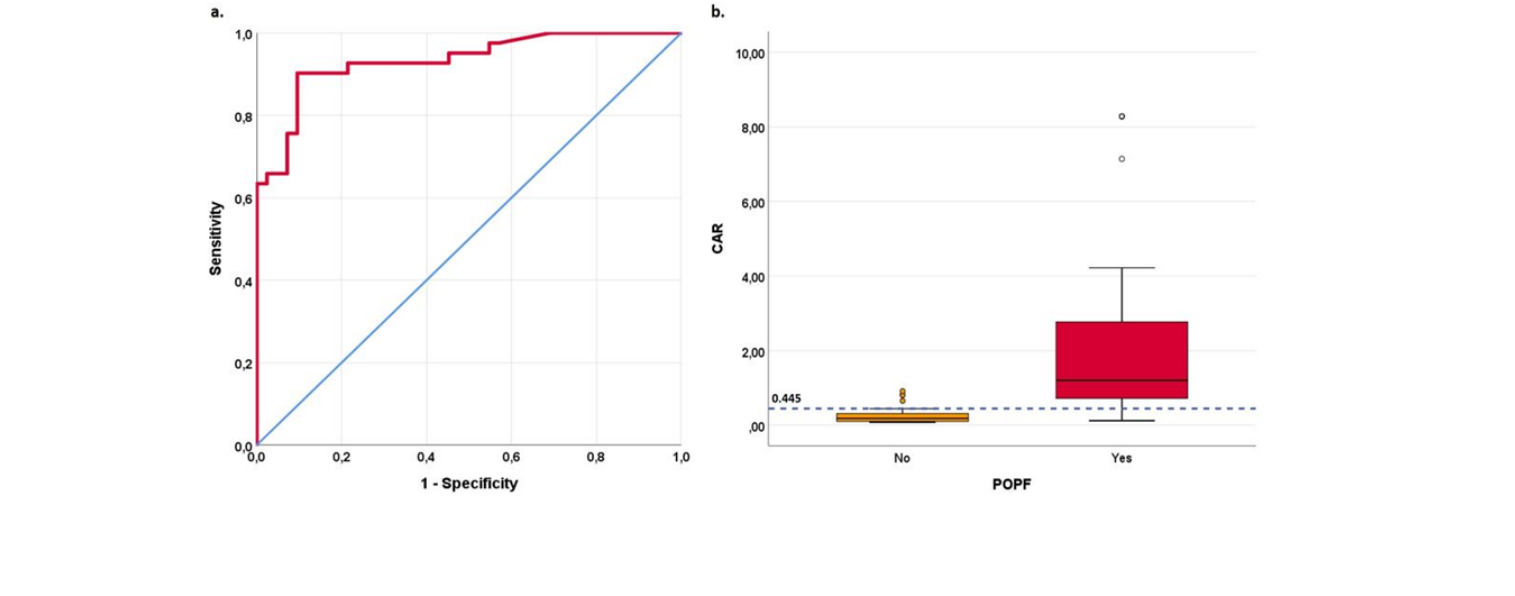
The ROC analysis findings, including sensitivity, specificity, positive and negative predictive values, and likelihood ratio (+) values computed using the cut-off values determined by ROC analysis to assess the predictive success of CAR in predicting POPF, are presented in Table 2. According to the ROC analysis results, CAR exhibited excellent predictive capability for POPF (AUC=0.934, 95% CI: 0.881-0.986) (Table 2). The calculated optimal cut-off point for CAR was 0.445, with a sensitivity of 90.2% (75.9 – 96.8) and specificity of 90.5% (76.5 – 96.9). The ROC curves for the CAR are shown in Figure 1a, while box plots illustrating the distribution of CAR values between groups and the optimal cut-off point are presented in Figure 1b.
| CAR | |
|---|---|
| AUC (95%CI) | 0.934 (0.881-0.986) |
| p values | < 0.001 |
| Cut-off | 0.445 |
| Sensitivity (95% CI) | 90.2% (75.9 – 96.8) |
| Specificity (95% CI) | 90.5% (76.5 – 96.9) |
| PPV (95% CI) | 90.2% (75.9 – 96.8) |
| NPV (95% CI) | 90.5% (76.5 – 96.9) |
| LR + (95% CI) | 9.5 (3.7- 24.2) |
CRP: C-reactive protein, ALB: Albumin, CAR: C-reactive protein to albumin ratio, ROC: Receiver Operating Characteristic, AUC: Area under curve, PPV: positive predictive value, NPV: negative predictive value, LR: Likelihood Ratio, CI: Confidence interval.
The results of Univariate and Multivariate Binary Logistic Regression analyses conducted to determine the impact of the created CAR parameter using the cut-off points determined by ROC analysis, along with other risk factors, on predicting POPF, are presented in Table 3. In the Univariate model, sex showed no significant effect (p=0.708), whereas age had a significant effect p<0.10 level (p=0.082). Duct size, tissue, and CAR parameters exhibited significance (p=0.001, p<0.001, p<0.001, respectively). Sex, which did not show a significant effect on POPF in the univariate model, was not included in the multivariate model (p=0.708). Age, duct size, tissue, and CAR parameters, which were significant p<0.10 in the univariate model, rendered age (p=0.128) and duct size insignificant (p=0.183) in the multivariate model. In the final model considering tissue and CAR, tissue parameters were significant at p<0.10 level, while CAR parameters were significantly impactful at p<0.001 (p=0.083 and p<0.001, respectively, Table 3). According to the Multivariate model, the odds ratio for CAR was 57.2 (12.8 – 254.9). The likelihood of developing POPF in patients with a CAR value greater than 0.445 was 57.2 times higher compared to that in patients with a CAR value lower than 0.445.
| Univariate | Multivariate | |||
|---|---|---|---|---|
| p values | OR (CI 95%) | p values | OR (CI 95%) | |
| Gender (M/F) | 0.708 | – | ni | – |
| Age (years) | 0.082 | 0.96 (0.93 – 1.01) | ns | – |
| Duct size (mm) (≤2 & >2) | 0.001 | 5.18 (1.97 – 13.6) | ns | – |
| Tissue (Soft & Hard) | <0.001 | 13.6 (4.09 – 45.2) | 0.083 | 4.46 (0.83 – 24.2) |
| CAR (≥0.445 & <0.445) | <0.001 | 87.9 (20.5 – 377.6) | <0.001 | 57.2 (12.8 – 254.9) |
Multivariate model: (Tissue + CAR) Nagelkerke R Square=0.727, Classification accuracy: 90.4%. Values below P < 0.1 were shown bold. ni: not included, ns: not significant (P>0.05), OR: Odds ratio, CI: Confidence interval, CAR: C-reactive protein to albumin ratio.
Despite advancements in surgical management, POPF continues to pose a significant complication following PD. Approximately 50% of the patients undergoing PD experience POPF [14]. Serious cases of POPF can lead to serious complications, including sepsis and intra-abdominal hemorrhage. This can result in prolonged hospitalization, escalated medical expenses, and mortality in extreme scenarios [2]. In addition, the poor prognosis of patients with malignant disease is exacerbated by the delayed initiation of adjuvant therapy resulting from POPF [15]. Several risk factors have been identified for the development of POPF after PD. These factors encompass pancreatic tissue characteristics, duct size, low albumin levels, gender, surgical technique, elevated CRP levels, and others [16]. As there are currently no definitive methods to entirely prevent POPF, despite numerous studies, there is a crucial need for accurate and reliable prediction of POPF in the early postoperative period after PD to prevent these complications. Many studies have investigated various parameters to predict POPF, but a definitive gold standard that can accurately predict POPF is yet to be established. Recent studies have shown that popular biochemical parameters can predict POPF [17]. In our study, we aimed to assess whether preoperative CAR is associated with the risk of POPF following PD.
CAR, a novel inflammatory marker, has been extensively used as a prognostic indicator for various cancers [18]. Sakamoto et al. [19] demonstrated in their study that the CAR value on the 3rd postoperative day proved to be a robust indicator for predicting POPF with statistical significance. However, it was not significant on the 1st postoperative day. The reason for this was thought to be that the expected postoperative CRP elevation may have affected the results and may have approached the preoperative values on the 3rd postoperative day. We thought that this parameter could be used in terms of POPF risk in the pre-operative period, and this became our main motivation for this study. In our study, 41 patients (49.4%) had POPF. In our study, a preoperative CAR value >0.445 was associated with an increased risk of POPF. Furthermore, this result indicates the patient’s preoperative nutritional status. Improving the nutritional status may suggest a potential reduction in the risk of POPF. Studies have shown a parallel relationship between hypoalbuminemia and morbidity [20].
Our study showed that both soft pancreatic tissue and duct size have a significant relationship with the development of POPF. Following PD with soft pancreatic tissue, the high rates of POPF can be attributed to various factors. These may include an increase in the exocrine function of the soft glands and a limited suture-holding capacity [21,22]. Moreover, Xingjun et al. [23] indicated that a low degree of fibrosis is a risk factor for the occurrence of POPF after PD. Creating anastomosis in a narrow duct size is technically difficult. In the majority of studies, a cut-off point of ≤3 mm for duct size was stipulated [24,25]. However, in our study, duct sizes of ≤2 mm were found to be significantly higher in terms of POPF. Considering the factors that increase or decrease the risk of POPF, this value may not have been significant in our study for different reasons. Studies have shown that small duct diameter and soft pancreatic tissue are associated with an increased risk of POPF [16]. In a previous study, the relationship between CAR and POPF was found to be significant, however, the relationship between pancreatic duct diameter and tissue has not been investigated [17]. Therefore, we investigated the relationship between car, duct size, and pancreatic tissue characteristics. Our results indicated that car was more significantly associated with POPF risk in patients with small duct diameters and soft pancreatic tissue. This was the first study to be conducted, and it was the most important difference in our study.
Our findings can be used in clinical decision management for patients undergoing pd by incorporating car values into preoperative assessments. Identifying patients with elevated car values preoperatively can help in strategizing post-operative care, close monitoring, and interventions aimed at reducing POPF risk.
In conclusion, CAR is a reliable and easily calculable predictive indicator for POPF risk after PD. Further prospective studies with larger patient populations are required to conclusively evaluate the reliability of this parameter; our study could serve as an illuminating guide for prospective randomized controlled trials that can be planned for carefully selected patient groups.
The authors declare that there are no conflicts of interest, financial or otherwise, related to the materials presented herein. The authors declare no conflicts of interest. The funder had no role in the design, data collaboration, data analysis, or reporting of this study
The current manuscript does not contain previously published materials or self-generated AI text.
Conceptualization (BK, ITS); methodology (BK); software (ITS); validation (VBT); formal analysis (BK, VBT, EGA); investigation (EGA); resources (BK); data curation (ITS, VBT); statistical analysis (VBT, EGA); writing – original draft preparation (BK, VBT, EGA); writing – review and editing of manuscript (VBT, EGA); visualization (BK,VBT); supervision (EGA); project administration (BK). All authors have read and agreed to the published version of the manuscript.
This study was approved by the Ethics Committee of Hitit University. Approval No: 2023-48. Written informed consent was obtained from the patients included in this study prior to their participation. The study was conducted in accordance with the Declaration of Helsinki. Informed consent was obtained from all subjects involved in the study. The study was obtained from clinical trials with study number NCT06300801.