
Health literacy, the ability of individuals to access, comprehend, and apply basic health information, is a fundamental determinant of public health outcomes. Individuals with adequate medical knowledge are more likely to engage in preventive behaviors, adhere to treatment regimens, and navigate healthcare systems effectively. However, in many Eastern European countries, the general population continues to face substantial deficits in health-related education, with far-reaching social implications [1].
For the purposes of this review, health literacy is adopted as the central organizing construct, defined in accordance with the WHO (World Health Organization) and HLS-EU (European Health Literacy Survey) framework as the ability of individuals to understand health information in order to make informed decisions regarding their health. This encompasses what may be known as public medical education and health knowledge itself. Public medical education is the formal and informal processes through which health knowledge is disseminated to the general population. Health knowledge refers to the factual understanding of disease, risk factors, and healthcare practices. While these terms are related and often used interchangeably in the broader literature, this review treats health literacy as the overarching concept, recognizing that public medical education and health knowledge are key determinants of an individual’s overall health literacy level.
According to the HLS-EU, more than 50% of adults in Bulgaria demonstrate inadequate or problematic levels of health literacy, among the worst scores in Europe (EU). Eastern countries also report some of the lowest rates of health-promoting behaviors, such as vaccination uptake, cancer screening participation, and physical activity. Even though vaccination rates remain low, the influenza mortality rates in Romania, Hungary, and Poland are under 0.5/100000. The influenza vaccination rates are over 70% in the Netherlands and 75% in Ireland and Denmark [2-4].
Poor health literacy is associated with a higher prevalence of preventable conditions, such as cardiovascular disease and type 2 diabetes, which are significantly more common and poorly controlled in Eastern Europe. In Romania, for example, approximately 45% of adults are hypertensive, yet over 40% are unaware of their diagnosis [5]. Similarly, avoidable mortality, defined as deaths that could be prevented through effective public health and medical interventions, remains disproportionately high in Eastern Europe. In 2020, Eurostat reported that Romania and Hungary ranked among the top three EU countries in terms of avoidable mortality rates [6,7].
Beyond individual health outcomes, poor medical education in the general population may contribute to increased pressure on healthcare services due to unnecessary emergency room visits, late presentation of chronic conditions, and reduced adherence to public health guidelines. During the COVID-19 pandemic, misinformation and low trust in medical authorities were associated with alarmingly low vaccination coverage in some Eastern European countries, with less than 20-40% of the adult population fully vaccinated by mid-2022 in Romania and Bulgaria, contributing to higher excess mortality compared to Western Europe [8,9].
This literature review aims to explore the social impact of inadequate medical education among the general population in Eastern Europe. Through a comprehensive synthesis of data and published research, we seek to highlight the structural, cultural, and policy-related factors that contribute to low health literacy in the region and outline potential pathways for intervention and reform.
This narrative literature review was conducted to explore and synthesize current knowledge on the social impact of inadequate public medical education in Eastern European countries. Given the interdisciplinary nature of the topic, including public health, education, sociology, and policy studies, a broad and flexible methodological approach was adopted.
A comprehensive search of the scientific literature was performed in September-October 2025 in the following electronic databases: PubMed, Scopus, Web of Science, and Google Scholar. Boolean search strings were adapted to the syntax and indexing conventions of each database, using the following keywords in various combinations: (“health literacy” OR “medical education” OR “public health education”) AND (“social impact” OR “health outcomes” OR “health inequalities”) AND (“Eastern Europe” OR “Romania” OR “Bulgaria” OR “Ukraine” OR “Moldova” OR “Serbia” OR “Poland”).
In addition, grey literature was searched using institutional websites (e.g., WHO Europe, the Organization for Economic Co-operation and Development (OECD), Eurostat, World Bank), and relevant government or NGO reports were included when peer-reviewed data were unavailable or limited.
Studies and reports were included in this review if they concentrated on health literacy, health knowledge, or health education within adult or general populations, and specifically addressed at least one Eastern European country. Articles examining social, behavioral, or health system outcomes related to low health literacy or inadequate medical education were also considered. Only articles written in English were included. No formal date restriction was applied. The majority of included sources were published within the last ten years; older studies were retained when considered particularly relevant to the topic.
Excluded from this review were articles focusing solely on professional medical training, studies lacking relevance to the general population or public health outcomes and opinion pieces or editorials without supporting data.
The screening and selection process was conducted independently by two authors. Following the database searches, titles and abstracts of all retrieved records were initially screened for relevance against the inclusion and exclusion criteria. Records that could not be excluded based on title and abstract alone were retrieved in full text and assessed for eligibility. Final inclusion decisions were made by consensus between the two reviewers. Discrepancies were resolved through discussion.
Relevant information was extracted from each included source, including study design, country, sample population, key findings related to health literacy or public education and reported social impacts. Given the heterogeneity of study types and outcomes, a meta-analysis was not performed. Instead, findings were synthesized narratively to provide a contextual and comprehensive overview of the issue across Eastern Europe. As this is a narrative review, no formal quality appraisal tool was applied; however, methodological rigor and relevance to the research question were considered during the selection process.
Following the screening and selection process, the included sources encompass peer-reviewed studies, public health reports, and grey literature from Eastern European countries, reflecting a range of study designs, national contexts, and outcome measures relevant to the research question.
The synthesis of included sources identified four major thematic domains through which inadequate health literacy is associated with negative outcomes in Eastern European populations (Figure 1). The following subsections present the key findings identified across these domains.
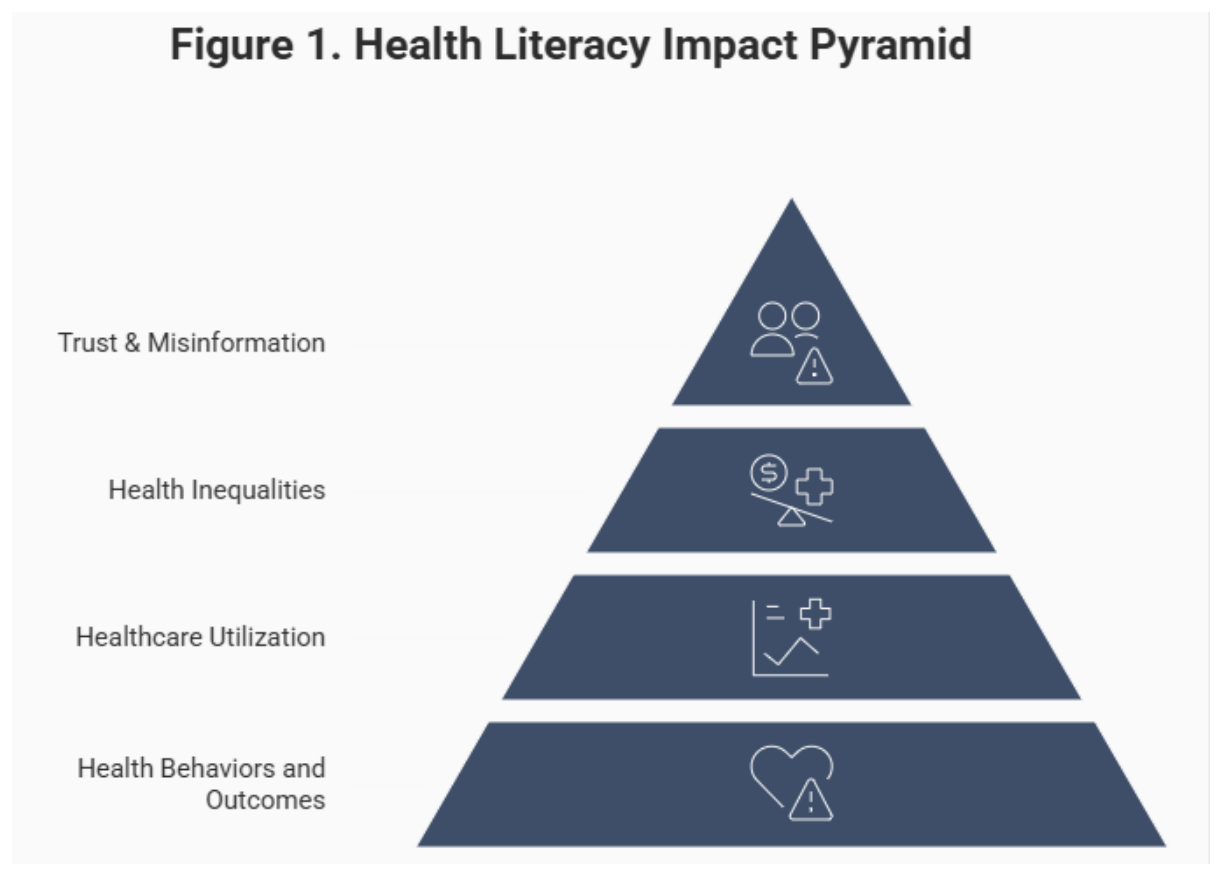
Low levels of health literacy in Eastern Europe are consistently associated with adverse health behaviors and outcomes. Multiple studies indicate that individuals with inadequate understanding of basic health principles are less likely to engage in preventive behaviors such as regular physical activity, healthy diet, smoking cessation, or routine medical screening [10–12]. In terms of outcomes, countries with lower health literacy scores tend to report higher rates of obesity [13,14], undiagnosed or poorly controlled diabetes [15,16], or avoidable mortality, particularly from cardiovascular diseases and certain cancers [17–19]. These findings are supported by a systematic review of observational studies conducted between 1980 and 2003 that concluded the significant correlation between low literacy and poorer health behaviors and outcomes [20].
In relation to diet, health literacy has been shown to have a substantial impact. The study by Stefler et al. analyzed dietary intake within the Health, Alcohol and Psychosocial Factors in Eastern Europe (HAPIEE) cohort study, concluding that decreased literacy in nutrition and awareness contributes to widespread unhealthy eating behaviors, which are strongly associated with higher all-cause and cardiovascular mortality [21]. Furthermore, the issue of diet-related health literacy is also expanding within families, where children’s habitual systems are significantly related to parental health literacy [22].
Another health outcome associated with health literacy is regular physical activity. In European countries, health literacy is linked to reduced physical activity, as demonstrated in the study by Mrazek et al. By comparing a country from Western Europe (Germany) with one from the East (Russia), they concluded that Western Europeans are more health- and body-conscious, internally motivated, and actively engage in sports and physical activity. In contrast, Eastern Europeans are less health-conscious, more externally motivated and engage less in physical activity [23]. These findings are further supported by a study conducted on the Bulgarian population, in which only 38% of adults reported engaging in regular physical activity, well below the EU average [24].
Low health literacy is associated with delayed presentation to medical services, reliance on emergency care, and inappropriate use of health resources. The study by Rasu et al., involving 22,599 participants, concluded that decreased health literacy is associated with increased healthcare utilization and expenditure, with a significant portion of the costs attributed to prescriptions [25]. Another study focused on this topic, establishing a correlation between health literacy and a higher likelihood of utilizing emergency departments for non-urgent conditions [26]. In terms of financial resources, health literacy is correlated with inappropriate healthcare utilization and inadequate patient follow-up, which may be associated with deteriorating health outcomes and ultimately, increased healthcare costs [27].
Furthermore, the uptake of preventive services remains critically low in many Eastern European countries. Regarding cervical cancer screening, research indicates reduced engagement in Eastern European countries, where health literacy is lower. A study conducted in Serbia reported that screening coverage varies between 35% and 68% across different regions [28]. Similarly, in Romania, a national colorectal cancer screening program remains absent, with only EU-funded regional pilot programs initiated since 2019 covering a limited proportion of the population, despite high incidence rates [29,30].
The research conducted by Andreeva et al. on Eastern European immigrant women underscores that a primary challenge in preventive medicine and cancer screening is health literacy, specifically the inadequate knowledge regarding early disease detection, regardless of the host country [31].
The burden of low medical education is unevenly distributed, disproportionately affecting rural populations, ethnic minorities, older adults, and those with lower socioeconomic status [32]. In Moldova and Ukraine, rural residents were found to have significantly lower awareness of chronic disease risk factors and lower participation in vaccination or screening programs [33,34]. On the other hand, Roma populations in several countries remain especially vulnerable: studies from Slovakia and Romania report significantly higher rates of communicable diseases and lower vaccination coverage among Roma children—often due to a combination of poor education, marginalization, and distrust in institutions [35–38].
Vulnerable populations—particularly rural residents, ethnic minorities, and low-income groups—bear a disproportionate burden of inadequate medical education. While some nations have implemented targeted health promotion initiatives, these efforts often lack sustainability, funding, and evaluation. In countries such as Romania and Bulgaria, public health campaigns remain fragmented and reactive rather than strategic and evidence-based [35,39].
Perhaps one of the most socially disruptive consequences of low public health literacy is the proliferation of health misinformation and the erosion of trust in medical authorities. During the COVID-19 pandemic, misinformation about vaccines, treatments, and the virus itself spread rapidly, with Eastern European countries being among the hardest hit.
By mid-2022, vaccination rates remained below 50% in Bulgaria and Romania, and excess mortality rates were among the highest in the EU [8]. In a study from 2024 that analyzed 2020–2022 Standard Eurobarometer datasets, only 52% to 66% of citizens in Eastern European countries expressed trust in their national health institutions, compared to 78% to 97% in Central and Western Europe. This placed countries such as Romania, Hungary, Greece, and Bulgaria among the lowest in the EU in terms of public trust in healthcare systems [38].
Low trust in health authorities is associated with refusal of vaccines, preference for alternative or unproven treatments, and resistance to public health regulations. A key theme emerging from the literature is the interplay between low health literacy and distrust in healthcare systems. This dynamic creates a vicious cycle: populations with a poor understanding of health information are more vulnerable to misinformation, less likely to follow medical advice and more prone to avoid preventive care. In turn, low engagement with the healthcare system is plausibly linked to poorer health outcomes, further eroding trust and increasing skepticism. This was particularly evident during the COVID-19 pandemic, which served as a real-time stress test for public health communication and education infrastructures [4,8].
The findings synthesized in this review point to a consistent and multifaceted association between inadequate health literacy and adverse social, behavioral, and systemic outcomes across Eastern Europe. The following sections contextualize these findings within the broader structural and historical landscape of the region, identify key research gaps, outline practical implications for clinical practice, and acknowledge the limitations of the present review.
The findings of this review clearly demonstrate that inadequate health literacy in Eastern Europe is associated with a wide range of negative social and health outcomes. From preventable morbidity and mortality to systemic inefficiencies and widening health inequalities, the impact of poor health literacy is both multifaceted and profound. Importantly, one of the causes of this outcome is the legacy of the post-communist transition that still casts a long shadow. Many Eastern European states inherited under-resourced health systems, limited public health expertise, and low institutional transparency. As a result, public health education has historically been under-prioritized in policy agendas, with greater focus placed on curative rather than preventive care. Despite EU membership and access to structural funds, progress remains uneven and hampered by bureaucratic and political instability [39,40].
It should also be acknowledged that Eastern Europe is not a homogeneous region. Countries vary considerably in terms of economic development, healthcare system structure, cultural context, EU membership status, and the availability of health literacy data. Well-documented cases such as Romania, Bulgaria, and Poland contrast with countries such as Moldova, Ukraine, or Albania, for which peer-reviewed evidence on health literacy remains scarce.
| Domain | Clinical Implication | Recommended Action | Relevance for Eastern Europe |
|---|---|---|---|
| Patient Assessment | Low health literacy is frequently undetected in routine clinical encounters | Implement routine health literacy screening using validated tools (e.g., SILS, BHLS) in primary care settings | Brief patient-provider interactions and acute- focused consultations make systematic screening particularly important |
| Clinical Communication | Patients with low health literacy may not understand diagnoses, treatment plans, or medication instructions | Adopt plain language communication; use the teach-back method; provide written materials at an accessible reading level | Cultural norms of deference toward medical authority may prevent patients from asking clarifying questions |
| Vaccine Hesitancy and Misinformation | Low health literacy increases vulnerability to misinformation and vaccine refusal | Engage patients in non- judgmental, motivational conversations about vaccination, preventive care, and cancer screening | Documented erosion of institutional trust in the region makes clinician-patient dialogue a critical point of intervention |
| Culturally Adapted Patient Education | Standard health education materials may be inappropriate for ethnic minority or low-literacy populations | Develop locally adapted materials; involve community health mediators, particularly for Roma and other marginalized groups | Significant ethnic minority populations in Romania, Slovakia, Bulgaria, and other countries require targeted, culturally sensitive approaches |
| Healthcare Provider Training | Health literacy is only partially integrated into medical and nursing curricula in Eastern Europe | Incorporate health literacy competencies into undergraduate medical education and continuing professional development programs | Systematic training is needed to prepare clinicians for the communicative demands of health-literate care across the region |
SILS= Single Item Literacy Screener, BHLS= Brief Health Literacy Screen
The literature also points to a lack of coordinated, region-specific research. While several cross-sectional studies highlight the magnitude of the problem, there is a notable scarcity of longitudinal or intervention-based research evaluating the effectiveness of public education programs. Moreover, national health literacy assessments are rarely standardized, making comparisons and benchmarking difficult [32,41].
The findings of this review carry important practical implications for healthcare professionals working in Eastern European settings. Clinicians occupy a frontline position in identifying and responding to low health literacy, and their role extends well beyond diagnosis and treatment. Table 1 summarizes the key domains of clinical relevance, together with recommended actions and their specific applicability to the Eastern European context.
Despite the major challenges that health literacy implies in Eastern European countries, there are emerging opportunities for improvement. International collaborations (e.g., WHO Europe, EU4Health), digital health tools, and school-based health education programs have shown promise in increasing health awareness and shaping healthy behaviors. Slovenia has developed a nationally scaled community-based health promotion model, establishing Health Promotion Centers across the country to increase health literacy at the primary care and community level. Poland has recently introduced structured health education as a dedicated school subject, signaling a policy shift towards embedding health literacy in formal education. While these represent promising examples, their long-term effectiveness and potential for regional adaptation remain to be fully evaluated. [42,43].
Overall, there is an urgent need for strategic, long-term investment in public medical education as a cornerstone of health system resilience and social cohesion. Addressing this issue requires a multi-sectoral approach involving healthcare providers, educators, policy-makers, media, and civil society. These include: investing in comprehensive, evidence-based health literacy programs, starting from school and continuing throughout adulthood; improving communication strategies by using accessible, culturally appropriate messaging across traditional and digital platforms; training healthcare providers to recognize and respond to low health literacy in clinical settings, and supporting research and evaluation to monitor the effectiveness of public education initiatives [44–46].
Crucially, these efforts must be tailored to the specific cultural, economic, and historical contexts of Eastern European societies. A one-size-fits-all approach is unlikely to succeed; instead, collaborative, interdisciplinary strategies grounded in local realities are essential.
Improving public health education is not merely a health sector responsibility—it is a cross-cutting issue that affects education, labor, social welfare, and democratic participation. Addressing it meaningfully has the potential to transform not only healthcare outcomes, but the overall well-being and resilience of societies across Eastern Europe.
Digital transformation in healthcare presents a unique opportunity to strengthen health literacy across Europe. Through mobile health applications, telemedicine platforms, and patient portals, individuals can access personalized health information, monitor key parameters, receive alerts, and communicate directly with healthcare providers. Research on digital health literacy—defined as the ability to seek, find, understand, and apply health information in digital environments—shows that it is now a critical determinant of whether technology translates into better health outcomes [47].
Expanding these tools in Eastern European populations could empower citizens to take a more active role in disease prevention and self-management, helping to close long-standing information and access gaps.
At the policy level, the European Union has positioned digitalization as a key pillar of public health reform. The EU4Health Program (2021–2027) aims to enhance health system resilience, improve digital infrastructure, and promote e-health and health literacy initiatives across Member States [48]. Complementing this, the European Health Data Space (EHDS) establishes a unified framework for citizens’ access to their health data and secure data sharing between Member States [49]. Together, these initiatives lay the groundwork for a digital ecosystem where informed citizens, interoperable data systems, and evidence-based policymaking can mutually reinforce one another, reducing inequities in health information and outcomes.
Nevertheless, the success of digital transformation depends on ensuring equitable access and adequate digital competencies among all population groups. Without deliberate efforts to improve digital and health literacy, technological advances risk widening existing inequalities. Studies emphasize the importance of user-friendly design, plain language communication, and inclusive training for patients and healthcare workers to prevent digital exclusion [50]. Therefore, digital transformation must be accompanied by education, outreach, and accessibility measures tailored to local contexts.
Several limitations of this review should be acknowledged. First, the search was restricted to English-language publications, which may have led to the exclusion of relevant studies published in Eastern European languages. This can potentially introduce a language bias and underrepresent locally conducted research. Second, the evidence base combines peer-reviewed studies with grey literature, including institutional reports and policy documents from organizations such as WHO Europe, Eurostat, and the OECD. While this approach was adopted deliberately to capture the full scope of available evidence in a field where peer-reviewed data are sometimes limited, grey literature sources are subject to less rigorous methodological scrutiny than peer-reviewed publications. Third, no formal quality appraisal tool was applied to the included sources, as is consistent with the narrative review methodology. However, this means that studies of varying methodological quality may have been weighted similarly in the synthesis. Fourth, the heterogeneity of study designs, populations, and outcome measures across the included sources precluded quantitative synthesis and limits the comparability of findings across countries and contexts. These limitations should be considered when interpreting the conclusions of this review, and future research would benefit from more standardized, longitudinal approaches to assessing health literacy and the effectiveness of public medical education interventions across Eastern Europe.
This review highlights the substantial social burden posed by inadequate health literacy among the general population in Eastern European countries. Low levels of health literacy are consistently associated with poor health behaviors, underutilization of preventive services, delayed care-seeking, and a higher prevalence of preventable diseases. These challenges are further amplified by systemic distrust in health institutions and the rapid spread of health misinformation, especially during public health crises.
In many countries across the region, the consequences of poor health education are not merely individual- they are societal. The cumulative effect of millions of people misunderstanding, ignoring, or distrusting medical advice may place unsustainable pressure on healthcare systems, widen existing health inequalities, and undermine national efforts to improve public health outcomes.
The authors declare no conflict of interest.
This research received no external funding.
During the preparation of this manuscript, the authors used Claude by Anthropic for grammar, structure, spelling, punctuation, and formatting, and Napkin.ai for figure editing. The authors have reviewed and edited the output and take full responsibility for the content of this publication.
Conceptualization, D.N.P. and A.C.P.; methodology, O.A.; validation, D.N.P., A.C.P., and O.A.; formal analysis, A.D.; investigation, A.C.P and A.D.; data curation, A.P.; writing— original draft preparation, A.C.P. and A.D.; writing—review and editing, O.A. and A.P.; visualization, D.N.P.; supervision, O.A.; project administration, D.N.P.; All authors have read and agreed to the published version of the manuscript.
Not applicable
Not applicable.