
Cardiovascular disease (CVD), chronic kidney disease (CKD), type 2 diabetes (T2D), and cancer are leading causes of morbidity and mortality worldwide [1-6]. CKD affects approximately 37 million people in the United States, with an estimated 726,000 individuals living with end-stage renal disease (ESRD). The annual incidence of ESRD exceeds 350 cases per million population. Although a slight decline in prevalence has been observed in recent years, CKD remains a major public health concern, particularly among older adults and individuals of African American and Hispanic descent [7-10]. While these conditions are often studied separately, they frequently coexist due to shared risk factors such as hyperglycemia, hypertension, and obesity, as well as complex organ crosstalk and overlapping pathophysiological mechanisms [11-14]. A key factor driving disease progression in this context is dysregulation of the renin–angiotensin–aldosterone system (RAAS), which leads to hemodynamic alterations, sodium retention, and systemic inflammation [12,15]. RAAS inhibitors (RAASi), including angiotensin-converting enzyme inhibitors (ACE inhibitors), angiotensin receptor blockers (ARBs), and direct renin inhibitors, have become essential in the management of hypertension, CKD, and heart failure, particularly in patients with albuminuria [16-21].
More recently, sodium–glucose cotransporter 2 inhibitors (SGLT2i) have gained recognition for their cardio-renal protective effects, initially demonstrated in patients with diabetes. Beyond glycemic control, these agents reduce intraglomerular pressure, proteinuria, and systemic blood pressure, providing significant benefits for patients both with and without diabetes [5,12,19,22,23]. By blocking glucose reabsorption in the proximal tubule, SGLT2i increase urinary glucose excretion through a mechanism that is independent of insulin secretion [19]. An emerging therapeutic strategy involves combining RAASi with SGLT2i in order to exploit their complementary mechanisms of action [24,25]. Preclinical and clinical studies suggest potential synergistic effects between these two drug classes. For example, SGLT2i have been shown to modulate RAAS activity [26] and to enhance antifibrotic effects when used alongside RAASi, as reflected by decreased endotrophin levels [27]. Additionally, SGLT2i may initially activate but subsequently attenuate tubular RAAS pathways and sympathetic nervous system activity [28-30]. Real-world evidence further supports the usefulness of this therapeutic combination. In the Indian SGRASS-DKD study, combination therapy improved blood pressure control and was well tolerated, despite mild electrolyte changes [31]. Vart al. also demonstrated prolonged renal survival and lower mortality in non-diabetic CKD patients with proteinuria treated with both agents, even in the setting of suboptimal treatment adherence [32].
The aim of our retrospective study was to evaluate the clinical and biochemical effects of combined therapy with RAASi and SGLT2i in a cohort of patients with CKD.
This retrospective observational study was conducted at a single nephrology center between August 2025 and February 2026. The medical records of 73 patients diagnosed with CKD according to the KDIGO 2012 guidelines were retrospectively reviewed. Of these, 54.79% had T2D and 68% had hypertension.
Participants met the following inclusion criteria: an estimated glomerular filtration rate (eGFR) between 25 and 60 mL/min/1.73 m² with any stage of albuminuria—A1 (≤30 mg/g), A2 (30–299 mg/g), or A3 (≥300 mg/g), based on the urinary albumin-to-creatinine ratio (UACR)—or an eGFR greater than 60 mL/min/1.73 m² with UACR >30 mg/g (A2 or A3).
All patients had been receiving treatment with RAASi, including angiotensin-converting enzyme inhibitors (ACEi) or angiotensin receptor blockers (ARBs), at the maximum tolerated dose for at least one year prior to study inclusion.
Patients were excluded if key clinical or biochemical data were missing or if they experienced major therapeutic changes unrelated to the study treatments (SGLT2i or RAASi).
Baseline evaluation (T0) was performed at the start of combined therapy with RAASi and SGLT2i (dapagliflozin-DAPA). Follow-up evaluation (T1) was conducted six months after initiating dual therapy [33].
Biochemical samples were collected at both time points (T0 and T1). The following parameters were assessed: urinary albumin-to-creatinine ratio (UACR, mg/g) obtained from a spontaneous urine sample, preferably first morning urine; estimated glomerular filtration rate (eGFR) calculated using the CKD-EPI 2021 equation; urinary albumin and urinary protein from 24-hour urine (standardized collection protocol) in a subset of the 73 enrolled patients; serum creatinine (mg/dL); and hemoglobin (g/dL).
The study protocol was approved by the hospital Ethics Committee of Sf. Ioan Clinical Emergency Hospital, Bucharest, Romania (Approval No. 2023/14.02.2025). The study was conducted in accordance with the Declaration of Helsinki. Written informed consent was obtained from all participants prior to inclusion in the study.
Normality testing indicated a non-parametric distribution for most variables. Therefore, continuous data are reported as median (Q1–Q3). Hemoglobin values at T0 and T1 were normally distributed and are presented as mean ± standard deviation, while the paired differences were analyzed using non-parametric tests.
Descriptive statistics for the study parameters at baseline (T0) and follow-up (T1) are presented in Table 1. Sample size varied across parameters due to missing data (albuminuria: n = 11; proteinuria: n = 10; UACR, eGFR, and creatinine: n = 73; hemoglobin: n = 70).
| Parameter | T0 | T1 | Δ(T0-T1) |
|---|---|---|---|
| Age (years) | 70.0 (62.50–75.00) | — | — |
| eGFR (mL/min/1.73 m²) | 45.81 (36.23–57.51) | 46.09 (36.72–57.04) | 2.15 (−3.18–6.20) |
| Creatinine (mg/dL) | 1.41 (1.14–1.79) | 1.35 (1.10–1.90) | −0.03 (−0.17–0.10) |
| Albuminuria (mg/24h) | 523.30 (314.00–1015.00) | 260.80 (120.00–1224.00) | −206.00 (−527.40– −40.00) |
| Proteinuria (mg/24h) | 602.35 (384.98–1274.70) | 329.75 (179.75–1863.15) | −241.95 (−360.10– −56.85) |
| UACR (mg/g) | 119.45 (17.92–590.09) | 56.00 (8.95–244.45) | −43.00 (−152.00– −3.33) |
| Hemoglobin (g/dL) | 12.76±1.70 | 13.19±1.78 | 0.20 (−0.50–1.03) |
Sample size varied across parameters due to missing data (Albuminuria: n = 11; Proteinuria: n = 10; UACR / eGFR / Creatinine: n = 73; Hemoglobin: n = 70).
Changes in renal parameters between baseline (T0) and follow-up (T1) were assessed using the Wilcoxon signed-rank test (Table 2).
| Parameter | Z | p value | Interpretation |
|---|---|---|---|
| eGFR | −1.427 | 0.154 | NS |
| Creatinine | −0.857 | 0.391 | NS |
| Albuminuria | −1.956 | 0.050 | Borderline ↓ |
| Proteinuria | −1.784 | 0.074 | NS trend ↓ |
| UACR | −5.981 | <0.001 | Significant ↓ |
A statistically significant reduction was observed in UACR values between baseline and follow-up (Z = −5.981, p < 0.001). Albuminuria showed a borderline significant decrease (Z = −1.956, p = 0.050), while proteinuria demonstrated a non-significant downward trend (p = 0.074). No statistically significant changes were observed in eGFR (p = 0.154) or serum creatinine levels (p = 0.391).
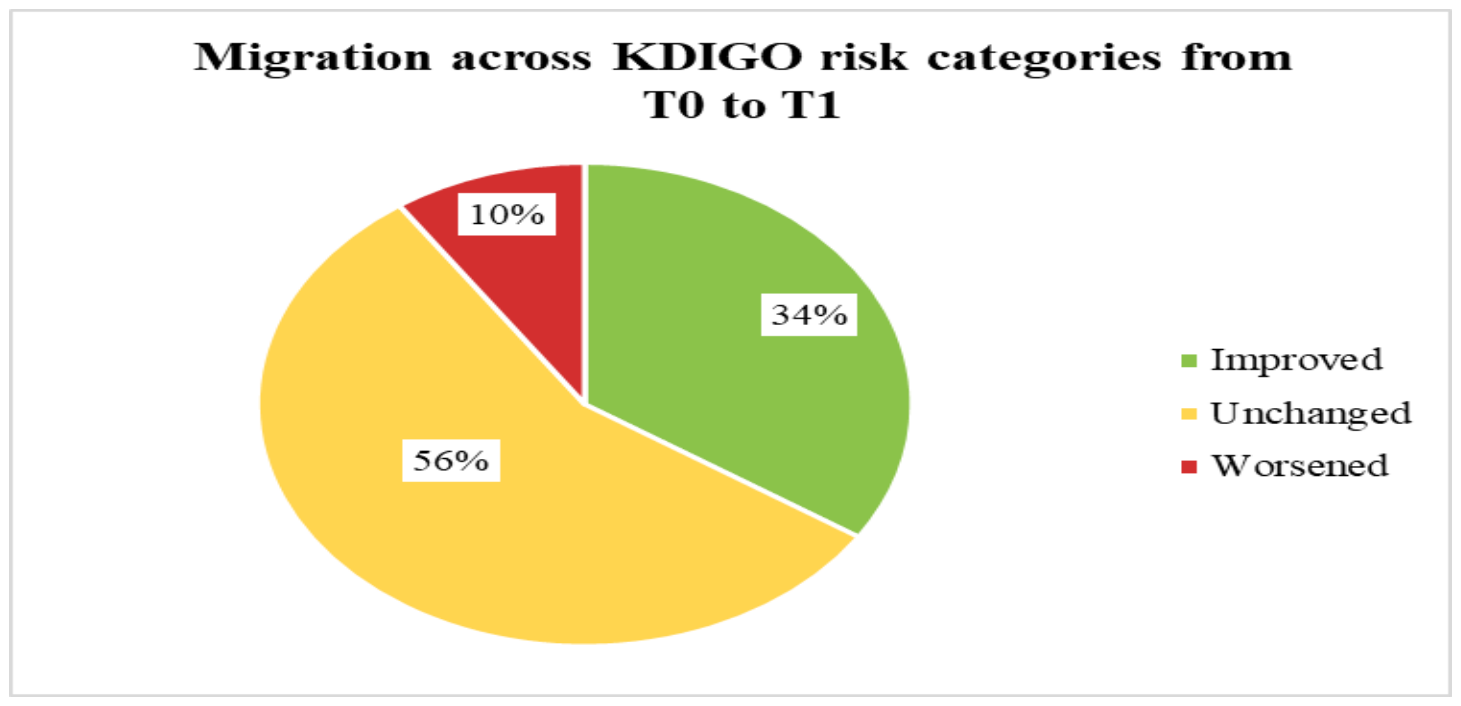
Migration of patients across KDIGO risk categories between baseline and follow-up is presented in Table 3 and Figure 1.
| CKD_Stage_T0 | Low (CKD_Stage_T1) | Moderate (CKD_Stage_T1) | High (CKD_Stage_T1) | Very high (CKD_Stage_T1) |
|---|---|---|---|---|
| Low | 0 | 0 | 0 | 0 |
| Moderate | 3 | 9 | 4 | 0 |
| High | 3 | 8 | 9 | 3 |
| Very high | 0 | 3 | 8 | 23 |
Improvement in KDIGO risk category was primarily driven by reductions in albuminuria rather than changes in eGFR. Risk category migration analysis showed that 34% of patients improved their KDIGO risk class, 56% remained unchanged, and 10% experienced worsening between T0 and T1. In Table 3, cell background colors illustrate risk category migration, with green indicating improvement, orange indicating worsening, and yellow indicating no change.
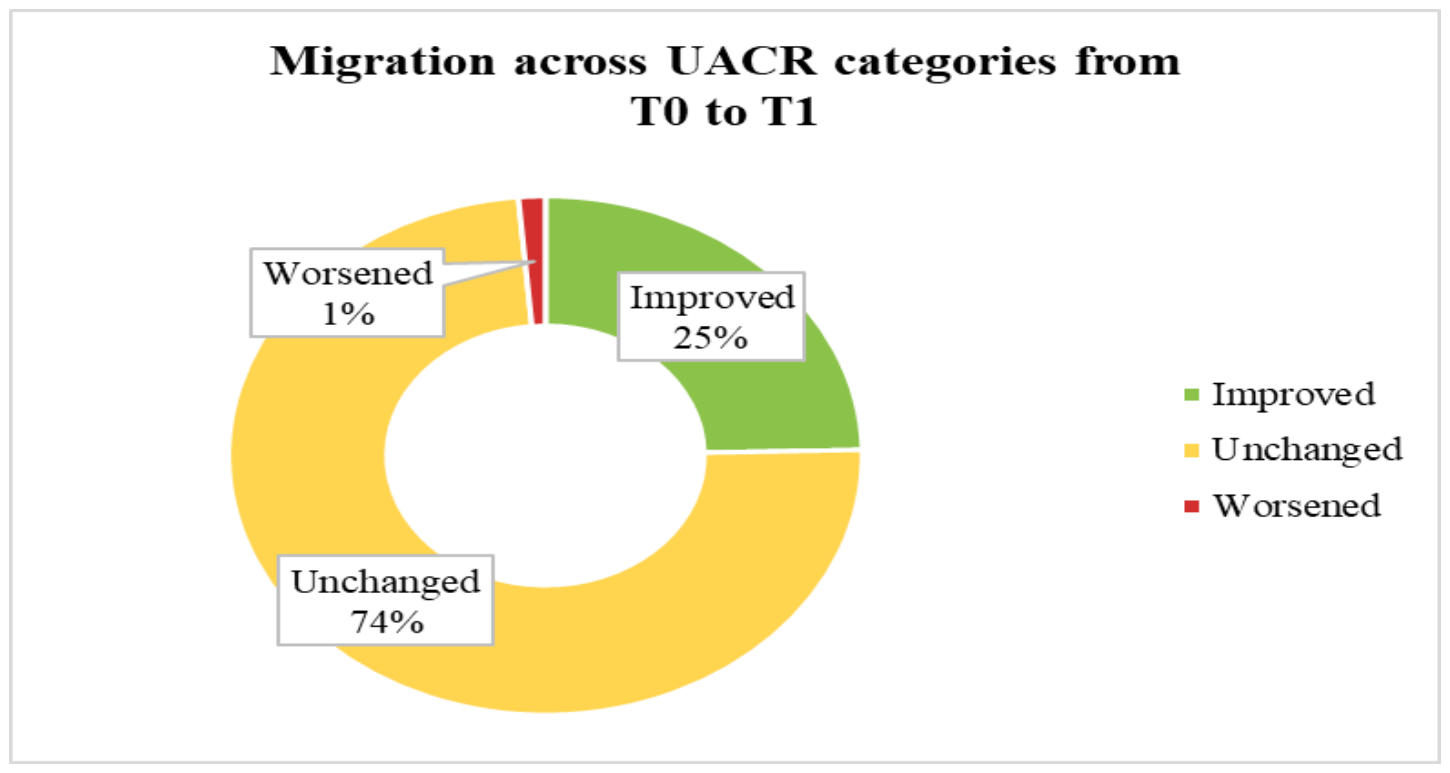
Migration across UACR categories is shown in Table 4 and Figure 2.
| UACR T0 | A1 (UACR T1) | A2 (UACR T1) | A3 (UACR T1) | Total |
|---|---|---|---|---|
| A1 | 21 | 0 | 0 | 21 |
| A2 | 11 | 17 | 1 | 29 |
| A3 | 0 | 7 | 16 | 23 |
| Total | 32 | 24 | 17 | 73 |
Reduction of UACR category was observed in approximately one-quarter of patients, with minimal progression. Improvement occurred predominantly among patients with moderate to severe baseline albuminuria. Notably, no patient in the A1 category progressed to a higher albuminuria stage.
Overall, 25% of patients improved their UACR category, 74.0% remained stable, and only 1.% experienced worsening between T0 and T1.
The relationship between KDIGO risk migration and changes in UACR is presented in Table 5.
| ΔRisk ΔUACR | UACR worsened | UACR unchanged | UACR improved | Total |
|---|---|---|---|---|
| Risk worsened | 0 | 7 | 0 | 7 |
| Risk same | 1 | 36 | 4 | 41 |
| Risk improved | 0 | 10 | 9 | 19 |
| Risk improved ≥2 | 0 | 1 | 5 | 6 |
| Total | 1 | 54 | 18 | 73 |
Cross-tabulation analysis showed that more than half of patients who improved their KDIGO risk category also exhibited a reduction in UACR. In contrast, risk worsening was not associated with progression of albuminuria, suggesting that other factors contributed to deterioration in risk classification.
Among patients who experienced KDIGO risk migration (n = 32), changes in albuminuria category contributed to 43.8% of transitions, whereas 56.2% occurred without UACR modification, suggesting that risk reclassification was predominantly driven by changes in eGFR (Table 6).
| Indicator | N | % |
|---|---|---|
| KDIGO migration total | 32 | 100% |
| + UACR migration | 14 | 43.8% |
| Without UACR change | 18 | 56.2% |
The association between KDIGO risk migration and changes in eGFR categories is presented in Table 7.
| ΔCKD_Risk (T0-T1) | -2.00 | -1.00 | .00 | 1.00 | 2.00 | Total |
|---|---|---|---|---|---|---|
| -1 | 0 | 7 | 0 | 0 | 0 | 7 |
| 0 | 2 | 6 | 30 | 3 | 0 | 41 |
| 1 | 0 | 1 | 9 | 9 | 0 | 19 |
| 2 | 0 | 0 | 0 | 5 | 1 | 6 |
| Total | 2 | 14 | 39 | 17 | 1 | 73 |
Cross-tabulation analysis demonstrated that KDIGO risk migration was predominantly associated with changes in eGFR stage. Among patients who experienced risk category changes, 72% also showed a shift in eGFR stage, highlighting glomerular filtration dynamics as a major determinant of global risk classification.
Changes in eGFR stage represented the primary driver of KDIGO risk migration, while changes in albuminuria category contributed to a lesser extent (Table 8).
| Driver | Contribution to risk migration |
|---|---|
| eGFR change | 72% |
| UACR change | 56% |
Transitions across eGFR stages between baseline and follow-up are presented in Table 9 and Figure 3.
| eGFR_cat_T0 | G1 (eGFR_cat_T1) | G2 (eGFR_cat_T1) | G3a (eGFR_cat_T1) | G3b (eGFR_cat_T1) | G4 (eGFR_cat_T1) | G5 (eGFR_cat_T1) | Total |
|---|---|---|---|---|---|---|---|
| G1 | 3 | 1 | 0 | 0 | 0 | 0 | 4 |
| G2 | 1 | 6 | 2 | 0 | 0 | 0 | 9 |
| G3a | 0 | 5 | 12 | 7 | 2 | 0 | 26 |
| G3b | 0 | 0 | 9 | 11 | 3 | 0 | 23 |
| G4 | 0 | 0 | 1 | 2 | 7 | 1 | 11 |
| Total | 4 | 12 | 24 | 20 | 12 | 1 | 73 |
Analysis of eGFR stage transitions showed heterogeneous changes across categories. Most patients remained within the same stage, while a smaller proportion improved or worsened their eGFR staging over time.
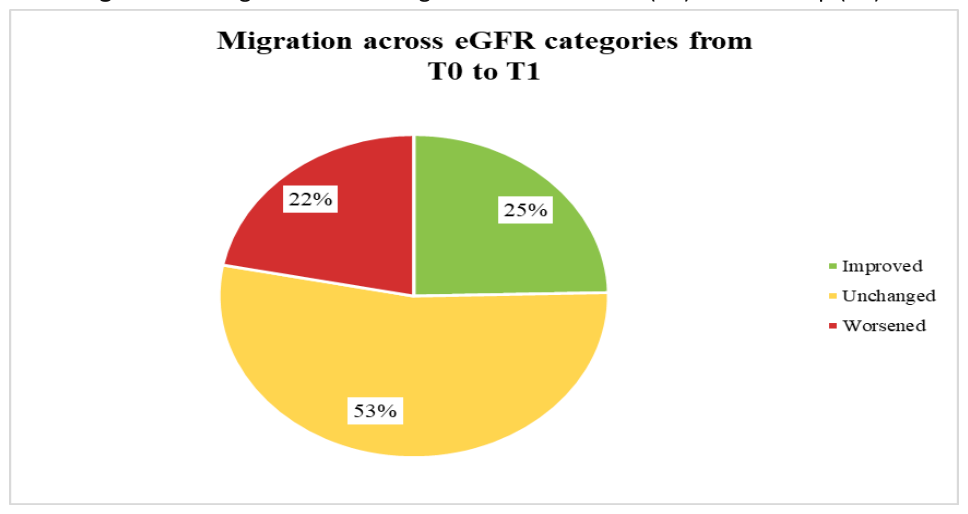
Overall, 53% of patients remained in the same eGFR stage, 25% showed improvement in their eGFR category, and 22% experienced worsening between T0 and T1.
Comparative migration across KDIGO risk, albuminuria (UACR), and eGFR categories is summarized in Table 10.
| Indicator | Improved | Stable | Worsened |
|---|---|---|---|
| KDIGO risk | 34% | 56% | 10% |
| Albuminuria | 25% | 74% | 1% |
| eGFR | 25% | 53% | 22% |
Proportion of patients demonstrating improvement, stability, or worsening across three renal risk indicators (KDIGO risk category, UACR category, and eGFR stage) between baseline (T0) and follow-up (T1). Overall, according to KDIGO, risk showed the highest proportion of improvement, while albuminuria remained largely stable, and eGFR demonstrated the greatest bidirectional variability.
Overall, the analysis of renal parameters and category migration patterns indicates that combined SGLT2i and RAASi therapy was associated with a predominantly stable or favorable renal trajectory over the six-month follow-up period.
Improvements were most evident in albuminuria-related parameters, with a significant reduction in UACR and a borderline decrease in 24-hour urinary albumin levels in a subset of patients. Migration analysis also demonstrated that one-third of patients improved their KDIGO risk category, while the majority remained stable. Changes in overall KDIGO risk classification were mainly driven by changes in eGFR stage (eGFR), although reductions in albuminuria/24 h also contributed to risk reclassification in a subset of patients. Taken together, these findings suggest that dual therapy may contribute to the stabilization of renal function and partial regression of renal risk markers in patients with CKD.
This retrospective study evaluated the effects of combined sodium–glucose cotransporter-2 inhibitor and RAAS inhibitor therapy in patients with CKD over a six-month follow-up. Overall, the results indicate a mostly positive renal profile, marked by a significant reduction in UACR and a borderline decrease in albuminuria in some patients. Renal filtration markers remained largely unchanged, with no significant differences in eGFR or serum creatinine. Migration analyses further revealed that one-third of patients improved their KDIGO global risk category, while the majority stayed the same. Changes in risk classification were mainly due to shifts in eGFR stage, although reductions in albuminuria also played a role in risk improvement for some patients.
Clinical studies have shown that inhibitors of the RAAS decrease proteinuria, reduce renal fibrosis, and slow the decline of kidney function, thereby protecting the kidneys in both early and advanced stages of CKD [15]. SGLT2i were first approved by the U.S. Food and Drug Administration (FDA) for treating T2D. SGLT2 is mainly expressed in the kidneys, especially on the apical membrane of the S1 and S2 segments of the proximal tubule. By blocking sodium and glucose reabsorption in this area, SGLT2i cause glycosuria and natriuresis, leading to improved blood sugar control and mild to moderate weight loss in patients with T2D [34].
The renoprotective effects of SGLT2i are achieved through multiple mechanisms. First, they indirectly protect renal function by reducing glucose reabsorption, which helps improve metabolic control and promotes weight loss. Second, they directly influence renal hemodynamics by lowering intraglomerular pressure, decreasing diabetes-related hyperfiltration and tubular hypertrophy. These drugs have also been shown to decrease albuminuria and serum uric acid levels without causing significant potassium imbalances. Moreover, mild natriuresis lowers blood pressure, especially systolic pressure, through mechanisms such as afferent arteriolar vasoconstriction, osmotic diuresis, and weight loss. Importantly, the diuretic effect can increase hematocrit and erythropoietin levels by improving tubulointerstitial hypoxia and allowing renal fibroblasts to resume normal erythropoietin production, which contributes to renal protection [29].
Clinical trial evidence has demonstrated that SGLT2i significantly reduce albuminuria in patients with CKD. For example, Oshima et al. reported that treatment with the SGLT2i Canagliflozin reduced UACR by 31% at week 26 and significantly increased the likelihood of achieving a ≥30% reduction in UACR. In patients with T2D and CKD, canagliflozin therapy was associated with early and sustained reductions in albuminuria, which were independently linked to improved long-term renal and cardiovascular outcomes [35].
Similarly, Nakhleh et al. evaluated 354 participants with CKD without diabetes who received SGLT2i and were followed for a median of 527 days. Their results demonstrated a significant increase in eGFR following SGLT2i therapy (p < 0.001), suggesting that these agents may exert renoprotective effects even in non-diabetic populations [36].
Our findings align with these observations. In this study, UACR showed a statistically significant decrease (p < 0.001), while urinary albumin excretion (independent of UACR) experienced a marginal reduction (p = 0.050) after six months of combination therapy. Urinary protein levels (measured in a subset of patients) and serum creatinine also displayed decreasing trends, although these changes did not reach statistical significance. Additionally, eGFR showed a modest increase over the follow-up period, though it was not statistically significant (Tables 1 and 2).
Zhou et al. further demonstrated that SGLT2i can sustainably reduce UACR at multiple time points and delay progression to macroalbuminuria. Moreover, within the first 24 weeks of treatment, SGLT2i therapy may increase eGFR compared with control groups and reduce the risk of incident or worsening nephropathy, including a ≥50% decline in eGFR, doubling of serum creatinine, acute renal failure, and end-stage renal disease. Importantly, these renoprotective effects appear to be largely independent of glycemic control [29].
According to the KDIGO classification, after six months of dual therapy, 34% of patients improved their renal risk category, 56% remained stable, and only 10% experienced worsening, suggesting an overall favorable treatment effect (Table 3 and Figure 1). This improvement appeared to be largely driven by reductions in UACR, rather than by substantial changes in glomerular filtration rate. The low rate of UACR progression, together with the proportion of patients showing improvement, indicates a beneficial nephroprotective effect of therapy even in the absence of major changes in overall KDIGO risk categories. Analysis of albuminuria stages (A1–A3) between T0 and T1 showed improvement in 25% of patients, stability in 74%, and worsening in only 1% (Table 4 and Figure 2).
Reduction in albuminuria is known to be associated with a lower risk of CKD progression, supporting its role as a key marker of renal injury. In several patients, UACR decreased without a formal shift in KDIGO risk category, highlighting the limitations of categorical thresholds in detecting early therapeutic benefits. Conversely, the absence of albuminuria progression in patients with worsening KDIGO risk suggests that deterioration in risk classification was mainly driven by reductions in eGFR (Table 5).
Further analysis indicated that composite KDIGO risk migration reflected multidimensional changes in renal parameters. Albuminuria (UACR) demonstrated greater stability and a very low rate of deterioration, whereas eGFR stages showed greater bidirectional variability, suggesting that glomerular filtration may be more sensitive to short-term clinical or therapeutic fluctuations. These findings indicate that UACR reduction may represent an earlier and more consistent marker of treatment response than changes in filtration parameters (Tables 6 and 10).
Regarding the relationship between KDIGO risk migration and eGFR category changes, cross-tabulation analysis showed that most patients remained in the same risk category, while a smaller proportion experienced improvement or worsening in eGFR stage (Table 7). Overall, changes in eGFR stage represented the primary driver of KDIGO risk shifts, accounting for approximately 72% of transitions, while reductions in albuminuria contributed to 56% of improvements (Table 8).
Migration analysis revealed heterogeneous patterns across the evaluated renal risk indicators. Overall, KDIGO risk improved in 34% of patients, remained stable in 56%, and worsened in 10%. Albuminuria categories were largely stable, with 74% of patients showing no change, 25% demonstrating improvement, and only 1% experiencing worsening (Table 10).
When assessing renal function based on eGFR, which was available for all patients included in the study, a higher proportion of worsening was observed compared with UACR and overall KDIGO risk categories (Table 10). For instance, among the 26 patients initially classified in stage G3a, seven progressed to stage G3b and two to stage G4. Similarly, among the 23 patients in stage G3b, three advanced to stage G4 (Table 9). Consequently, eGFR stages demonstrated the greatest variability, with 25% of patients improving, 22% worsening, and 53% remaining unchanged (Table 10).
The combination of RAASi with SGLT2i may exert synergistic renoprotective effects by enhancing antifibrotic and antiproteinuric mechanisms through complementary pharmacological pathways (Ksiazek SH). Results from randomized controlled trials suggest that treatment combining angiotensin-converting enzyme inhibitors or angiotensin receptor blockers with SGLT2i in patients with albuminuria CKD, even in the absence of diabetes, may significantly improve kidney failure–free survival [32].
A two-year longitudinal retrospective study by Ngai et al. compared the effects of angiotensin receptor blocker (ARB) monotherapy with those of SGLT2i therapy combined with angiotensin-converting enzyme inhibitors (ACEi) in patients with CKD and diabetes mellitus. The ARB group showed a modest increase in eGFR and a reduction in serum creatinine levels compared with the dual therapy group, while glycated hemoglobin (HbA1c), potassium levels, and blood pressure remained within normal ranges in both groups. Albuminuria remained relatively stable over time, with 60.8% of ARB users and 73.1% of those receiving combined therapy consistently or usually testing negative. Despite the expected additional benefits of SGLT2i/ACEi therapy, ARB monotherapy was associated with slightly better renal function markers and a lower prevalence of severe albuminuria in this cohort [37].
Jongs et al. investigated adult patients with CKD, eGFR between 25 and 75 mL/min/1.73 m² and UACR between 200 and 5000 mg/g, with or without T2D, to evaluate the effects of the SGLT2i Dapagliflozin. Their results demonstrated a significant reduction in albuminuria among patients treated with SGLT2i, including those with preserved or mildly reduced renal function [38].
Another important aspect of SGLT2 inhibitory therapy is its modest impact on lipid metabolism, characterized by reductions in plasma triglyceride levels and increases in the HDL concentration [26,39,40]. SGLT2i may enhance fatty acid oxidation and ketogenesis, which can help reduce oxidative stress and offer additional kidney protection compared to other glucose-lowering treatments [41]. Yen et al. conducted a study comparing the risks of dialysis, cardiovascular events, and mortality between SGLT2i users and non-users among patients with T2D and stage 5 CKD. The authors reported that SGLT2i use was linked to lower risks of dialysis initiation, hospitalization for heart failure, acute myocardial infarction, diabetic ketoacidosis, and acute kidney injury, although no significant differences were observed in all-cause mortality [42]. Therefore, SGLT2i also affect several local and systemic pathways involved in the progression of CKD and cardiovascular disease, further supporting their kidney-protective effects [43].
Furthermore, systematic reviews and meta-analyses including multiple randomized trials in patients with heart failure, CKD, and T2D have demonstrated that SGLT2i slow the decline of eGFR over time and reduce the risk of sustained doubling of serum creatinine, confirming their beneficial impact on renal outcomes across diverse patient populations [44].
Anemia represents one of the most common complications of CKD and results from multiple mechanisms, including erythropoietin deficiency, iron dysregulation, chronic inflammation, bone marrow dysfunction, and nutritional deficiencies [45]. Previous studies have shown that increases in hemoglobin levels, particularly during SGLT2i therapy, are associated with improved outcomes in patients with heart failure and CKD [46]. In our cohort, mean hemoglobin levels increased from 12.76 g/dL at baseline to 13.19 g/dL after six months of dual therapy, although this change did not reach statistical significance (Table 1).
Several limitations of this study should be acknowledged. First, the retrospective observational design may introduce selection bias and limit the ability to establish causal relationships between therapy and outcomes. Second, the study was conducted at a single center with a relatively small sample size, which may restrict the generalizability of the findings to broader CKD populations. In addition, some biochemical parameters, particularly albuminuria and proteinuria measurements, were available only for a subset of patients due to incomplete data collection. The relatively short follow-up period of six months may also limit the ability to fully evaluate long-term renal outcomes and disease progression. Finally, the absence of a control group receiving monotherapy prevents a direct comparison of treatment effects between dual therapy and standard RAAS inhibition alone. Despite these limitations, the study provides valuable real-world insights into the renal effects of combined SGLT2i and RAASi therapy in patients with CKD.
CKD remains a significant global health issue. In this study, patients with CKD who received combined RAASi and SGLT2i therapy for 6 months showed a notable decrease in UACR and urinary albumin excretion over 24h (measured in a subset of patients). Renal filtration markers remained mostly stable, with slight increases in eGFR and hemoglobin levels, and minor decreases in serum creatinine and proteinuria, although these changes did not reach statistical significance. Migration analysis revealed that only a small percentage of patients experienced worsening according to KDIGO risk (10%) or albuminuria category (1%), while a larger proportion stayed stable or improved. Overall, these results suggest that dual therapy with RAASi and SGLT2i may help stabilize renal function and reduce albuminuria-related risk markers in patients with CKD. Further prospective studies with larger groups and longer follow-up are needed to confirm these findings.
The authors declare no conflict of interest. This research received no external funding.
Conceptualization, I.V.; D.M.; C.S.; E.B.; and A.S.; methodology, I.V., D.R.; C.S.; F.T. and L.-F.F.; validation, I.V.; D.R.; F.T.; L.-F.T.; A.S.; C.S.; D.M.; A.B. and O.C.C.; formal analysis, A.S.; C.S.; D.M. and I.V.; investigation, I.V.; F.T.; L.-F.F.; A.S.; O.C.C.; and A.S.; resources, I.V.; A.B.; O.C.C.; and D.R.; data curation, I.V.; E.B.; and C.S.; writing—original draft preparation, I.V.; C.S. and A.S.; writing—review and editing, I.V.; D.M.; C.S.; D.R.; E.B.; A.B.; and A.S.; visualization, I.V.; E.B.; D.R.; F.T.; L.-F.T.; A.S.; C.S.; D.M.; A.B. and O.C.C.; supervision, E.B.; I.V.; C.S. and A.S.; project administration, I.V.; D.M.; and C.S.
The study was conducted in accordance with the Declaration of Helsinki and approved by the hospital Ethics Committee of Sf. Ioan Clinical Emergency Hospital, Bucharest, Romania (Approval No. 2023/14.02.2025).
Informed consent was obtained from all subjects involved in the study. Written informed consent has been obtained from the patient(s) to publish this paper.
No generative AI was used in the production of this article.