
Establishing adequate case management strategies for patients diagnosed with delirium is among the most challenging aspects of liaison psychiatry due to the complexity of the interactions between psychiatric phenomenology and organic pathology. Psychiatrists working in general hospitals are frequently called for consultation by colleagues with different medical specialties to „calm down” patients who suddenly become confused and agitated or, on the contrary, to „wake up” patients who abruptly become nonresponsive to external stimuli. This psychiatric disorder is, however, far from being possible to approach by a single therapeutic method and requires an individualized case conceptualization and treatment. While in some cases, identification and correction of the causal factor(s) are simple and may be conducted promptly, such as in the case of severe dyselectrolytemia or hypoglycemia, in most cases, extensive investigations and multiple interventions are needed before the symptoms of delirium may be adequately managed. In this context, it would be necessary to mention that delirium is frequently deceptive because it can be the final manifestation of multiple organic comorbid conditions and a superficial investigation and treatment of the patient may make his or her prognosis worse. Therefore, psychiatrists should be aware of the intricate etiopathogenesis of delirium and of the necessity to investigate and treat such patients within a multidisciplinary framework. These considerations become more obvious when patients with severe chronic cognitive deterioration are evaluated since their anamnesis is reputedly difficult and the psychiatric exam also is frequently challenging.
Due to the changes in the names and definitions of neurocognitive disorders along the main classifications of psychiatric disorders, edited by the World Health Organization (WHO) and American Psychiatric Association (APA) [1-5], a trans-nosographic analysis is considered necessary to configure the framework of case management in patients affected by these conditions. Although there is a clear tendency to increase the concordance between the APA’s Diagnostic and Statistical Manual of Mental Disorders (DSM) and the WHO’s International Classification of Diseases (ICD) criteria for the diagnosis of psychiatric disorders, there are still important nosographic differences that need to be acknowledged by clinicians due to practical reasons.
Major neurocognitive disorders (MND) are defined, according to the latest editions of the DSM (DSM-5 and 5 TR, published in 2013 and 2022, respectively), by significant cognitive decline compared to the individual’s previous level of performance in at least one cognitive domain; this cognitive impairment has to be supported by concerns reported by the patient, significant caregiver or clinician; also, a substantial deficit in cognitive performance, documented by a quantitative clinical assessment is required [1,2]. Also, significant interference of these cognitive impairments with the individual’s ability to perform independent daily tasks is needed for the diagnosis, and the exclusion of other mental disorders is required as a differential diagnosis in these cases [2]. It is important not to consider the diagnosis of MND in patients who present cognitive impairment exclusively during the periods of delirium [2]. Once the diagnosis of MND is made, the presumed type of disease must be formulated, and the specifiers „with/without behavioral disturbance” and „severity” (mild/moderate/severe) are added [2].
The previous edition, DSM IV-TR, not only used different terminology for MNDs, which were called „dementias”, but also the diagnosis criteria included neurological signs, i.e., aphasia, apraxia, agnosia, and the existence of disturbances in executive functioning, besides the memory impairment [3]. Regarding the ICD-10 and ICD-11, their perspective on the terminology is quite similar, and the term „dementia” is preserved in both editions, but in the latest version of ICD, there is an increased focus on the behavioral or psychological disturbances in dementia (BPDD), which received their own set of codes [5].
According to DSM-5 and 5 TR, to formulate a diagnosis of delirium, the clinician should confirm the existence of a disturbance in attention and awareness, accompanied by disturbances in cognition, i.e., memory, orientation, language, visuospatial abilities, or perception [1,2]. Additionally, this diagnosis requires an abrupt onset (e.g., hours to a few days), a change from the baseline level of attention/awareness, and a tendency towards fluctuation in severity during a single day [1,2]. The clinician must exclude the presence of a preexisting or evolving neurocognitive disorder and the presence of a coma or related conditions [1,2]. DSM-5 and 5 TR also state, as an essential criterion, the evidence supporting the direct causal-ship between a general medical condition, substance withdrawal/intoxication, exposure to a toxin/medication, or multiple etiologies and the symptomatology of delirium [1,2]. There are several specifiers for delirium, i.e., those related to the etiology, specifiers of severity (acute/persistent), and level of behavioral symptoms (hyperactive/hypoactive/mixed level of activity) [1,2].
When comparing the diagnostic criteria for delirium in the DSM-IV TR, DSM-5, and DSM-5 TR, several differences emerge [1-3]. The latest editions emphasize the need for disturbances in attention and awareness to represent a change from baseline, exclude coma from the category of delirium, and recognize the potential for multiple cognitive domains to be impaired by this disorder. Furthermore, both DSM-5 and DSM-5 TR provides a more comprehensive list of etiological types of delirium than does the DSM-IV TR [1-3].
The WHO’s ICD-10 (the 2019 version) specifies that delirium is „an etiologically non-specific organic cerebral syndrome” that is characterized by disturbances of consciousness and attention, perception, thinking processes, psychomotor behavior, emotions, and the sleep-wake rhythm [4]. ICD-10 mentions that the duration of delirium is variable and the degree of severity may be different, from mild to severe [4]. Regarding the possible etiological considerations, ICD-10 includes different codes for delirium not induced by psychoactive substances, in cases where it is not superimposed on dementia, in cases of delirium superimposed on dementia, and contains codes for other types of delirium (e.g., mixed delirium, or post-surgery), and delirium-unspecified; delirium is also a complication of various withdrawal/intoxication states or somatic diseases (e.g., thyroid storm, kidney failure) [4].
The latest edition of the WHO Classification of Diseases (ICD-11) expands the definition of delirium (but preserves the core dimensionsphenomenological description, changes in functionality) and specifies the main differential diagnoses and potential etiologies, i.e., direct physiological effects of a medical condition, direct physiological effects of a substance or medication (including withdrawal), and unknown factors [5]. Residual categories, such as multiple etiological factors and other specific causes, are also coded [5].
The phenomenon of delirium in patients diagnosed with MND is very complex since the relationship between the two pathologies is far from being easy to define in each case. Individuals with MND have an increased risk of delirium onset when compared to the general population, but delirium in itself represents an independent risk factor for developing MND [6]. Also, delirium may be more difficult to diagnose in patients with MND because disentangling cognitive changes and sensorium clouding in a patient with an already deteriorated cognitive status, based on clinical evaluation, is challenging. Even more, confusional episodes appearing in patients with MND can worsen the cognitive decline and the overall functioning level [6]. It must also be mentioned that MNDs associate multiple well-defined psychiatric disorders (e.g., mood, anxiety, psychotic) as well as BPDDs, which creates supplementary difficulties in detecting new-onset cognitive decline due to delirium [7]. These convoluted interactions between delirium and MND are represented in Fig.1., but caution is recommended when interpreting these relationships due to the intricacy of organic and psychological factors (e.g., infectious diseases may trigger delirium, and delirium may, in patients with MND, worsen the psychological long-term evolution, or, a psychological trigger may be responsible for the clouding of sensorium in a patient with MND, which also may worsen the longterm biological evolution of the patient, if the trigger is not properly identified and corrected; also, psychosocial factors may inadvertently worsen a somatic disease that, in turn, may aggravate the preexisting MND).
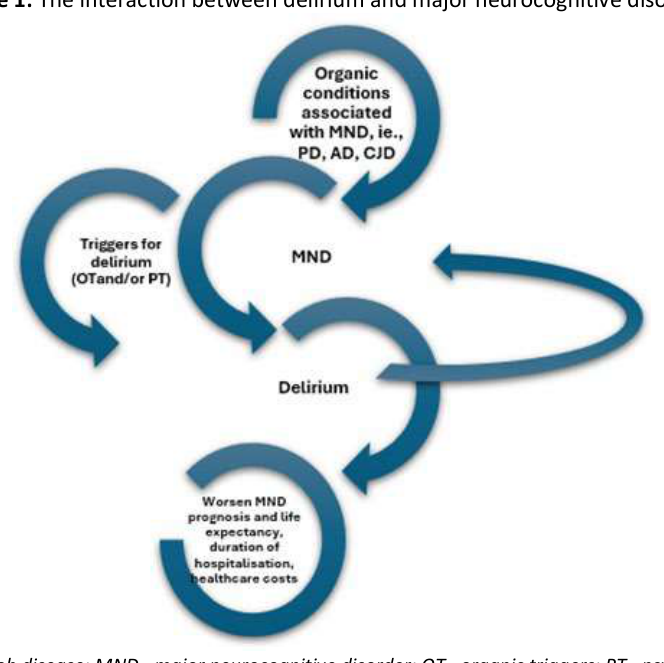
AD= Alzheimer’s disease; CJD= Creutzfeldt-Jakob disease; MND= major neurocognitive disorder; OT= organic triggers; PT= psychological triggers; PD= Parkinson’s disease
Although the phenomenology of delirium encompasses prodromal and subsyndromal stages [8], no consensus about corresponding specific symptoms exists, making it difficult for clinicians to identify such forms of delirium in daily practice. Due to the complexity of the phenomenological presentation of delirium, the differential diagnosis is another important challenge for clinicians [8]. More exactly, delirium consists of core manifestations, which are expected to be present in all cases (e.g., awareness alterations), frequently met symptoms (e.g., motor activity dysfunctions), and associated, variable symptoms (e.g., hallucinations), which may reflect the etiological medical or toxic factors [8]. The evolution of delirium is difficult to predict because it is dependent on etiological factors, but it was reported that almost 57% of hospitalized patients may still have delirium after discharge from the hospital [9].
The reported prevalence in hospitalized patients varies across studies, depending on the criteria used, the type of department reporting the cases, the instruments applied for quantifying the severity of the symptoms, etc. The prevalence of delirium was reported between 1 and 31%, and the incidence between 3 and 25% [10-12]. For example, 39% of the patients admitted to intensive care units (ICUs) were diagnosed with delirium, according to a cross-sectional multicenter study (N=256 participants) that used a he case of 55.4% of the 327 participants using the 3-Minute Diagnostic Confusion Assessment Method (3D-CAM) [9]. A surprisingly high rate of patients with delirium (35.4%) were not identified by the treating team, indicating the need for increased awareness about the existence of this neurocognitive disorder [9]. Also, it is important to explore the possibility of multiple etiologies in patients with delirium, including organic acute diseases, chronic illnesses that are acutely decompensated, new drugs recently introduced for the treatment of a physical or mental disorder, different environmental stressors, etc. [14-16].
The presence of delirium was independently associated with worse clinical prediction of survival, lower quality of life, and increased healthcare costs through longer hospitalizations have been reported in patients with delirium [17-19]. More specifically, an economic analysis of healthcare for older hospitalized patients with or without Alzheimer’s disease and related dementias associated with delirium showed that in the first group, the adjusted mean difference in costs related to delirium was almost 35000 USD, and these costs increased progressively over one year vs. non-MND patients [20]. The same study revealed that patients with Alzheimer’s disease-related MND were more likely to develop delirium (51% vs. 24%) and die within one year (38% vs. 21%), all values being statistically significant [20]. Because delirium is considered a modifiable factor for prognosis in patients with MND and, frequently, a preventable one, the necessity for a correct diagnosis and early treatment, whenever delirium is identified, could have both shortterm and long-term substantial benefits for the MND population. According to a systematic review, the prevalence of delirium superimposed on dementia varies between 22% and 89% in hospitalized patients aged over 65 [21]. Such high prevalence indicates, once again, that there is an acute need to detect and treat delirium actively in vulnerable populations.
This narrative review aims to identify the most valid interventions that could be included in case management for patients with delirium associated with MND. Because it was anticipated that the sources for this specific population might be scarce, the secondary objective included finding case management recommendations for patients with delirium in clinical populations, regardless of the organic or psychiatric background; these supplementary data were explored to see if they allow for being extrapolated to MND + delirium cases.
This review explored three electronic databases (Pubmed, Cochrane, and Web of Science/Clarivate) for primary and secondary sources dedicated to this topic, using as keywords „delirium”, OR „confusional episodes” OR „confusion superimposed on dementia”
AND „major neurocognitive disorder” OR „dementia” AND „pharmacologic” OR „drug” OR „non-pharmacologic” OR „psychosocial”. All papers published in English between the inception of each database and September 2024 were screened for relevant data on pharmacological and non-pharmacological therapies targeting delirium. The results were grouped into two classes: (1) guidelines for patients with delirium in clinical populations and (2) case management for patients with delirium and neurocognitive disorders.
Based on the 36 sources reviewed in the first section, dedicated to delirium case management in clinical populations, and 15 sources (partially overlapping) focused on the evaluation and treatment of delirium superimposed on MND, the following results are presented.
The papers reviewed and grouped in this section were distributed according to their main clinical use, i.e., (1) validated tools for screening and monitoring delirium and (2) therapeutic recommendations, since these two components were considered essential for clinicians to construct a case management plan (Fig.2).
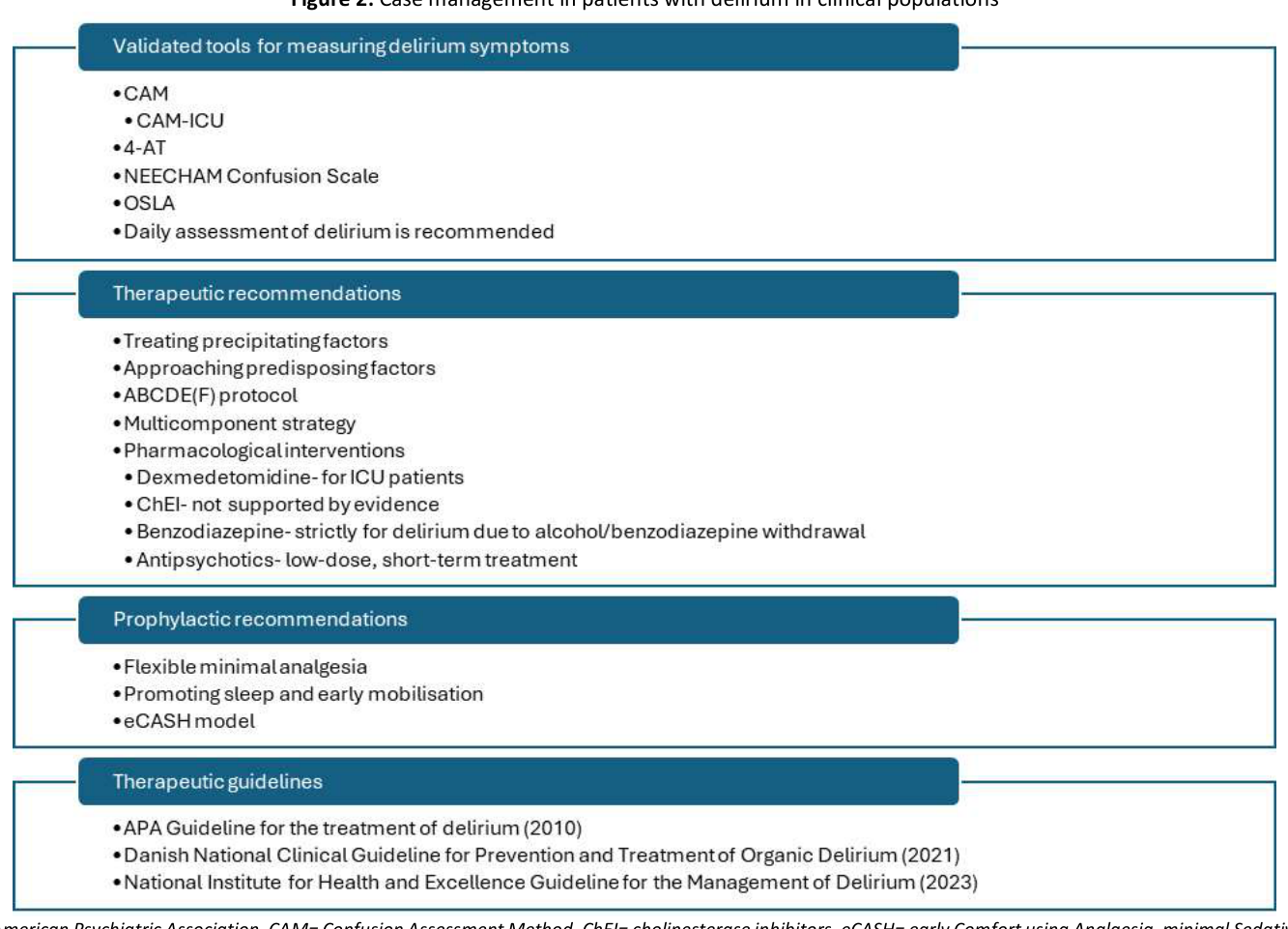
There are many instruments for the diagnosis and monitoring of the presence of delirium, some of them being more widely used and largely validated than others. CAM was developed by an expert panel through a consensus process and has the clear advantage of its brevity and easiness of administration [22]. CAM may be applied in less than five minutes and consists of nine criteria derived from DSM III R, the main symptoms of delirium being acute onset and fluctuating course, lack of attention, disorganized thinking, and altered sensorium [22]. Different versions of this instrument emerged, such as CAM-ICU, which is dedicated to patients admitted to intensive care units and can be administered by non-specialists [23].
4-AT is another tool conceived for the screening of delirium symptoms in elderly patients and demonstrated good sensitivity and specificity for hospitalized subjects [24]. This instrument has four items, i.e., alertness, two items for cognitive function, and one for fluctuation in mental status [24].
The NEECHAM (Neelon and Champagne) Confusion Scale is also used for rapid assessment of delirium and has been proven to have good internal consistency and interrater reliability, and it also correlated well with the Mini-Mental State Examination [25]. This tool has nine scale items, is easy to use, and can be scored by nurses with minimal training. Also, NEECHAM may be administered initially and periodically to monitor mental status [25].
The Observational Scale of Level of Arousal (OSLA) can be used for the identification of abnormal levels of arousal associated with delirium and may be administered for screening and monitoring purposes [26]. The items refer to eye-opening, eye contact, posture, and movement, and the total score is between 0 and 15 [26].
Regarding the therapeutic approaches to delirium, after the diagnosis of an acute confusional state was formulated, the first step is to analyze the potential contributors to the onset of this disorder. Predisposing and precipitating factors must be evaluated, and modifiable etiological factors should be addressed [27]. The case management of patients with delirium has as the main objective the correction of the biological disequilibrium that fueled the confusional state, but the prevention of relapse is also of major interest since several causes may be chronic or recurrent. According to an expert consensus on delirium management, „early identification and intervention of subclinical delirium can reduce the risk of clinical delirium” [28]. Also, daily assessment of at-risk patients is important for early detection of delirium and adequate therapeutic interventions [28].
The most common precipitating factors that should be approached during the evaluation of a patient with delirium are infections, electrolyte imbalances, drugs (medications, drugs of abuse-intoxication/withdrawal, toxic substances), pain, organ failures, traumas, metabolic and nutritional imbalances, central nervous system (CNS) pathologies, environmental factors (e.g., sensorial deficits for patients with neurocognitive disorders, immobilization, sleep-wake cycle dysfunctions), but also psychiatric factors (e.g., anxiety, insomnia or depression in elderly patients with severe organic disease).
The ABCDE/ABCDEF protocol was suggested for managing delirium [29,30]. This acronym stands for (a) assessing, preventing, and managing pain, (b) both Spontaneous Awakening Trials and Spontaneous Breathing Trials (SAT and SBT, respectively), (c) choice of analgesia and sedation, (d) delirium – assessment, prevention, and management, (e) early mobility and exercise, and (f) family engagement and empowerment [31].
Another integrated approach algorithm for critically ill patients targeted the prevention of early deep sedation in the ICU as a risk factor for poor long-term outcomes, including mortality and neurocognitive disorders [32]. Flexible multimodal analgesia, with the minimal use of opioids, is the main concept of this algorithm, together with the use of the lowest doses of sedatives that are still efficient [32]. Promoting sleep, early mobilization, and improved communication of patients with medical personnel and caregivers are also included in the eCASH (early Comfort using Analgesia, minimal Sedatives, and maximal Human care) model as methods to avoid isolation, delirium, and a decreased quality of life [32].
APA= American Psychiatric Association, CAM= Confusion Assessment Method, ChEI= cholinesterase inhibitors, eCASH= early Comfort using Analgesia, minimal Sedatives and maximal Human care, ICU= Intensive Care Unit, NEECHAM= Neelon and Champagne, OSLA= Observational Scale of Level of Arousal
The multi-component strategy for delirium in the elderly includes six intervention directions, i.e., cognitive deficits, sleep deprivation, immobility, visual deficits, hearing impairments, and dehydration [33,34]. Early psychomotor and cognitive action may reduce the duration of delirium in critically ill patients [35].
Methods may be specific to the identified causal factors, such as the treatment of alcohol withdrawal, Wernicke encephalopathy, acute kidney injury, hepatic encephalopathy, diabetic ketoacidosis, etc. [36-40]. Exploring neurological disorders that may represent vulnerability factors for the onset of delirium is an important step in the prophylaxis of these patients [14,41,43]. In patients with neurocognitive disorders due to Alzheimer’s disease, Parkinson’s disease, or vascular diseases, the initiation of acetylcholinesterase inhibitors (AChEI) may help in reducing the risk of delirium onset/recurrence or its severity [44,45].
Dexmedetomidine was associated with an improved diagnosis for patients with delirium and mechanical ventilation admitted to ICUs [29]. Dexmedetomidine combined with analgesics may reduce the duration of delirium in patients with agitated forms of confusional states [29]. Dexmedetonimide is usually administered in the ICU for adult patients who require a level of sedation that allows for awakening as a response to verbal stimulation, meaning a Richmond Agitation and Sedation Scale (RASS) score between 0 and -3 [46]. Dexmedetomidine is administered by infusion and requires continuous monitoring of the blood pressure, cardiac rhythm, and respiratory functioning [46].
Impairment of cholinergic neurotransmission by high levels of circulating proinflammatory cytokines is considered a critical contributor to the onset of delirium; therefore, the administration of pharmacological agents that increase acetylcholine may be an adequate method to prevent or treat confusional episodes [47,48]. Following this line of reasoning, cholinesterase inhibitors (ChEI) were explored as symptomatic treatments for delirium, independent of the presumed pathophysiological substrate. However, a systematic review found only one study matching the inclusion/exclusion criteria (N=15 participants, out of which 7 have comorbid dementia) did not find a significant difference between rivastigmine and placebo regarding the duration of delirium, adverse events, use of rescue medication, mortality, and study discontinuation [49].
Benzodiazepines are used in cases of delirium due to withdrawal of substances in patients with substance use disorders, and where antipsychotics are contraindicated [29,50]. SAT, which is one of the core elements of the ABCDEF bundle previously mentioned, refers to the need to use a daily discontinuation strategy of sedatives or a continuous titration of these drugs in order to preserve the minimum level of sedation [31].
Antipsychotics are associated with variable results in this population. Based on the results of a meta-analysis and systematic review (n=5 randomized controlled trials, N=1750 patients), the use of antipsychotics in critically ill adults with delirium did not increase the
number of days without delirium or coma vs. placebo and did not show a significant effect on mortality, duration of mechanical ventilation, ICU stay or hospital length [51]. Another meta-analysis (n=19 studies) focused on the prevention and treatment of delirium by using antipsychotics showed these agents had no significant effect on delirium incidence, duration, severity, or ICU length of stay [52]. Yet another systematic review (n=14 sources) showed that uncontrolled studies reflect limited support for the use of low-dose, short-term treatment of delirium with several antipsychotics [53].
APA Guidelines for the Treatment of Delirium (2010) recommends (1) a close collaboration between the psychiatrist and other physicians to ensure appropriate care for these patients; (2) identify the precipitants; (3) initiate interventions for acute conditions; (4) provide disorder-specific treatment for co-occurring diseases; (5) monitor and ensure the safety of the patient; (6) assessment and monitoring of the psychiatric status; (7) assessment of individual and family psychosocial and social characteristics; (8) maintain the therapeutic alliance with the patient and his/her family; (9) education of the patient and family regarding the illness; (10) provide post-delirium management [54]. Environmental interventions, structuring and ensuring support for the patient, and support and education for the family are the most important non-pharmacological interventions, while antipsychotics (orally or intramuscularly, low doses, and for the shortest time needed), benzodiazepines (but there are only limited data, except for the treatment of delirium related to alcohol or benzodiazepine withdrawal), pro-cholinergic drugs (but there is a risk for cholinergic adverse events), vitamins (in specific cases, such as patients with hemodialysis, or alcohol use disorder), morphine or other opiates (in palliative care, and there is a risk of exacerbating the delirium) are considered the most important pharmacological strategies for the management of delirium [54].
The Danish National Clinical Guideline for Prevention and Treatment of Organic Delirium (2021) recommends non-pharmacological therapy to be initiated in all patients with a risk of delirium and in those with delirium (i.e., sensory optimization, orientation and cognitive stimulation, mobilization, nutrition, rehydration, supporting the circadian rhythm) [55]. Placing the delirious patient in a protected environment, actively involving relatives in the treatment of patients with delirium, and constantly reviewing medication for all these patients (i.e., adjusting, including stopping non-essential drugs), and avoiding routinely using antipsychotics for all delirious patients are also recommended by this guideline [55]. Benzodiazepines should not be used in this population except for palliative patients with agitation and terminal delirium or for patients in ICU where respiratory support and monitoring are accessible [55]. Melatonin is not considered by the Danish guidelines a useful intervention, but electroconvulsive therapy may be recommended in refractory cases where other therapeutic options have failed [55].
The National Institute for Health and Excellence (NICE) guideline for the management of delirium (updated January 2023) recommends, for the prevention of delirium, a multi-component approach conducted by a multidisciplinary team, addressing the cognitive impairment and/or disorientation by environmental measures, and address all potential triggers for confusion [56]. Treating delirium involves management of the underlying causes, ensuring communication and reorientation, de-escalation of the situation using verbal and non-verbal techniques, followed, if necessary, by short-term haloperidol, and, if there is still little or no improvement, re-evaluation of the potential precipitants and vulnerability factors, dementia included [56].
The distribution of the sources retrieved during the literature search for the case management of patients with delirium overimposed on MND was similar to that mentioned in the previous section for delirium in clinical populations, and the results are synthetically represented in Figure 3.
Regarding the diagnosis aspects, an analysis of the potential biomarkers for delirium superimposed on MND showed that genetic, epigenetic, and pharmacogenetic variables might be used in the near future to construct personalized case management for these patients [57].
Gene-gene, protein-protein, gene-drug, and gene-miRNA interactions have been detected as potentially significant in this specific population, with several essential genes, like BDNF (brain-derived neurotrophic factor), APP (amyloid beta precursor protein), DNMT1 (DNA methyltransferase 1), APOE (apolipoprotein E), and TNF (tumor necrosis factor) presenting gene x drugs interactions also relevant for this pathology [57]. However, there is no single independent, validated biomarker for delirium, which leaves, for now, at least, the diagnosis to the clinicians [58].
A review dedicated to the best tools for identifying delirium in patients with MND concluded there is no concordance between validated diagnostic criteria, psychometric instruments, and therapeutic guidelines, which makes it difficult for clinicians to identify and treat this pathology appropriately [59]. Taking into account such limitations, CAM and CAM-ICU are the most recommended instruments for the diagnosis of delirium in dementia, based on the review of clinical studies [21,59]. Other instruments, such as 4- AT or 4-DSD (Delirium superimposed on dementia), have also been studied in this population, but there is less data to support their clinical use [59]. The 4-AT may be beneficial for the correct and timely detection of delirium in this population because it can help in the exclusion of cognitive impairments in emergency rooms and hospital admissions [33]. Therefore, as a screening tool, 4-AT is a helpful instrument that requires little time for administration.
The 4-DSD has four items and is derived from 4-AT, but the scoring algorithm is different, and several items have a changed content compared to the initial tool [59]. This instrument assesses the level of alertness, altered brain function, attention integrity, and acute change and fluctuation in mental status [59].
The use of the OSLA in combination with another very simple attention test (that requires the patient to identify a certain letter in a sequence) correctly identified more than 90% of the cases of delirium superimposed on dementia [33,60].
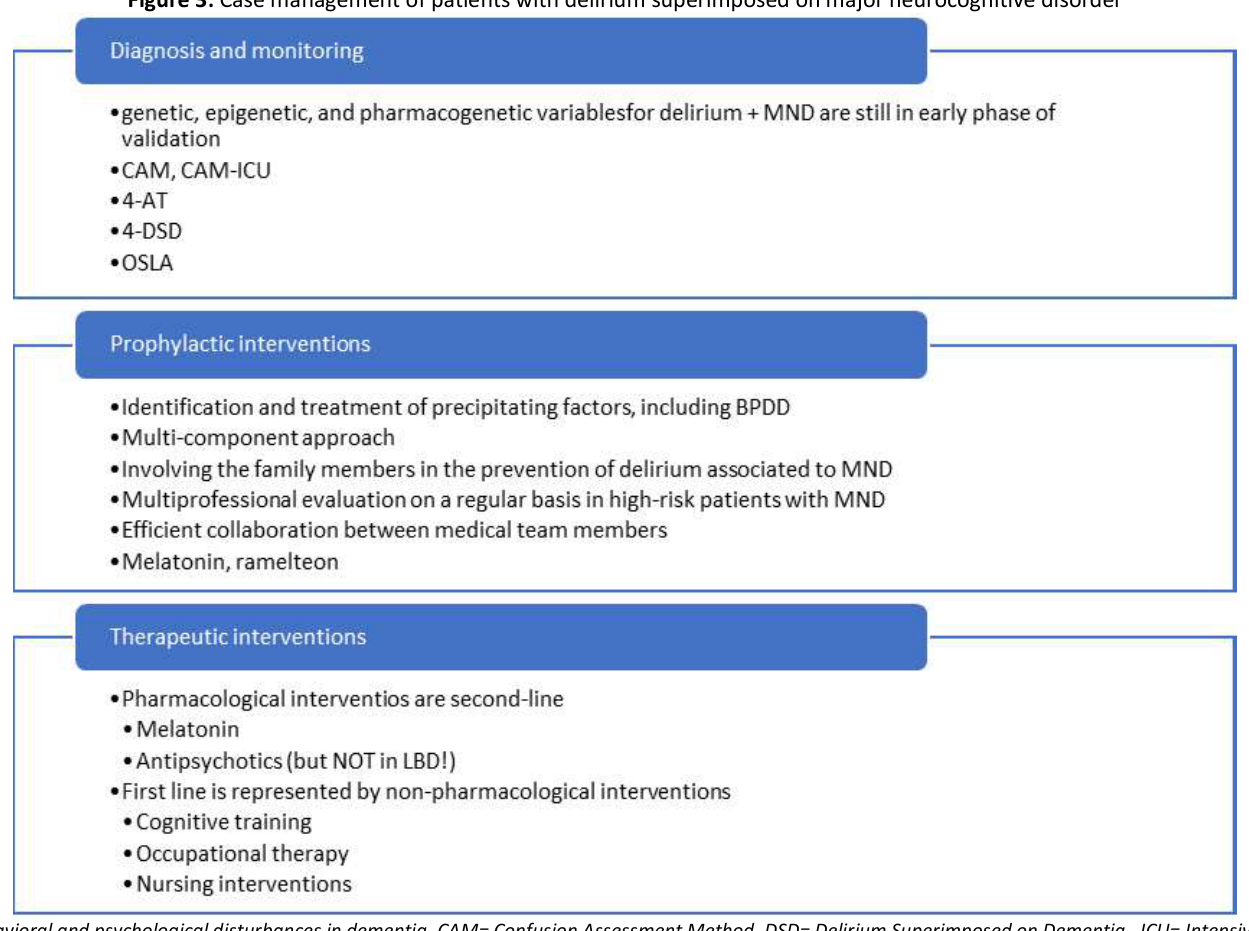
BPDD= behavioral and psychological disturbances in dementia, CAM= Confusion Assessment Method, DSD= Delirium Superimposed on Dementia, ICU= Intensive Care Unit, LBD+ Lewy body dementia, MND= major neurocognitive disorder, OSLA= Observational Scale of Level of Arousal
Mentioning that there is no „gold standard” for the diagnosis and treatment of delirium in patients with MND, a systematic review showed that a multi-professional evaluation regularly of high-risk patients with MND is recommended as a step toward the prevention of delirium [61]. An efficient collaboration between multiple members is also needed within the team, which is involved in case management [61]. Eliminating the risk factors for delirium in this vulnerable population is essential [61]. Screening for all the major causes of delirium in patients with MND is strongly recommended and could have significant benefits [33]. Constipation, medications with central nervous system adverse events, infections, vascular factors, electrolytic imbalance, low mobility, malnutrition, pain, incorrect sleep hygiene, and urinary retention should be screened for in patients with MND and sudden clouding sensorium [33].
A non-pharmacological approach is initially indicated in all individuals presenting delirium and MND, based on decreasing the number of medications used, maximization of family support, orienting techniques, adequate hydration, and correction of visual and hearing deficits, whenever possible [21]. However, the controlled studies did not show a consistent effect of environmental strategies in preventing delirium in patients with MND [21].
Pharmacological therapies are considered second-line interventions and applied only when non-pharmacological strategies have failed or are insufficient [61]. The use of melatonin and antipsychotics to treat delirium in MND is not supported enough by evidence [62].
As for the prevention of delirium, the identification of the precipitants and their treatment, initiation of multicomponent interventions, prevention of complications, and monitoring the resolution of the core symptoms are the main directions of case management in patients with delirium and MND [58,62]. The participation of the family members is strongly encouraged by the case managers because the evolution of the patients is often unpredictable even after hospital discharge, and caregivers may play an important role in re-orienting a confused individual by offering him or her a point of reference [58]. Re-assessment of precipitating and vulnerability factors is the first step, and only after that can non-pharmacological and pharmacological treatment be considered [62].
Special care should be given to patients with MND and BPDD, a sub-population that is more vulnerable to the onset of delirium than patients with dementia but without BPDD [63]. The recovery of delirium is slower in patients with both dementia and BPDD; therefore,
identifying early signs of delirium, like sleep impairments, mood lability, and psychomotor agitation, should trigger increased attention and more intensive monitoring [63].
Cognitive training was explored as a possible intervention for MND, to facilitate neuroplasticity in these patients [64]. Based on several similar cognitive features between dementia and MND, the use of recreational activities to enhance attentional abilities and offer cognitive stimulation was suggested to reduce delirium severity and duration, improving quality of life and reducing healthcare costs [64]. A pilot study dedicated to this intervention (N=16 participants) demonstrated a greater decrease in physical function and mental status during the 30 days of monitoring vs. the control group [65]. Delirium, but also the severity of delirium and attention had a trend toward significance in the study vs. control group [65].
Occupational therapy, based on preliminary evidence, can be another option for patients with delirium and MND [66]. A case series (N=6 patients with dual disorders) reported positive results of occupational therapy conducted twice daily for a total of 40 minutes until the delirium was remitted [66].
Nursing interventions for delirium over-imposed on MND were associated with good results [67]. A 10-step intervention was reported to help in the dissolution of delirium in a patient with Alzheimer’s dementia: interdisciplinary communication with care providers, reduction of medications administered, communicating calmly and slowly with the patient, avoidance of physical restraints, rehydration, regulation of the sleep-wake cycles, assess and prompt treatment of pain, education of the family and encouraging family members to participate in care, mobilize the patient as soon as possible, and regulation of the excretory function [67].
Melatonin and ramelteon may be recommended in older patients for the prevention of delirium when admitted to an acute geriatric facility [68,69]. According to the results of a multicenter, randomized study (N=67 patients admitted in ICUs), ramelteon administered nightly was associated with a lower risk of delirium, even after controlling the risk factors, vs. placebo [69].
Antipsychotics are frequently used in clinical practice for this population, but a trial with these medications should be recommended only for a short time, in low doses, and under careful supervision [33]. Special care should be taken when administering antipsychotics in patients with MND due to Parkinson’s disease or Lewy Body Dementia [33].
The existing evidence reviewed in the previous chapter supports the use of validated instruments for (1) screening in vulnerable populations, patients with MND included; (2) supporting the clinical diagnosis of delirium in the absence of validated biomarkers; (3) monitoring the evolution of delirium during treatment, until the complete resolution of its symptoms [22-26, 33,61]. Also, preventative measures could be applied in vulnerable populations, which may lead to a reduction in the risk of delirium onset, i.e., treating risk factors, close assessment of the clinical status, multi-component interventions, and even limited data supporting pharmacological interventions for short periods of time [58,62,63]. Therapeutic measures that can be initiated in cases of delirium superimposed on MND are mainly non-pharmacological since, for the pharmacological agents, there is only limited data to support their use [29,33,46-50,53-56].
Limitations of this review are related to its narrative nature, and, as a result, not all significant sources may have been found and reviewed. Also, due to the narrative character of the review, no quality of data was assessed, and all sources were treated equally. Finally, there is a paucity of data derived from good-quality trials focused on delirium overimposed on MND, which limits the validity of the review’s results, since most data are extrapolated from studies with patients presenting delirium in the clinical population, regardless of the causal factors.
The strengths of the present review are related to the enlarged focus on both pharmacological and non-pharmacological components of case management and the integration of structured assessment instruments into the clinical practice in vulnerable populations.
Future directions of research should include better-quality trials with homogenous populations, e.g., delirium with onset in patients with MND due to Alzheimer’s disease, or the prevention of delirium in patients with MND due to Parkinson’s disease, but also active comparators and placebo for the pharmacological trials, and a large number of participants with long-period of follow-up, in order to assess the risk of recurrence.
When formulating the case management plan for patients with delirium superimposed on MND, the clinician should take into account (1) the need for a multidisciplinary team since the precipitating and vulnerability factors may be complex and have intricate relationships; (2) regularly and frequently assess the patient using instruments like CAM, 4-AT, OSLA, or 4-DSD; (3) include the family in the monitoring of the patients, whenever possible; (4) non-pharmacological interventions, such as cognitive training and occupational therapy, nursing techniques, multi-component approaches, are first-line strategies; (5) pharmacological interventions are considered second-line, and they are administered only for short time and low doses; (6) prophylaxis of delirium in vulnerable populations, MND patients included, remains the single most important way to reduce the complications associated with this pathology.
The authors declare no conflict of interest. This research received no external funding.
The current manuscript does not contain previously published materials or self-generated AI text.
Conceptualization, O.V., M.M., A.G.M., B.M.P, A.M.C., C.A.S, and C.A.P.; methodology, M.M.M, O.V., A.M.C., C.A.S., and C.A.P; software, O.V..; validation, O.V., C.A.C., A.M.C., C.A.S., and C.A.P..; formal analysis, O.V., M.M.; investigation, O.V., M.M., A.G.M, B.P., M.M.M., A.M.C., and C.A.P..; resources, C.A.P., C.A.S., M.M., O.V..; data curation, O.V., M.M.; writing—original draft preparation, O.V..; writing—review and editing, M.M., C.A.S., A.M.C., C.A.P.; visualization, O.V..; supervision, O.V., C.A.P.; project administration, O.V., M.M. All authors have read and agreed to the published version of the manuscript
Not applicable.
Not applicable.