
The coronavirus disease 2019 (COVID-19) pandemic has profoundly impacted intensive care practice worldwide, leading to an unprecedented number of critically ill patients requiring prolonged mechanical ventilation and complex multidisciplinary management. Although the acute respiratory manifestations of severe acute respiratory syndrome coronavirus 2 (SARS-CoV-2) infection initially dominated clinical attention, it rapidly became evident that survivors frequently experience significant neuromuscular and functional impairments that extend well beyond the acute phase of illness [1,2].
Among the most clinically relevant complications in critically ill patients is intensive care unit-acquired weakness (ICUAW), a syndrome characterized by diffuse, symmetrical muscle weakness that develops during critical illness in the absence of other identifiable causes [3]. ICUAW encompasses critical illness polyneuropathy, critical illness myopathy, or their combination, and is associated with prolonged mechanical ventilation, extended ICU and hospital length of stay, increased mortality, and persistent long-term disability [4,5]. In the context of severe COVID-19, the risk of ICUAW appears to be amplified by multiple converging factors, including systemic inflammation, prolonged immobilization, deep sedation, hypoxemia, and frequent use of neuromuscular blocking agents [6].
Post-intensive care syndrome (PICS) has further emphasized the multidimensional burden faced by ICU survivors, involving physical, cognitive, and psychological impairments that may persist for years after discharge [7]. From a rehabilitation perspective, the physical domain—particularly severe deconditioning and neuromuscular weakness—represents a major determinant of delayed functional recovery and reduced quality of life. Previous longitudinal studies in non-COVID acute respiratory distress syndrome (ARDS) survivors have demonstrated functional disability persisting up to five years post-ICU, underscoring the long-term consequences of critical illness [5].
Early mobilization and structured physical and rehabilitation medicine (PRM) interventions have emerged as key strategies to counteract ICU-related deconditioning. Current evidence suggests that initiating rehabilitation as soon as the patient achieves hemodynamic and respiratory stability can reduce muscle wasting, improve functional outcomes, shorten duration of mechanical ventilation, and decrease ICU length of stay [8,9]. However, during the COVID-19 pandemic, the implementation of early rehabilitation has faced substantial barriers, including infection control constraints, staff overload, patient instability, and limited availability of specialized rehabilitation teams [10].
In this context, innovative neurorehabilitation approaches that can be applied even in deeply impaired or non-cooperative patients are of particular interest. Proprioceptive focal stimulation (PFS) represents a modern therapeutic modality designed to preserve the functional interaction between sensory input and motor output by delivering patterned proprioceptive stimuli that mimic physiological gait-related afferent signals. Preliminary data suggest that such approaches may help maintain central motor programs and mitigate disuse-related neuromuscular decline, even when active movement is not yet feasible [11].
Despite the growing recognition of the importance of early rehabilitation in COVID-19 critical care, real-world clinical data integrating conventional kinesitherapy with advanced proprioceptive stimulation techniques remain limited, particularly in Eastern European ICU settings [12-15]. Moreover, the interaction between intubation status, timing of rehabilitation initiation, and functional outcomes in severe COVID-19 populations requires further clarification.
Aim of the study. The present study aimed to evaluate the clinical correlations and functional impact of early rehabilitation interventions—including kinesitherapy and proprioceptive focal stimulation—in critically ill patients with SARS-CoV-2 infection and ICU-acquired weakness, and to identify factors associated with unfavorable functional evolution during ICU stay.
The present research was designed as a retrospective observational cohort study conducted in the adult Intensive Care Unit (ICU) of the National Institute for Infectious Diseases “Prof. Dr. Matei Balș”, Bucharest, Romania. The study period extended from 9 June 2020 to 9 June 2022, corresponding to the major pandemic waves requiring intensive care support.
The study followed the principles of the Declaration of Helsinki and current recommendations for observational clinical research. All rehabilitation procedures were integrated into routine clinical care and adapted to the dynamic clinical status of critically ill patients.
A total of 148 patients with confirmed SARS-CoV-2 infection were included in the analysis.
Patients were consecutively enrolled to minimize selection bias.
Rehabilitation management was delivered by a specialized multidisciplinary team coordinated by a physician in Physical and Rehabilitation Medicine and supported by physiotherapists/kinetotherapists, ICU physicians, nursing staff, when necessary, occupational therapists and speech therapists.
This integrated approach is consistent with modern ICU rehabilitation frameworks [9,16-19].
The rehabilitation program was individualized according to the patient’s clinical status, respiratory support level, and neurological responsiveness. Interventions were progressively adapted from passive to active-assisted modalities. Of the total of 148 patients participating in the study, 98 (66.2%) received functional proprioceptive stimulation treatment through vibrations with the specific device, and the remaining 50 (33.8%) patients benefited from physiotherapy. The device was a multifunctional rehabilitation system integrating a central control unit with an interactive touchscreen display, combined with upper and lower limb support structures, proprioceptive stimulation modules, and adjustable positioning frames to facilitate motor recovery, balance training, and neuromuscular re-education in clinical settings.
Kinesitherapy represented the core rehabilitation intervention and included passive mobilization of major joints, passive-active mobilization, low-, medium-, and high-resistance exercises when feasible, positioning and postural management, prevention of joint stiffness and pressure injuries. Session frequency and duration were tailored to patient tolerance and ICU constraints.
Selected patients received adjunctive proprioceptive focal stimulation using a dedicated medical device designed to deliver patterned sensory inputs mimicking physiological gait-related afferent signals.
The system consisted of a central control and charging unit, wireless stimulators, limb orthoses and fixation straps, and a mobile support system for bedridden patients. The therapeutic rationale was to maintain sensorimotor loop activation and preserve central motor programs even in the absence of voluntary movement [11,20].
Functional and clinical assessment was performed using validated instruments widely employed in ICU rehabilitation research.
Primary functional measures: Medical Research Council (MRC) muscle strength score (0–5 grading), ICU Mobility Scale (IMS), Manchester Mobility Score, and Glasgow Coma Scale (GCS).
Secondary qualitative measures quality of movement sensation, motor response quality, and level of active participation. Evaluations were performed at rehabilitation initiation and at ICU discharge when clinically feasible.
The study database included both quantitative and qualitative variables.
Demographic and clinical variables include sex, age, intubation status, and days until initiation of rehabilitation.
Musculoskeletal variables include motor deficit severity, presence of muscular atrophy, and functional mobility scores.
Rehabilitation exposure variables include the number of kinesitherapy sessions, the number of PFS sessions, the total duration of rehabilitation, and the intensity level of exercises.
Statistical processing was performed using IBM SPSS Statistics version 20. Descriptive statistics were used to characterize the study population.
Inferential analysis included Chi-square test and Fisher’s exact test for associations between categorical variables, Mann–Whitney U test and Kruskal–Wallis test for non-parametric comparisons, Spearman rank correlation (two-tailed) for relationships between quantitative variables.
Effect size indicators (Phi coefficient and odds ratio, where applicable) were calculated to estimate the strength of associations. Statistical significance was set at p < 0.05.
The study was conducted in accordance with the Declaration of Helsinki and approved by the Institutional Ethics Committee of the National Institute for Infectious Diseases “Prof. Dr. Matei Balș” (approval code: 3249).
Given the observational nature of the study and the use of standard-of-care rehabilitation procedures, informed consent was obtained according to institutional regulations.
The analyzed cohort included 148 patients admitted to the adult intensive care unit with confirmed SARS-CoV-2 infection. The demographic and clinical profile reflected a severely affected critical care population requiring complex multidisciplinary management.
Out of the total sample, 108 patients (73.0%) required endotracheal intubation and invasive mechanical ventilation, while 40 patients (27.0%) were managed without intubation. This distribution highlights the high severity burden of the studied ICU population.
Male patients were predominant in the severe clinical spectrum, consistent with previously reported sex-related differences in COVID-19 severity.
A highly significant association was identified between intubation status and the presence of muscular atrophy. The chi-square test demonstrated a very strong relationship between invasive ventilation and musculoskeletal deterioration (χ² test, p = 7.1×10⁻¹⁰).
From a clinical perspective, intubated patients showed a markedly higher prevalence of muscle atrophy compared with non-intubated patients, supporting the hypothesis that prolonged immobilization and mechanical ventilation substantially contribute to ICU-acquired weakness.
Similarly, motor deficit severity was more pronounced among intubated patients, reinforcing the central role of respiratory support duration in functional decline.
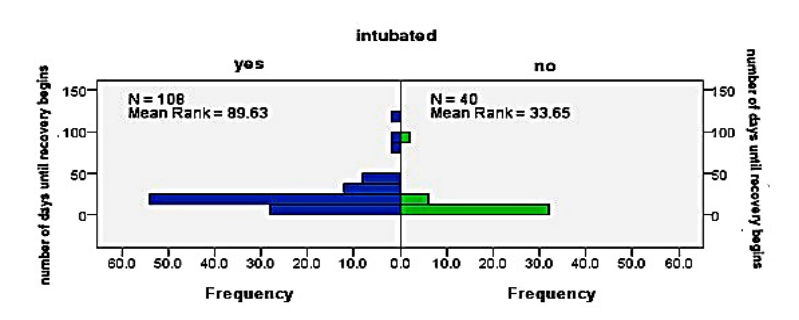
Functional mobility at ICU discharge, assessed using the ICU Mobility Scale, differed significantly between the two groups.
The Mann–Whitney U test revealed that intubated patients had significantly lower mobility scores compared with non-intubated patients (p = 1.56×10⁻¹¹). The magnitude of this difference indicates a clinically meaningful functional gap between the groups. These findings confirm that invasive mechanical ventilation is strongly associated not only with respiratory severity but also with impaired early functional recovery.
Table 1 summarizes the functional outcomes according to intubation status.
| Parameter | Value |
|---|---|
| Total N | 148 |
| Mann-Whitney U | 3794.000 |
| Wilcoxon W | 9680.000 |
| Test statistic | 3794.000 |
| Standard Error | 231.234 |
| Standardized Test Statistic | 7.066 |
| Asymptotic Sig. (2-sided test) | .000 |
Figure 1 illustrates the distribution of ICU Mobility Scale scores in intubated versus non-intubated patients.
An important objective of the present study was to evaluate whether the delay in initiating the rehabilitation program influenced functional outcomes.
Spearman correlation analysis demonstrated a moderate negative correlation between the number of days until rehabilitation onset and the ICU Mobility Scale score at discharge (ρ = −0.397). This finding indicates that patients who started rehabilitation earlier tended to achieve better functional mobility.
From a clinical standpoint, this result strongly supports the concept of early mobilization as a key determinant of functional prognosis in critically ill COVID-19 patients.
Qualitative analysis of rehabilitation sessions showed that patients who were able to engage earlier in passive-active or assisted mobilization demonstrated improved quality of movement sensation, better motor response scores, and higher levels of active participation. Although variability existed depending on clinical stability, the overall trend favored early, progressively intensified rehabilitation exposure. At the end of the program, 39.2% (58 patients) were transferred to the ward.
Consistent with the observed functional impairments, intubated patients also exhibited a more severe overall clinical trajectory. At the end of the program, 60.8% (90 patients) died. The coexistence of muscular atrophy, severe motor deficit, and reduced mobility scores characterized the subgroup with the highest risk profile. These findings emphasize the tight interconnection between respiratory severity, immobilization burden, and neuromuscular deterioration in critically ill COVID-19 patients.
The present study provides additional real-world evidence regarding the functional burden associated with severe SARS-CoV-2 infection in critically ill patients and reinforces the central role of early physical and rehabilitation medicine (PRM) interventions in the intensive care setting. Several clinically relevant observations emerged from the analysis.
First, the very high proportion of intubated patients (73%) reflects the severity profile of the studied cohort and is consistent with reports from tertiary COVID-19 centers during peak pandemic waves [6,12]. More importantly, intubation status was strongly associated with muscular atrophy and impaired mobility outcomes. The highly significant relationship identified in our cohort (p = 7.1×10⁻¹⁰) supports the well-established pathophysiological link between prolonged mechanical ventilation, immobilization, systemic inflammation, and the development of ICU-acquired weakness (ICUAW) [3,4].
Our findings are in line with previous investigations demonstrating that patients requiring invasive mechanical ventilation are at markedly increased risk of critical illness polyneuropathy and myopathy [5,13]. The observed functional gap between intubated and non-intubated patients, as reflected by significantly lower ICU Mobility Scale scores (p = 1.56×10⁻¹¹), further confirms that respiratory severity directly translates into early functional disability. From a clinical rehabilitation perspective, this emphasizes the need for proactive neuromuscular monitoring in mechanically ventilated COVID-19 patients.
A particularly important contribution of the present study is the demonstration of a moderate negative correlation between delayed initiation of rehabilitation and functional mobility at ICU discharge (ρ = −0.397). This finding strongly supports the concept that timing matters in ICU rehabilitation. Earlier studies in non-COVID critical care populations have shown that early mobilization is associated with shorter duration of delirium, improved muscle strength, and better functional independence at discharge [8,14]. Our data extend these observations specifically to the severe COVID-19 population, where implementation barriers were initially substantial.
From a mechanistic standpoint, early mobilization likely mitigates multiple pathways involved in the development of ICUAW, including muscle protein catabolism, mitochondrial dysfunction, impaired neuromuscular junction transmission, and central motor deconditioning [3,15]. In the context of SARS-CoV-2 infection, these mechanisms may be further amplified by cytokine-mediated inflammation and prolonged hypoxemia, making timely rehabilitation even more critical.
Another relevant aspect of the present study is the integration of proprioceptive focal stimulation (PFS) within the rehabilitation protocol. Although the current analysis was not designed to isolate the independent effect of PFS, qualitative observations suggested improved sensorimotor engagement in patients exposed to structured proprioceptive input. The theoretical rationale for PFS is supported by neurophysiological principles indicating that patterned afferent stimulation can help preserve central pattern generator activity and maintain sensorimotor loop integrity even in conditions of limited voluntary movement [11,16]. This approach may be particularly valuable in deeply sedated or minimally responsive ICU patients, where conventional active mobilization is not yet feasible.
The multidimensional nature of post-intensive care syndrome (PICS) must also be considered when interpreting our results. Physical impairment rarely occurs in isolation and is frequently accompanied by cognitive and psychological sequelae [7]. Therefore, the benefits of early PRM involvement likely extend beyond pure motor recovery, potentially contributing to improved global functional trajectories. This supports current recommendations advocating for early, multidisciplinary rehabilitation pathways in critical care [9,16].
From a sex-related perspective, our observations of more severe functional profiles among male patients are consistent with epidemiological data showing higher COVID-19 severity and mortality in men [12]. Potential explanations include differences in immune response, hormonal modulation, comorbidity burden, and health-seeking behavior. While sex was not the primary focus of the present study, these findings suggest that male ICU patients may require particularly vigilant functional monitoring.
The present findings carry several practical implications for ICU teams, such as that early PRM consultation should be considered standard of care in severe COVID-19, mobilization protocols should begin as soon as hemodynamic stability allows, mechanically ventilated patients represent a high-risk subgroup for ICUAW, adjunctive modalities such as proprioceptive stimulation may be useful in low-responsiveness phases, continuity of rehabilitation after ICU discharge is essential.
In resource-constrained environments, even low-intensity early mobilization strategies may yield meaningful functional benefits.
Several limitations must be acknowledged. First, the observational design precludes causal inference regarding the effectiveness of the rehabilitation interventions. Second, although the cohort reflects real-world ICU practice, potential confounding related to baseline disease severity and comorbidities cannot be fully excluded. Third, long-term post-discharge functional outcomes were not available, limiting conclusions regarding sustained recovery. Finally, the independent contribution of proprioceptive focal stimulation could not be isolated from the global rehabilitation program.
Future research should prioritize randomized controlled trials of early ICU rehabilitation in COVID-19, dose–response analyses of mobilization intensity, long-term functional follow-up, mechanistic studies of sensorimotor stimulation in ICUAW, and integration of digital and automated rehabilitation technologies. Such investigations may help refine personalized rehabilitation pathways for critically ill patients.
The present study confirms the substantial functional burden associated with severe SARS-CoV-2 infection in critically ill patients and highlights the pivotal role of early physical and rehabilitation medicine (PRM) interventions in the intensive care environment. In our cohort, invasive mechanical ventilation was strongly associated with muscular atrophy and significantly reduced functional mobility, emphasizing the close interplay between respiratory severity and neuromuscular deterioration.
An important finding of this research is the moderate negative correlation between delayed initiation of rehabilitation and functional mobility at ICU discharge, supporting the concept that early mobilization represents a key determinant of functional prognosis in severe COVID-19. Patients who benefited from earlier rehabilitation exposure demonstrated better sensorimotor engagement and higher levels of active participation.
The integration of conventional kinesitherapy with adjunctive proprioceptive focal stimulation appears feasible in the ICU setting and may contribute to preserving sensorimotor loop activity during phases of limited voluntary movement. Although further controlled studies are required to isolate the independent effect of this modality, the present data support its potential role within comprehensive ICU rehabilitation protocols.
From a clinical perspective, mechanically ventilated patients should be considered a high-risk subgroup for intensive care unit-acquired weakness and require proactive functional monitoring and early rehabilitation planning. Continuity of multidisciplinary rehabilitation after ICU discharge remains essential for optimizing long-term recovery trajectories.
Future research should focus on randomized controlled trials, standardized early mobilization algorithms, and long-term functional follow-up in post-COVID critical care survivors. The development of personalized, phase-adapted rehabilitation pathways may further improve outcomes in this vulnerable population.
The present study has several strengths that enhance its clinical relevance. First, it reflects real-world ICU practice during the COVID-19 pandemic, providing valuable insight into the functional evolution of critically ill patients managed in a high-complexity infectious diseases center. Second, the study integrates standardized functional assessment tools (MRC, ICU Mobility Scale, Manchester Mobility Score, Glasgow Coma Scale), allowing objective evaluation of neuromuscular status. Third, the analysis includes the timing of rehabilitation initiation, an important but often underreported determinant of functional recovery.
The authors declare no conflict of interest. This research received no external funding.
No generative AI was used by the authors in the production of this article.
Conceptualization, A.P. and E.C.; methodology, M.P.; software, E.C.; validation, C.U., M.P., and A.S.C.; formal analysis, C.U.; investigation, A.P.; resources, A.P.; data curation, A.P.; writing—original draft preparation, A.P.; writing—review and editing, E.C.; visualization, M.P.; supervision, A.S.C.; project administration, A.P.; funding acquisition, A.P. All authors have read and agreed to the published version of the manuscript.
The study was conducted in accordance with the Declaration of Helsinki and approved by the National Institute for Infectious Diseases “Prof. Dr. Matei Balș” Ethics Committee, protocol code 3249 for studies involving humans.
Informed consent was obtained from all subjects involved in the study. Written informed consent has been obtained from the patient(s) to publish this paper.