
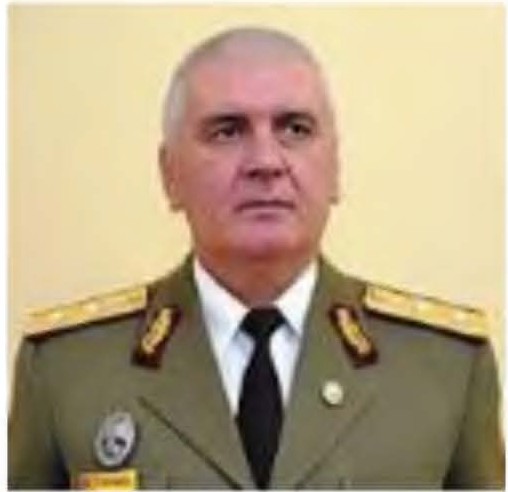
Chief Editor
Romanian Journal of Military Medicine
The publication that would later become the Romanian Journal of Military Medicine was founded on September 15, 1897, as the Military Medicine Magazine by distinguished military medical professionals.
On January 12, 1897, Army Corps General Professor Dr. Athanase Demosthen was elected a corresponding member of the Medical Academy of Paris. Those who celebrated him for his success, mostly his students and contemporaries, doctors, pharmacists, and veterinarians (military veterinarians, the cavalry did not disappear – as a fighting weapon!), decided, according to the French example, to create a magazine with independent status and organization, and objectives that do not go beyond our present understanding. Namely: “maintenance of scientific activity and emulation among the members of the sanitary body, establishment of the collegiality links between the sanitary officers, as well as the preservation of the scientific and moral prestige that they should enjoy in the army and in society, the culture of all scientific and technical knowledge among the members of the military health body related to the medical, pharmaceutical and veterinary profession” (Revista Sanitară Militară, 1972, nr. 4-5, p. 411).
The “Steering Committee” met three months later, on April 12, 1897, and established that, under the leadership of General Prof. Dr. Athanase Demosthen as chairman, a new magazine, Revista Sanitară Militară, would be born with the previously mentioned status. The companions of General Demosthen for this enterprise were the generals Dr. I. Șerbănescu, N. Zorileanu, the army pharmacist M. Marinescu, first class regiment physician I.M. Călinescu, second class regiment physician Iacob Potârcă (a memorable name in Romanian surgery – versus Whitehead procedure!), pharmacists C. Dumitrescu-Parepa and Constantin Merișanu (whose bust guards a hospital alley).
The magazine appeared on 15 September 1897, and the photocopy reproduced here shows the first cover of the Military Health Magazine (Revista Sanitară Militară, 1972, nr. 4-5, p. 409).
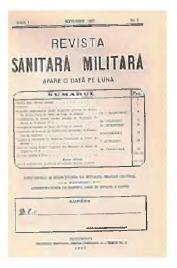
The Military Health Magazine wanted to be, from the very beginning, “the depository of the work and activity of the health officers in the realm of veterinary and human medicine and military pharmacy” (Oameni și Fapte din Istoria Medicinii Militare Românești, Gral brig (r) dr. Mircea Diaconescu, vol. II, p. 229). The Military Health Magazine records a great performance in our medical literature: it appeared in the same year as the Surgery Magazine – 1897, faced similar institutional and financial challenges, did not have the same audience, but resisted… An absolutely remarkable fact!…
The magazine has gone through chaotic and sad moments. It had “ups and downs,” a sort of “crises” as they are told today. Most of the causes were financial, leading to changes in the typographic format and in the continuity of occurrence. The first syncope is in 1903, so that between 1903 and 1905 the magazine no longer appears. In April 1905, everything went back to normal. The first exchanges of journals began with other armies: Italian, English, French, German, and everything went flawlessly until 1908. The number 2 of 1906 was a jubilee number; ten years had passed from the gorgeous initiative of 1897, the number being dedicated to “the great and mighty King Carol I”.
Unfortunately, after the numbers 3 and 4 of 1908, the second syncope is recorded. The Military Health Magazine ceased to appear in 1913 (Oameni și Fapte din Istoria Medicinii Militare Românești, Gral. brig. (r) dr. Mircea Diaconescu, vol. II, p. 230). Still, the magazine is coming back shortly. On June 28, 1914, Archduke Franz Ferdinand and his wife were assassinated in Sarajevo, the three kings – blood cousins: Kaiser Wilhelm II of Germany, Tsar Nicholas II of Russia, and King George V of The United Kingdom of Great Britain, all three good English speakers were not able to come to terms (they were grandchildren of the Queen Victoria of Great Britain), the Great War (or the First World War as it is known today) begins, our magazine has its third syncope: 1915–1919.
With all these vicissitudes, in 1917 and 1918, in Iași and Bacău appear “the Comptes bulletins from the Societe medico-surgical du russo-roumain, namely ‘Comptes rendus des séances from the medical reunion of 11ème armée’, presenting medico-military communications with participants from Russian and French allied armies” (Revista Sanitară Militară, 1972, nr. 4-5, p. 412).
There is also a fourth syncope, after the first numbers appeared in 1919. In fact, the magazine really revived in 1928, when things were settled, and the country seemed to have emerged from the crisis. It is Miron Costin’s word: “There are not the times under the man, but the poor man under the times!”
In the review, there are reports of the “continuous medical education” sessions – that is the sessions of the Romanian Military Doctors’ Association with the subsequent subsidiaries from all the existing Military Hospitals, homage numbers regarding the personalities of the Romanian medicine who came from the same medical tradition or not: General Dr. N. Zorileanu (dermatovenerologist), Professor Dr. V. Babeș (bacteriologist), Professor Dr. Dimitrie Gerata (surgeon, radiologist), Professor Dr. Al. Costiniu (ENT), etc. Articles in French and German also appear (Revista Sanitară Militară, 1972, nr. 4-5, p. 413).
The fifth syncope, hopefully the last, is also the longest: 1949–1957. The times were like they were; everything was changing, and who needed the written word of the Romanian military doctors?
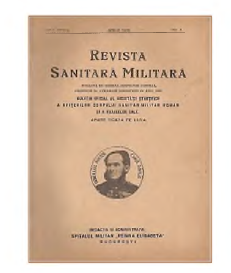
We publish the cover of a Magazine published in 1938 in which, in the end, Lieutenant Colonel Dr. Eugen Mareș publishes an obituary of a colleague from a previous generation (Oameni și Fapte din Istoria Medicinii Militare Românești, Gral brig (r) dr. Mircea Diaconescu, vol. II).
The same man, the same true Romanian military doctor whom I personally met, when he was at the peak of his profession, Deputy Minister of Health in socialist Romania, and at the end of his life, with a typical Oltenian perseverance, “revives” the Military Health Magazine in 1957.
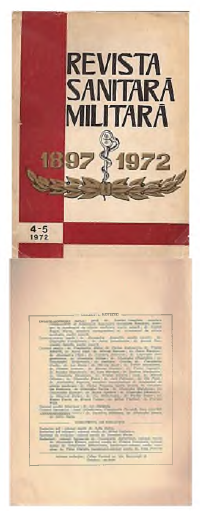
In 1972, when the magazine was celebrated for “three quarters of a century of existence in the service of the protection of the health of our soldiers”, the technical box of Sanitary Military Magazine no. 4-5/1972, which we reproduce in the facsimile, mentions his name, along with the name of another military doctor dear to my soul – General Professor Iuliu Șuteu – editor-in-chief of the magazine at that time.
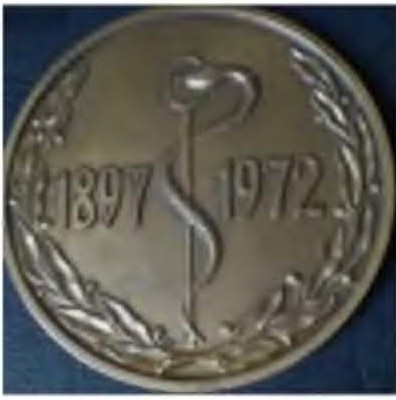
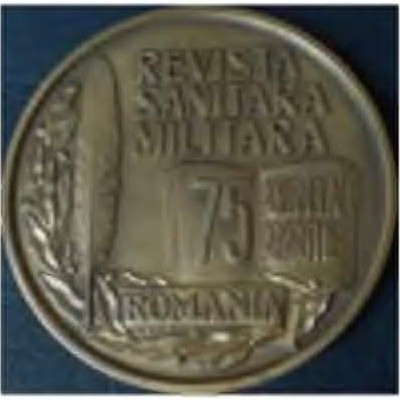
I also want to remember another name dear to me: Lt. General Academician Gheorghe Niculescu, for many years the editor-in-chief and “living spirit” who agglutinated the energies and “pencils”, stimulating and promoting those who really had something to say in this field.
After 1990, fearful, as observed in another journal, “Surgery”, changed its name. It became the Journal of Military Medicine.
Probably the term “sanitary” was appropriate in the beginning, the term “medicine” is common to all military doctors because we all come from the same strain – the School of Medicine created by Carol Davila, who arrived on Romanian soil as a French civilian and became a Romanian general and physician!
In this way, the terminology evolved naturally, reflecting the broader scope of modern medicine.
In time, there have been other Romanian medico-military publications. However, the Romanian Journal of Military Medicine remains unique and emblematic after five major “syncopes”, having in its portfolio “a valuable scientific and informational forum not only for military doctors but for all Romanian medicine” (Oameni și Fapte din Istoria Medicinii Militare Românești, Gral brig (r) dr. Mircea Diaconescu, vol. II, p. 232).
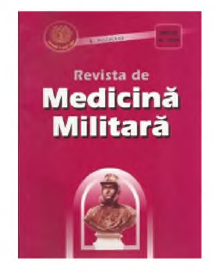
The magazine had the power, and those close to it knew how to wield it, thus demonstrating remarkable resilience and continuity. More than twelve decades after its first appearance, the Romanian Journal of Military Medicine remains a scientific journal with its own program, unaltered by the passing of the ages, even when the inter-war or post-war political factors perhaps implied another orientation.
The Romanian Journal of Military Medicine is committed to providing up-to-date, evidence-based information to members of this noble profession. In an era characterized by an overwhelming and often confusing abundance of online information, the Journal seeks to ensure that all published material—whether in print or digital format—is carefully reviewed, critically evaluated, and refined by recognized experts in the field, rather than merely disseminated without rigorous scrutiny. I am firmly convinced that Romanian military and civilian medical professionals, heirs to the legacy of General Professor Dr. Carol Davila, will embrace this shared professional commitment and continue to uphold these principles for as long as the profession calls upon them.
This presentation is based on the article: Mischianu D. The story of a journal – The 120th anniversary of the Romanian Journal of Military Medicine. RJMM 2017; CXX(2):3-7.