
The management of competencies and skills in the healthcare sector has drawn significant attention from international organizations, recognizing that a well-trained workforce is essential for ensuring patient safety and delivering high-quality care [1,2]. In alignment with the continuous advancements in medical technology, the necessity for healthcare professionals to develop new skills has become increasingly urgent [3,4]. This need was starkly highlighted during the recent COVID-19 pandemic, where the heightened digital demands of healthcare services underscored the importance of sufficient digital capabilities [5,6].
In particular, digital skills are deemed critical not only for the effective management of healthcare organizations but also for medical diagnosis, treatment monitoring, patient care, and decision-making processes [7,8]. Within the healthcare domain, digital competence encompasses knowledge of digital literacy and technology as essential tools for the patient-centered provision of quality healthcare services. It reflects the dynamic interaction between healthcare professionals, patients, and colleagues, as well as the drive to acquire professional expertise in digital technology [9,10].
It is widely recognized that digital competencies are essential for the effective integration of health technologies into routine clinical practice. Numerous processes are now carried out digitally, such as patient monitoring, where electronic health records and vital sign monitoring systems enable doctors and nurses to track patient status in real time. Material procurement is also facilitated through electronic systems, enhancing both accuracy and efficiency. Furthermore, telemedicine plays a pivotal role, particularly in military hospitals, by enabling the delivery of healthcare services to remote areas and military bases. Digital tools further support decisionmaking by allowing healthcare professionals to analyze data and make evidence-based decisions more efficiently [3,11,12].
In Greece, military hospitals offer more structured training programs for digital skills, supported by military frameworks that emphasize continuous professional development of their personnel. These programs encompass modules on the management of digital tools, telemedicine, and electronic patient record systems, reflecting the military’s long-standing tradition of structured training and lifelong education. Additionally, military healthcare professionals are often encouraged to engage in e-learning programs to further enhance their expertise in healthcare technologies.
Conversely, in public hospitals, training programs for digital skills vary depending on the institution and the extent of technological integration. Significant advancements have been observed in large hospitals that have adopted electronic medical records; however, training opportunities remain limited due to resource constraints and time pressures. Healthcare professionals, including nurses and doctors, typically receive training through Ministry of Health initiatives or European-funded programs such as eHealth and Horizon 2020 [9,10].
Despite extensive research on digital skills, a literature review from the past decade indicates a scarcity of studies that examine the digital competencies of healthcare professionals within a specific and well-defined conceptual framework. One such framework is the European Digital Competence (DigComp) Framework, created by the European Union as a common umbrella of digital competences for its citizens, which defines digital competence domains, indicators for each domain, competence levels, examples of knowledge, skills, and at udes, as well as examples of application [13]. Moreover, limited research has explored the associations between digital skills and the organizational work environment. To the best of our knowledge, no prior studies have investigated differences in this domain between military and civilian healthcare professionals.
Therefore, the objective of this paper is to address this research gap by examining the relationship between digital skills of healthcare professionals and the organizational structures of their work environments. We aim to contribute evidence on the organizational factors influencing healthcare professionals’ digital competencies, which can inform policymakers and healthcare managers’ efforts to implement targeted organizational improvements.
A cross-sectional survey utilizing a descriptive study design was conducted based on prior research, which demonstrated that the Digital Competence Indicator tool is a reliable and valid measurement scale applicable to Greek doctors and nurses [14]. The study addressed two primary research questions: (1) How are healthcare professionals’ digital skills assessed? and (2) Are there differences in the digital skills of healthcare professionals between military and civilian hospitals?
The present study was conducted as part of the research activities of the Department of Nursing at the Hellenic Mediterranean University and received ethical approval from the Review Committee (Protocol No.: 4634/29-03-2021). Additionally, the necessary permissions were obtained from the Scientific Committees of all participating hospitals (Protocol No.: 5584/1973/26-06-2021). Data were collected using a self-assessment questionnaire, with the principal investigator maintaining sole access to the collected data. Participation was entirely voluntary, and all participants were informed both verbally and via an information/consent form that completing and returning the questionnaire constituted their consent to participate in the study. The information/consent form was approved by the above Scientific Committees. The research adhered strictly to the European Union’s General Data Protection Regulation, ensuring full compliance with personal data protection standards.
A convenience sample of doctors and registered nurses was selected from seven tertiary care hospitals in Greece. This particular sampling method was preferred because it offers time and cost savings, ease of access, and an abundance of qualitative data. However, it carries the risk of bias and systematic errors, and therefore, research findings cannot be accurately generalized beyond the study sample. The selection of hospitals was based on the diversity of organizational structures between military and civilian institutions, as well as the aim of achieving a large sample size. The study population size was calculated using a 95% confidence interval and a 5% margin of error, ensuring that the final sample accurately represented healthcare professionals in Greek hospitals. The target sample size was N>800. A total of 1207 questionnaires were distributed, and 876 were collected, of which 19 were invalid due to incomplete responses. Thus, the study population is N=857.
The inclusion criteria for participation were employment in either a military or civilian hospital, professional status as a doctor or nurse, and, for nurses, registration as per the European Qualifications Framework (EQF). The distribution of questionnaires was proportional to the size of each hospital, based on the number of medical and nursing staff within the institutions. Data collection
occurred during staff meetings, where participants from various work positions within the hospitals were approached, provided with explanations of the study objectives, and given clarifications on completing the questionnaire. Data collection was conducted between July and November 2021.
Data were collected using a validated 37-item paper-based questionnaire. It is built on the European DigComp Framework, which comprehensively defines the elements of digital competence as a combination of skills, abilities and at udes essential for incorporating data processing into the professional careers of healthcare providers [13,15].
The questionnaire consisted of two parts. The first part captured demographic characteristics, including gender, age, educational level, profession, specialty, hospital type, professional experience, administrative responsibilities, and possession of digital skills certification. The second part assessed 26 digital skills, organized into five competency domains (subscales): information, communication, content creation, problem-solving, and safety skills (Table 1).
| Competence Area | Digital Skills |
|---|---|
| Information Skills | 1. Finding information about goods and services |
| 2. Obtaining information from public authority websites | |
| 3. Reading or downloading online news/newspapers/news magazines | |
| 4. Copying or moving a file or folder | |
| 5. Seeking health-related information | |
| Communication Skills | 6. Sending/receiving emails |
| 7. Telephoning over the internet/video calls (via webcam) over the internet | |
| 8. Participating in social networks | |
| 9. Posting messages to chat sites | |
| 10. Uploading self-created content to any website to be shared | |
| Content Creation Skills | 11. Creating websites or blogs |
| 12. Writing a computer programme using a specialized programming language | |
| 13. Using copy and paste tools to duplicate or move information within a document | |
| 14. Creating electronic presentations with presentation software (e.g., slides), including e.g., images, sound, video, or charts | |
| 15. Using basic arithmetic formulae to add, subtract, multiply, or divide figures in a spreadsheet | |
| Problem-Solving Skills | 16. Connecting and installing new devices |
| 17. Installing a new or replacing an old operating system | |
| 18. Modifying or verifying the configuration parameters of software applications | |
| 19. Doing an online course | |
| 20. Buying or ordering goods or services for private use (last 12 months) over the internet | |
| 21. Selling online | |
| 22. Job search or sending an application | |
| 23. Internet banking | |
| 24. Making an appointment with a practitioner via a website | |
| Safety Skills | 25. Using any kind of IT security software or tool (anti-virus, anti-spam, firewall, etc.) in order to protect private computers and data |
| 26. Updating one or more security products at least occasionally |
Subscale values were calculated on a scale ranging from 0 to 100, with scores approaching 0 reflecting a more negative evaluation of the variable and scores approaching 100 reflecting a more positive assessment.
The questionnaire provided a concise yet compelling assessment of the Information Technology (IT) skills of hospital doctors and nurses. Designed for ease of use and brevity, it was particularly suitable for hospital settings often characterized by high workloads and limited time for activities outside core medical and nursing responsibilities. Participants rated the extent of their computer usage for each activity on a five-point Likert scale, ranging from 1 (“not at all”) to 5 (“very much”).
Statistical analysis was performed using SPSS (Statistical Package for Social Sciences) version 26.0. Continuous variables were expressed as mean ± standard deviation (SD) and categorical variables were presented as absolute numbers (n) and percentages (n%). The normality of variables was assessed using the Shapiro-Wilks test, alongside graphical methods such as the Normal Q-Q plot, Detrended Normal Q-Q plot, and Box Plot. For all statistical tests, differences were considered significant at p < 0.05. Effect sizes weren’t reported. The independent t-test was employed to compare the means of two groups, while one-way analysis of variance (ANOVA) was used for comparisons involving more than two group means.
The study population comprised 857 Greek healthcare professionals employed across seven tertiary care hospitals. The results indicate that 538 participants (62.8%) were female, while 319 (37.2%) were male, with a mean age of 39.7 years (SD = 10.0). Of the total, 657 participants worked in military hospitals, while 200 worked in civilian hospitals. Indicatively, it is reported that the number of military doctors and nurses in hospitals, at the present time, amounts to approximately 1,700 people.
Specifically, among the military hospitals, 384 participants were from the 251 Hellenic Air Force General Hospital, 110 from the 401 General Military Hospital of Athens, 66 from the Athens Naval Hospital, and 97 from the General Military Training Hospital. Among civilian hospitals, 82 participants were from the Sismanoglio General Hospital of Attika, 51 from the Asklepieio Voulas General Hospital, and 67 from the Henry Dunant Hospital Center.
The majority of participants were registered nurses (70.2%), with doctors comprising 29.8% of the sample. Considering the nature of the study population, where nurses outnumber doctors by more than twice, the preponderance of the female gender can be explained by the fact that the nursing profession in Greece has traditionally been considered female-dominated for many years. The average professional experience was estimated at 15.3 years. Regarding educational levels, 528 participants (61.6%) held a Bachelor of Science (BSc) degree, 275 (32.1%) had also completed a Master’s degree, and 54 (6.3%) held a PhD degree. Examining the level of education by profession, doctors have a higher proportion of PhD holders (5.4%) than nurses (0.9%). Conversely, nurses have a higher percentage of master’s degree holders (22.8%) than doctors (9.3%). The demographic characteristics of the study population are summarized in Table 2.
| Hospital | Total | p-value | ||||||
|---|---|---|---|---|---|---|---|---|
| Civilian hospital | Military hospital | |||||||
| N | N % | N | N % | N | N % | |||
| Age (years)* | 40.6 (9.9) | 39.4 (10) | 39.7 (10) | 0.143 | ||||
| Gender | Female | 134 | 67.0% | 404 | 61.5% | 538 | 62.8% | 0.158 |
| Male | 66 | 33.0% | 253 | 38.5% | 319 | 37.2% | ||
| Educational level | BSc | 136 | 68.0% | 392 | 59.7% | 528 | 61.6% | 0.092 |
| MSc | 52 | 26.0% | 223 | 33.9% | 275 | 32.1% | ||
| PhD | 12 | 6.0% | 42 | 6.4% | 54 | 6.3% | ||
| Profession | Medical Doctor | 53 | 26.5% | 202 | 30.7% | 255 | 29.8% | 0.250 |
| Registered Nurse | 147 | 73.5% | 455 | 69.3% | 602 | 70.2% | ||
*Note. Age expressed as mean (standard deviation)
Regarding digital skills, the results are overall. The mean scores of all digital skills subscales indicate an average level and are as follows: information skills, 52.1 (SD = 32.3); communication skills, 50.6 (SD = 31.8); content creation skills, 48.4 (SD = 33.3); problem-solving skills, 49.8 (SD = 30.8); and safety skills, 52.8 (SD = 34.1). Median scores, interquartile ranges (IQR), and p-values of the above subscales are presented in Table 3.
The reliability of the subscales was confirmed, with Cronbach’s alpha values indicating high internal consistency: information skills (5 items; α = 0.95), communication skills (5 items; α = 0.95), content creation skills (5 items; α = 0.95), problem-solving skills (9 items; α = 0.97) and safety skills (2 items; α = 0.92). Cronbach’s alpha was calculated by group. It is worth noting that the high Cronbach’s alpha values (>0.9) observed in the study results are likely due to the narrowness of the aspect structure of the measurements’ tool subscales. However, the measurement scale was taken as an existing structure from the European DigComp Framework and was not developed by the researchers. Future survey to explore the factor structure by removing some potentially redundant items or adding
new ones is a challenge for the present investigators.
| Hospital | ||||
|---|---|---|---|---|
| Civilian hospital | Military hospital | Total | ||
| Information skills | Median | 45.00 | 60.00 | 55.00 |
| IQR | 63.75 | 60.00 | 60.00 | |
| p-value | <0.001 | |||
| Communication skills | Median | 40.00 | 55.00 | 50.00 |
| IQR | 50.00 | 65.00 | 60.00 | |
| p-value | 0.002 | |||
| Content creation skills | Median | 40.00 | 50.00 | 50.00 |
| IQR | 60.00 | 67.50 | 65.00 | |
| p-value | 0.001 | |||
| Problem-solving skills | Median | 30.60 | 52.80 | 50.00 |
| IQR | 58.30 | 52.80 | 55.60 | |
| p-value | <0.001 | |||
| Safety skills | Median | 37.50 | 62.50 | 62.50 |
| IQR | 71.88 | 62.50 | 62.50 | |
| p-value | 0.007 | |||
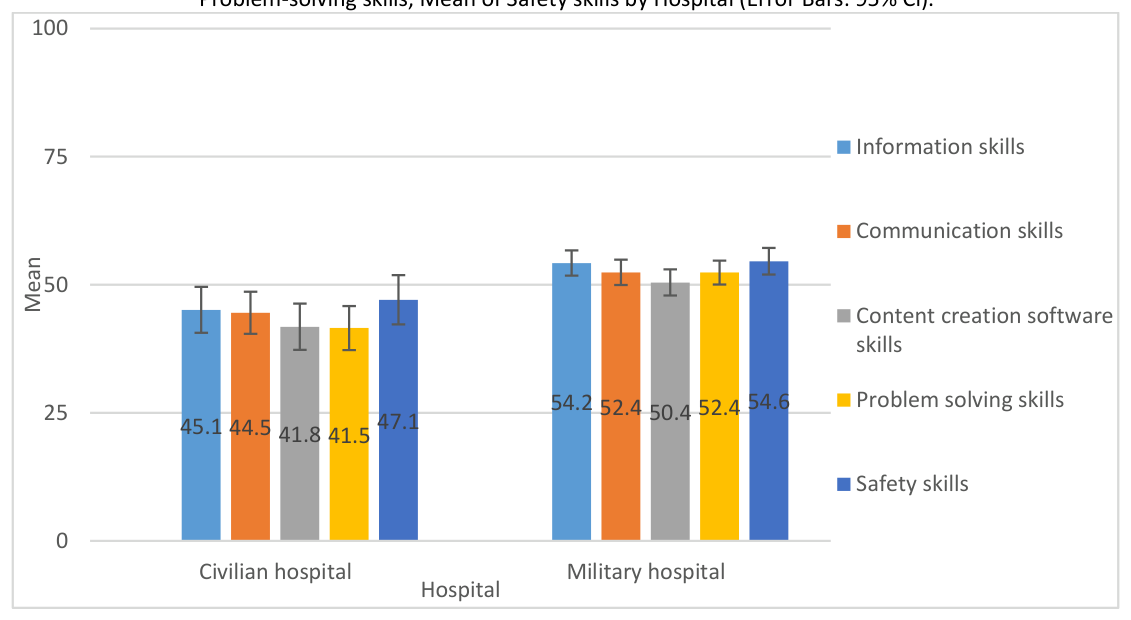
The mean scores across all five subscales of the measurement tool were found to differ significantly between military and civilian hospitals. Specifically, the mean score for the “Information skills” subscale in military hospitals was M = 54.2 (SD = 32.1), compared to M = 45.1 (SD = 32.2) in civilian hospitals, with t(855) = -3.522, p < 0.001. For the “Communication skills” subscale, the mean score in military hospitals was M = 52.4 (SD = 32.3), while in civilian hospitals it was M = 44.5 (SD = 29.5), with t(855) = -3.088, p = 0.002.
Similarly, the “Content creation skills” subscale showed a mean score of M = 50.4 (SD = 33.3) in military hospitals versus M = 41.8 (SD = 32.4) in civilian hospitals, with t(855) = -3.236, p = 0.001. For “Problem-solving skills,” the mean score in military hospitals was M = 52.4 (SD = 30.4), compared to M = 41.5 (SD = 30.8) in civilian hospitals, with t(855) = -4.395, p < 0.001. Lastly, the “Safety skills” subscale yielded a mean score of M = 54.6 (SD = 33.8) in military hospitals and M = 47.1 (SD = 34.5) in civilian hospitals, with t(855) = -2.740, p = 0.006.
The mean values (SD) of digital skills (information, communication, content creation, problem-solving, and safety skills) by hospital type are illustrated in Figure 1.
Based on the theoretical framework outlined, the findings of this study align with existing research emphasizing the growing importance of digital skills for healthcare professionals. Digital competence is essential not only for the effective delivery of healthcare services but also for ensuring patient safety and enhancing the overall efficiency of healthcare systems [16,17]. These competencies enable healthcare professionals to manage patient data effectively, navigate electronic health records [18,19], process large volumes of information[20], and utilize telemedicine tools [21,22]—capabilities that are no longer optional, but essential and fundamental to healthcare professionals’ expertise [10,23,24].
In the present study, digital skills of the Greek study population can be characterized as good, as they are proven to be above the median level, with safety and information skills gathering the highest averages, communication and problem-solving skills being at the median level, and content creation skills being the weakest, with a score just below the median level. It is noteworthy that content creation skills require particular IT knowledge and technical skills, such as developing or maintaining computer systems, hardware, or software, and writing a computer program using a specialized programming language. Thus, they appear as the digital skills category with the lowest proficiency rates in the majority of occupations in Europe [25].
The above levels of digital skills are in line with a similar Greek study, where the digital competence of healthcare professionals is moderate to good [26]. Research conducted on healthcare professionals in European countries shows that the majority have medium levels of digital competence. A study carried out in Moldova found advanced levels of digital skills in the areas of information and communication and moderate levels in the areas of content creation, safety, and problem solving[6]. In Finland, the levels of digital
competence are relatively high[27], while in some regions in Finland and Sweden, digital skills are reported as adequate but with several shortcomings[16] and in Catalonia, they appear at a basic and intermediate level [28]. According to the European Centre for the Development of Vocational Training (Cedefop), in terms of digital intensity measurements in the EU for 2021, the level of digital skills for health professionals appears as basic to intermediate, and only in a percentage of 13.4% as advanced [29].
Consistent with prior research, this study also revealed that younger healthcare professionals demonstrated higher levels of digital competence, particularly in domains such as communication and content creation. Literature suggests that younger professionals tend to exhibit greater eHealth literacy and are more adept at using digital tools [30,31]. This generational disparity in digital skills underscores the need for targeted interventions that provide older healthcare professionals with the necessary training and support to enhance their digital proficiency. Hospital management can organize continuing education programs that are easily accessible and tailored explicitly to older professionals, such as online courses, interactive sessions, or specially designed workplace courses.
It is worth noting that, in the measurement tool, all possible demographic confounding factors were included to avoid biased conclusions. According to the literature review, the demographic factors found to be associated with digital skills levels were age, type of occupation, gender, professional experience, and educational level, which were studied in our research [30,32,33]. However, the results of this study found no significant differences in digital skills based on gender, professional experience, specialty, or educational level.
In addition, research underscores the critical role of the working environment in shaping digital literacy. For instance, De Veer and Francke (2010) observed that attitudes toward electronic health records varied significantly depending on the type of healthcare organization [11]. Similarly, Jarva et al. (2023) as well as Rippen et al. (2013), emphasized that strong organizational support—through timely interventions and the provision of adequate resources—is essential for the successful adoption of digital technologies by healthcare professionals [9,34]. Similarly, the findings of the present survey revealed significant differences in digital skills between military and civilian hospitals, with the predominance of health professionals in military hospitals.
This superiority can be attributed to several factors, including the structured nature of military institutions, where digital training and protocols are more systematically integrated into daily operations [35,36]. Military hospitals often place a stronger emphasis on technical proficiency and operational readiness [37,38], which likely fosters the development of higher digital literacy among their staff. Moreover, they prioritize digital training for their personnel as part of their operational strategies and compliance with applicable protocols. In contrast, civilian hospitals may face a broader array of challenges, including inconsistent administrative policies and slower technology adoption due to resource constraints [35,39].
In Greece, in recent years, the Ministry of Digital Governance, in coordination with the Ministry of Health and other bodies, has been working to strengthen the digital competence of doctors and nurses through the implementation of a national e-health strategy. Among the objectives are to improve the continuous education of health professionals and to ensure access to reliable digital information and tools [40]. However, training programs for civilian health professionals are usually their personal responsibility, as organizational procedures are inadequate. In contrast, in military environments, such programs are supported by the respective military education sectors, financed with their own resources and means, and organized on a regular and periodic basis for the training of all their personnel.
The operation of military hospitals, with adherence to hierarchical procedures, is a significant factor in their ability to implement and
train staff in digital technologies efficiently. These institutions often adopt new systems at a faster pace, which may explain the consistently higher levels of digital proficiency observed among healthcare personnel in military settings. Such an organizational advantage aligns with the findings of Ludwick and Doucette (2009), who emphasized that organizational readiness and robust support systems are critical to the successful implementation of electronic health records [41].
Furthermore, the constant exposure to technology [36,42] and digital tools [43,44] observed in military settings provides healthcare professionals with more opportunities to enhance their digital skills. In contrast, civilian hospitals face a variety of challenges that may hinder the development of such competencies. In Greece, these challenges include diverse administrative structures, slower decisionmaking processes, and limited access to resources for digital training [45,46]. The inherent flexibility within civilian hospital operations may further contribute to inconsistencies in the application and development of digital skills among healthcare professionals. This discrepancy could reflect differences in organizational priorities and the availability of technological resources within these institutions.
A noteworthy area where military healthcare professionals excel is in safety skills, likely due to the stringent data protection and cybersecurity protocols mandated within military environments [47,48]. This focus on safeguarding sensitive patient and operational data, cultivates a more advanced understanding of cybersecurity measures among military hospital staff. Although civilian hospitals also prioritize data security, they often encounter greater challenges in implementing uniform protocols due to variations in organizational structure and resource constraints.
Another significant disparity lies in problem-solving skills. Military healthcare professionals appear to be better equipped to handle technical challenges, potentially due to the emphasis on problem-solving as an integral part of military training and operational effectiveness [49]. In contrast, the less regimented procedures commonly found in civilian hospital settings may provide healthcare professionals with fewer structured opportunities to develop and refine these skills.
We consider that the Ministry of Health or the EU frameworks could adopt military-style training modules emphasizing techniques such as extensive practical training, simulation exercises, the development of specialized centers of expertise, field training techniques, the use of existing training frameworks, needs- and context-based design, continuous harmonization with modern standards, and synergies between civilian and military professionals. One such model is the Common Security and Defence Policy (CSDP) Training Programme, an EU policy to provide senior civil and military officers with the necessary skills and knowledge in crisis management situations [50].
We believe that civil-military cooperation, by embracing strengths and avoiding weaknesses, could improve the overall digital capability of health professionals. As military hospitals provide a more conducive environment for developing digital skills, civilian hospitals could benefit from adopting some of the structured approaches used in military hospitals. With the continuous evolution of healthcare technology, it is essential that all healthcare professionals, irrespective of their work environment, are supported in acquiring and maintaining high levels of digital competence.
Digital skills among healthcare professionals represent a burgeoning field of research that has experienced rapid growth over the past decade. The findings of this study highlight the need to explore further the role of institutional support in fostering digital skills, as well as the factors contributing to digital competence gaps among healthcare professionals across different organizational settings. These results hold international relevance, given the global significance of digital transformation in the healthcare sector. With additional research conducted in similar settings across various countries, these findings could be generalized to further advance digital literacy and transformation in healthcare systems worldwide.
This study is subject to three key limitations that may affect the generalizability of the findings. First, the participating nurses were all registered nurses (European Qualifications Framework – EQF 6) and not practicing nurses (EQF 5), and therefore, the measurement tool is validated and reliable only for registered nurses. Second, a self-assessment questionnaire was used as a measurement tool, which entails the risk of subjectivity due to overestimation or underestimation of the actual skills of the participants. Finally, the convenience sampling approach carries the risk of bias and systematic errors.
This study underscores the critical importance of digital skills among healthcare professionals, drawing attention to notable differences between staff in military and civilian hospitals. The findings indicate that military healthcare professionals generally demonstrate higher levels of digital competence, likely attributable to the structured and resource-rich environments characteristic of military hospitals. These organizational factors, which foster a more digitally skilled workforce, serve as a foundation for identifying and implementing necessary organizational improvements that healthcare managers can leverage.
However, it is important to note that both military and civilian healthcare professionals exhibited moderate levels of digital skills overall, signifying substantial room for improvement across both settings. Strengthening digital competence across the healthcare sector remains essential for meeting the demands of modern healthcare systems.
The authors declare no conflict of interest. This research received no external funding.
No artificial intelligence automatically generated text was inserted in this manuscript, and no image was previously published in another journal or is under consideration for publication elsewhere.
Conceptualization, A.K. and C.M.; methodology A.K. and C.M.; software, A.K. and C.C.; validation, A.K. and C.M.; formal analysis, C.C. and V.A.K.; investigation, A.K., D.K., V.A.K., M.M., V.T. and C.M.; resources, A.K. and C.M.; data curation, A.K., D.K., C.C. and C.M.; writing—original draft preparation, A.K.; writing—review and editing, A.K., D.K., C.C., V.A.K., M.M., V.T. and C.M.; visualization, A.K.; supervision, C.M., D.K. and C.C.; project administration, A.K., C.C. and C.M. All authors have read and agreed to the published version of the manuscript.
The study was conducted in accordance with the Declaration of Helsinki and approved by the Hellenic Mediterranean University Ethics Committee (Nursing Department’s Executive Board 4634/29-03-2021).
Informed consent was obtained from all subjects involved in the study.