
The clinical state of frailty is one of the most difficult issues facing the senior citizen population. Frailty is linked to a higher risk of falls, disability, hospitalization, and mortality [1] and is thought to be common as people age. The onset of frailty in the elderly is often characterized by muscular weakness, reduced mobility, and constraints in performing routine physical tasks. [2]. Sarcopenia is characterized by the loss of muscle mass and can stem from chronic malnutrition, musculoskeletal changes related to aging, chronic illnesses, micro-inflammation, and related comorbidities. For elderly individuals, being admitted to the hospital is one of the most distressing experiences. The gait speed test is a widely used tool for assessing the mobility of elderly individuals [3]. The level of physical activity and adequate nutrition intake considerably declined among older adults at risk of developing sarcopenia [4]. Muscle weakness and reduced movement speed leading to disabilities characterize sarcopenia, a health condition associated with the aging process among the geriatric population. [5]. Physical activity and gait speed are protective factors for the occurrence of sarcopenia in older adults. The primary physical activity for seniors is walking. Clinical research and
clinical objectives are increasingly relying on the evaluation of walking ability [6]. Evaluation of gait speed and its effects on hemodynamic parameters and cognitive status in older persons was the aim of this study.
From the 160 patients hospitalized in the months of January-March who met the eligibility criteria: 8 patients refused to participate, 4 patients presented a new diagnosis of oncological disease in the middle of the hospitalization and 5 patients withdrew.
Our study involved 143 patients, 113 of whom were women, and had a mean age of 72.85 ± 10.07 years. This six-month observational, clinical trial was conducted at the Geriatrics Clinic “Carol Davila” in the Chronic Disease Hospital “Sf. Luca.” Enrolment was contingent upon the participants fulfilling the subsequent eligibility requirements: being 65 years of age or older; having no self-reported health conditions that would preclude physical examinations; being able to perform basic mobility tasks (such as walking without extreme pain, aching, or stiffness); and not being undergoing cancer treatment, knee or hip replacement, heart or spinal surgery, myocardial infarction within the previous six months, or experiencing chest pain while walking within the previous 30 days. A MMSE score < 20 points resulted in the exclusion of participants. Before participating, each participant gave written, informed consent. The Clock Drawing Test (CDT) is a simple tool used to check for early signs of dementia, scoring up to 10 points. We used the Short Physical Performance Battery (SPPB) to measure physical activity, which includes the tandem standing, 4-meter walk test, and Up-and-Go [7]. For functional capacity, we used the standardized scales Activity Daily Living (ADL) with ranges from 0 to 6 points and Instrumental Activity Daily Living (IADL) with ranges from 0 to 8 points, where a high score indicates high function [8, 9]. We measured hand grip strength using a hydraulic dynamometer and used the Tensiomed Arteriograph to evaluate arterial vascular stiffness: pulse wave velocity (PWVao), heart rate (HR), central aortic systolic blood pressure (SBPao), and central aortic pulse pressure (PPao) [10].
To illustrate the degree of comorbidity, we categorized the patients into three groups based on a comorbidity index: low comorbidity index, which represented patients with up to two chronic pathologies; moderate comorbidity index, which represented patients with three to five chronic pathologies; and high comorbidity index, which represented patients with more than five chronic pathologies.
The inclusion of patients with metabolic syndrome was achieved by evaluating those with 3 criteria (MS3) or with the presence of 4 of them (MS4) and all 5 criteria (MS5). In addition, we conducted a search through reference lists of pertinent publications, Google Scholar, EBSCOhost, and Medline in order to find published hand grip strength norms.
All determinations are performed according to the protocol and the results are analyzed according to standardized scales. This study was approved by the Ethics Commission (9/09.12.2023).
All the data from this study were analyzed using IBM SPSS Statistics 25 and illustrated using Microsoft Office Excel/Word 2021 Stundent’s t-test was used for parametric distributions. Qualitative variables were written as absolute frequencies with percentages and were tested between groups using Fisher’s Exact Test.
The age caused changes in the physical status of patients. Thus, 56% of the subjects with low physical activity were in the age group 75-84 years, and only 39% of very elderly subjects were characterized by medium and good physical activity (Chi-square test, p < 0.001). Also, in the “very, very elderly” age group (over 85 years), we noticed the same statistically significant difference between the two groups (see Figure 1).
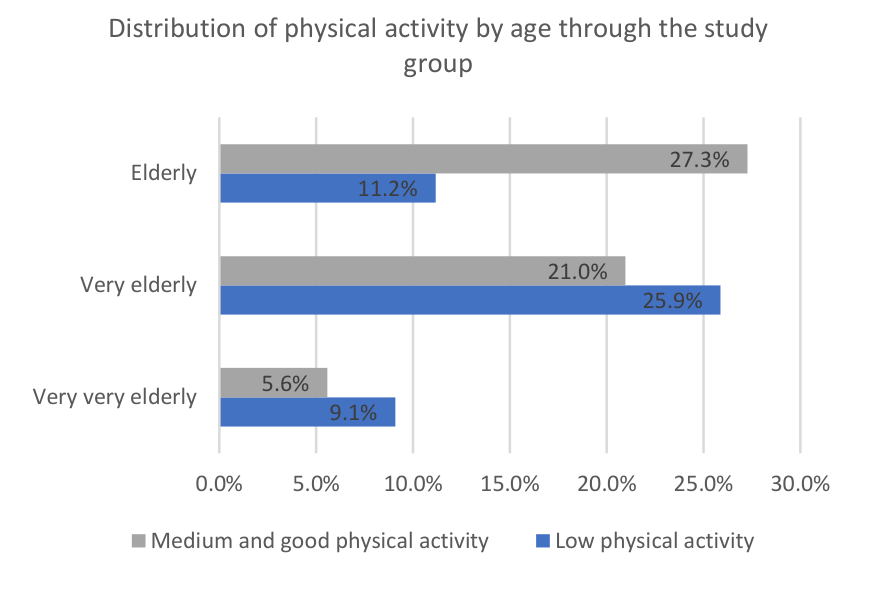
<!– Start of picture text –> Distribution of physical activity by age through the study<br>group<br>27.3%<br>Elderly<br>11.2%<br>21.0%<br>Very elderly<br>25.9%<br>5.6%<br>Very very elderly<br>9.1%<br>0.0% 5.0% 10.0% 15.0% 20.0% 25.0% 30.0%<br>Medium and good physical activity Low physical activity<br><!– End of picture text –>
Within the group, there is no statistically significant difference in terms of physical performance and the number of associated diseases (expressed by the comorbidity index, student T-test) (see Table 1).
The functional capacity of the elderly in the study group was relatively normal, with no more than two activities affected, especially in the instrumental activities of living: the mean IADL is 6.66 ± 1.71 (out of a maximum of 8 points), and the mean ADL is 5.74 ± 0.92 (out of a maximum of 6 points). Quantitative independent variables were tested between groups using Mann–Whitney U tests (see
Table 2).
| Characteristic | Low physical activity (N = 66) | Medium and good physical activity (N= 77) | p |
|---|---|---|---|
| Comorbidity index Low Moderate High | 1 (2%) 52 (79%) 13 (19%) | 2 (2%) 66 (86%) 9 (12%) | 0.389 |
| Metabolic syndrome criteria Without MS<sup>1</sup> MS3 MS4 and MS5 | 18 (27%) 23 (35%) 25 (38%) | 14 (18%) 34 (44%) 29 (38%) | 0.353 |
| Diabetes Yes No | 29 (44%) 37 (56%) | 40 (52%) 37 (48%) | 0.339 |
| Characteristic | Low physical activity (N = 66) | Medium and good physical activity (N = 77) | p |
|---|---|---|---|
| ADL | 5.50 ± 0.93 | 5.95 ± 0.87 | 0.004 |
| IADL | 6.06 ± 1.81 | 7.17 ± 1.43 | < 0.001 |
| Subjective fatigue Rare Sometimes Often | 8 (12%) 9 (14%) 49 (74%) | 17 (22%) 37 (48%) 23 (30%) | < 0.001 |
| Hand grip strength | 11.74 ± 2.9 | 17.08 ± 4.94 | < 0.001 |
| Walking speed | 0.34 ± 0.1 | 0.69 ± 0.13 | < 0.001 |
| Statin treatment Yes Not | 29 (44%) 37 (56%) | 39 (51%) 38 (49%) | 0.423 |
Physical performance and impact on daily activity scores show a direct relationship between the functionality and the SPPB values. A statistically significant difference was found in IADL scores within the group with low physical activity (6.06 ± 1.81 compared to 7.17 ± 1.43, Student’s t-test, p < 0.001). Additionally, basic individual needs, such as eating and washing, are impacted in the group with reduced functionality, as measured by the ADL, like those with lower physical performance (Student’s t-test, p = 0.004) (see Table 2).
Hand grip strength measured by a dynamometer, adjusted for age, gender, and height, revealed a significant difference in the group with low physical activity, with an average strength of just 11.74 ± 2.9 kg (Student’s t-test, p < 0.001) (see Table 2).
In the context of long-term treatment of elderly patients with chronic cardiovascular disease, statins are often associated with the development of sarcopenia, chronic fatigue, and reduced physical activity. However, our study findings revealed no statistically significant correlation between the use of statins and the decline in hand grip strength or physical performance among the elderly patients in our study group. Remarkably, more than half (51%) of the elderly patients undergoing statin treatment maintained satisfactory levels of physical activity (see Table 2).
In our analysis of walking speed, we calculated patients’ movement rates and correlated them with some hemodynamic parameters (HR, PWVao, PP) and functional capacity, through multiple regression analyses. We divided the patients into three groups: the first group (home movement) consisted of elderly individuals at heightened risk of disability who have limited mobility confined to their residence, with a walking speed of up to 0.4 m/s; the second group (limited community movement) included elderly people engage in movement within the community and are at moderate risk of losing their autonomy, with a walking speed between 0.4 – 0.8 m/s; the third group (full mobilization) comprised individuals who are not exposed to the risk of disability and are fully mobile with a walking speed exceeding 0.8 m/s (see Table 3).
The results showed a significant statistical difference on the pulse pressure (PP) (p = 0.001). This indicator could potentially serve as a valuable predictor for gauging cardiovascular risk and assessing disability risk, particularly in relation to walking speed.
Regarding the cognitive level there is a clear difference between the two groups. The mean MMSE values, which assess the cognitive status of the subjects, are significantly lower (21.02 ± 4.68 points) among those with low activity compared to those with good physical activity (Student t-test, p < 0.001) (see Table 4).
| Group 1 = home movement (N = 48) | Group 2 = limited community movement (N = 71) | Group 3 = full mobilization (N = 24) | p | |
|---|---|---|---|---|
| ADL | 5.46 ± 0.84 | 5.80 ± 0.95 | 6.13 ± 0.85 | 0.011 |
| IADL | 6.19 ± 1.8 | 6.75 ± 1.71 | 7.33 ± 1.09 | 0.021 |
| PWVao | 10.37 ± 1.74 | 9.94 ± 1.93 | 9.95 ± 1.63 | 0.419 |
| PP | 66.71 ± 14.23 | 65.17 ± 15.31 | 53.42 ± 12.75 | 0.001 |
| HR | 68.81 ± 12.7 | 66.61 ± 11.36 | 65.33 ± 7.02 | 0.404 |
| Characteristic correlation | Coefficient | p |
|---|---|---|
| PWVao and SPPB | – 0.141 | 0.092 |
| HR and SPPB | – 0.166 | 0.047 |
| Walking speed and SBPao | – 0.149 | 0.076 |
| Walking speed and Body Mass Index (BMI) | 0.125 | 0.138 |
| Walking speed and MMSE | 0.339 | < 0.001 |
| Right-Hand grip strength and SPPB | 0.422 | < 0.001 |
| Left-Hand grip strength and SPPB | 0.440 | < 0.001 |
| Fatigue and statin treatment | 0.064 | 0.450 |
The presence of this difference comes as an important finding that supports the potential role of physical exercise in preventing cognitive impairments in the elderly. Given the limited effectiveness of current drug treatments for dementia, geriatric clinicians should place greater emphasis on incorporating physiotherapy programs for these elderly patients.
Another important finding is the difference between the two groups in the case of the Clock Drawing Test (CDT), which is easy to use, quick to administer, and can be implemented as a screening tool in primary care settings [11].
The group of those with low physical activity had an average CDT score of 6.63 ± 1.33 points (out of a max. 10 p), compared to an average score of 7.96 ± 1.72 points among those with good physical performance (Student t-test, p < 0.001). Our findings once again emphasize the importance of the age-old adage, “Mens sana in corpore sano”.
Regular physical activity is not only crucial for maintaining autonomy but also for preserving cognitive function [12]. It is widely recognized that consistent aerobic exercise enhances cardiorespiratory function, reduces arterial stiffness [13], diminishes cardiovascular risk factors, and lowers cardiovascular mortality. Conversely, anaerobic exercises promote skeletal muscle strength and are instrumental in preventing age-related muscle atrophy [14]. Elderly patients can benefit from the high level of education of nurses, which influences the degree of clinical autonomy. The nurse needs to be aware of any barriers to learning, like loss of hearing or decline of vision and should tailor his or her education for that specific patient [15].
Physical activity is an effective strategy for protecting against sarcopenia and promoting healthy aging. Most studies on exercise in elderly people show that participants achieve positive results, although maintaining muscle strength appears to depend on the continued implementation of certain types of physical activities. One of the conclusions from a meta-analysis of 10 studies was that there was no consistency in the measurement of sarcopenia, indicating a need for further investigations [16].
For elderly people, regular exercise (at least one hour, at least twice a week) through personalized exercise programs can have beneficial cardiovascular effects, such as lowering blood pressure, improving skeletal muscle perfusion, and enhancing glucose utilization in myocytes. Additionally, regular exercise helps maintain muscle fiber quantity and supports skeletal muscle strength [17]. Numerous studies have demonstrated the significant impact of this factor on recovery rates in neurological system disorders and cardiovascular diseases, both of which are primary contributors to disability and diminished quality of life (QoL) [18-20].
The QoL significantly influences patients’ adherence to treatment and their overall recovery, making it a pivotal endpoint in clinical research. Aspects such as pain management, emotional well-being, social interactions, and independence profoundly impact patient outcomes. Consequently, enhancing QoL becomes a primary objective from the point of diagnosis. While both patients and physicians acknowledge the importance of prolonging survival, maintaining an optimal quality of life throughout the treatment process is equally imperative [21]. We consider that physical activity plays a major role in enhancing QoL. Due to the Coronavirus (COVID-19) pandemic, many elderly individuals—already a high-risk group for severe illness and adverse SARS-CoV-2 outcomes—opted to remain at home out of fear of contracting the virus, regardless of their associated comorbidities. Consequently, it is hypothesized that a significant
number of older adults are now facing the repercussions of that period, notably sarcopenia, which is linked to a lack of physical activity. As a result, these individuals are now tasked with recovering from that phase, underscoring the need to increase awareness about the importance of physical exercise in this population [22]
In our study, the measurement of muscle strength through the dynamometer revealed a significant difference in the group of elderly patients with low physical activity (Student t-test, p < 0.001). Traumatic injuries accounted for the largest percentage of rehabilitation cases in Romania (73.17%), with musculoskeletal illnesses coming in second (70.06%). Reduced recovery was observed in cases of neurological system disorders (50.56%) and cardiovascular diseases (44.23%) [18].
Although other studies have debated the potential link between statin administration in the elderly and the development of sarcopenia, fatigue, and decreased physical activity [23], our group did not find a positive correlation supporting this relationship. Hence, it endorses the recommendations for the continued utilization of statins, even in advanced age, as they have exhibited protective advantages in averting cardiovascular incidents.
Analyzing and interpreting walking speed presents a challenge for clinicians, but recent specialist studies have provided new insights into survival and mortality predictors. Normal walking speed requires a relatively low level of energy consumption [24, 25]. Our study found statistically significant results related to pulse pressure (PP), which is considered a predictor for evaluating disability risk in the elderly population [26].
Cognitive status can be improved by exercise. Several prospective studies have demonstrated that maintenance of higher levels of physical fitness helps protect against cognitive deterioration, even at an advanced age [12,27,28]. Conversely, poor physical performance among older adults may accelerate cognitive decline and lead to early onset of dementia [29, 30]. Additionally, muscle strength has been linked to cognitive performance [31,32]. Promising trials utilizing AI and technology, which show significant improvements in autonomy and reduced reliance on human resources point to a bright future for the medical care and recovery of elderly patients with cognitive impairments [33,34,35].
Several limitations of the present study should be acknowledged. First, the study sample was predominantly female, which could potentially influence the results. Second, the study group was relatively small, and there was a lack of homogeneity, which may affect the comparability of the findings with the broader Romanian population.
Maintaining physical performance, especially in the elderly with associated chronic diseases, has an important role in maintaining autonomy and quality of life, especially in the very old and very, very old age groups that become frailer. Assessing hand grip strength can provide valuable insights into physical performance and guide lifestyle optimization and treatment recommendations for elderly patients. Exercise training has been shown to improve hemodynamic status (including SBP, PP, SBPao, PPao) and may help delay arterial aging, playing an important role in healthy aging. Muscle strength, balance, flexibility, endurance, and mobility are all aspects of whole-body functioning that are included in physical performance. When older adults perform poorly physically, they experience a decline in their quality of life, a loss of cognitive function, an increase in their risk of falling, poorer clinical outcomes, and a reduction in their independence when it comes to doing activities of daily living (ADL).
Early detection of rehabilitation potential in frail elderly patients is essential for initiating timely recovery interventions through specialized medical services and multidisciplinary teams.
From a practical and clinical perspective, developing a consistent program of adapted, personalized physical activities is necessary. Such programs can positively affect functional parameters and significantly enhance the quality of life for elderly individuals. In order to corroborate these findings and draw further conclusions, it is essential to conduct studies encompassing a more diverse and extensive demographic.
The authors declare no conflict of interest. This research received no external funding.
The current manuscript does not contain previously published materials or self-generated AI text.
Conceptualization, J.A., S.M.A., A.Z. and C.O.; methodology, R.M., A.P..; software, S.M.G, C.D.G., A.G.P .; validation, J.A., S.M.A., A.Z. and C.O; formal analysis, J.A., A.Z., V.M.A.M., M.N; investigation, V.M.A.M., C.D.G., S.M.G.; resources, A.G.P., S.M.A., M.N., C.O.; data curation, S.M.G, C.D.G, A.G.P., M.N.; writing—original draft preparation, J.A, S.M.A, A.Z., C.O.; writing—review and editing, J.A., S.M.A., C.O.; visualization, A.Z., R.M., S.M.A.; supervision, S.M.A, J.A, C.O.; project administration, A.Z., J.A.; funding acquisition. All authors have read and agreed to the published version of the manuscript
The study was conducted in accordance with the Declaration of Helsinki and approved by the Ethics Commission of the HOSPITAL OF CHRONIC DISEASES “SF. LUCA” (protocol code 9, date of approval 09.12.2023).
Written informed consent to participate in the research was obtained from each patient/subject..