
The World Health Organization (WHO) considers antimicrobial resistance (AMR) among the top 10 priorities for global public health. This phenomenon has developed and spread due to the selection pressure resulting from the excessive or incorrect use of antibiotics [1]. The number of deaths caused by antimicrobial resistance (AMR) could exceed 10 million annually by the year 2050 without active measures promoting the prudent use of antibiotics, improving hand hygiene in hospitals and environmental healthcare hygiene, as well as enhancing food biosecurity [2].
The emergence of multidrug-resistant (MDR) bacteria poses a concerning issue for public health due to the increased risk of healthcare-associated infections and limited treatment options. “ESKAPE” is an acronym for six bacteria of major interest in AMR surveillance systems, namely: (E) Enterococcus faecium, (S) Staphylococcus aureus, (K) Klebsiella pneumoniae, (A) Acinetobacter baumannii, (P) Pseudomonas aeruginosa, and (E) Enterobacter species [3, 4].
The “ESKAPE” pathogens are frequently implicated in severe infections, ranking high among the causes of morbidity and mortality worldwide. However, the WHO has developed a list of priorities within this group. Gram-negative bacilli are considered “critical”: carbapenem-resistant CBR Acinetobacter baumannii (A. baumannii), CBR Pseudomonas aeruginosa (P. aeruginosa), third-generation cephalosporin-resistant
(C3R) Klebsiella pneumoniae (K. pneumoniae), and C3R Enterobacter spp. In the second line of priority are Gram-positive cocci, namely vancomycin-resistant (VAN-R) Enterococcus faecium (E. faecium) and Methicillin-Resistant Staphylococcus aureus (MRSA) [5,6].
Antibiotics are frequently used to treat COVID-19-related bacterial infections. The excessive use of antibiotics during the COVID-19 pandemic can accelerate the emergence and spread of antibiotic-resistant bacteria [7].
In the first year of the COVID-19 pandemic, although many E.U. countries experienced a general decrease in antibiotic consumption both in the community and in healthcare facilities, certain antibiotics, such as azithromycin and ceftriaxone, saw an increase in usage. The reduction in prescriptions was induced by isolation, decreased mobility, and a decline in elective surgical interventions, but the impact of reduced antibiotic use on AMR, especially concerning the ESKAPE group, is insufficiently understood. In a survey conducted in 26 E.U. countries, monitoring antibiotic prescribing behaviors in healthcare facilities was halted in 9 countries, and antibiotic prescriber education programs were interrupted in 11 countries [8,9]. Understanding the link between COVID-19 and antibiotic use can contribute to the development of strategies to limit the impact of infections on vulnerable populations, thereby aiding the global effort to combat infectious diseases.
The study aims to assess the frequency of ESKAPE pathogens and their antimicrobial resistance profile during the COVID-19 pandemic (2020-2022) in a multidisciplinary Romanian hospital.
A retrospective analysis of the isolated bacterial strains was conducted in the Microbiology Laboratory of the Emergency Military Hospital ” Dr. Aristide Serfioti” Galati, derived from various biological samples obtained from hospitalized patients. The hospital is found in the Southeast region of Romania, on the eastern border of the European Union, and includes surgical departments (75 beds), medical departments (100 beds), and an intensive care unit (15 beds).
Escherichia coli and microorganisms in the ESKAPE group had their antibiotic susceptibility evaluated. Escherichia coli was included in the analysis due to its frequent association with horizontal gene transfer of resistance genes from other Enterobacterales, potentially reflecting the resistance profile of Klebsiella pneumoniae or Enterobacter spp, both of which are part of the ESKAPE pathogens [10].
The study was conducted from January 1, 2020, to December 31, 2022. This timeframe coincides with the hospital’s focus on COVID19 support, meaning that the hospital provided healthcare to COVID-19 patients, along with healthcare assistance to the general population, mostly in emergencies.
According to the current work procedures, bacterial isolation was performed by inoculating biological samples either “in sector” or “by exhaustion” on solid media, including Columbia blood agar, Chapman agar, and MacConkey agar (GRASO Biotech, Oxoid – Thermo Scientific, USA), followed by incubation for 24-48 hours at a temperature of 37°C. Biochemical identification of isolated bacterial strains was done through multi-testing and the automatic Vitek 2 Compact method (bioMérieux-l’Etoile).
Antibiotic susceptibility testing was conducted using either the classic disk diffusion method or the minimum inhibitory concentration (MIC) method with the Vitek 2 Compact automated system, adhering to the current CLSI standards of the working period. The choice of the MIC testing method was contingent upon laboratory availability, the clinical severity of the patient, and the need for an urgent result, particularly in cases of multidrug-resistant bacteria or discrepancies found in the disk diffusion testing.
Depending on the isolated bacteria and the type of sample, specific sets of antibiotics were used for the antibiotic susceptibility testing, including Penicillin’s (P – Penicillin – 10 U, A – Ampicillin – -lactam combination agents (AMC – Amoxicillin-clavulanate – 20/10, TZP – Piperacillin-tazobactam – 100/10 µg), cephems (CXM – Cefuroxime – 30 µg; FOX – Cefoxitin – 30 µg, CTX – Cefotaxime – 30 µg, CAZ – Ceftazidime, FEP – Cefepime – 30 µg), monobactams (AZM – Aztreonam – 30 µg), carbapenems (IMP – Imipenem – 10 µg, MEM – Meropenem – 10 µg, ERT – Ertapenem – 10 µg), fluoroquinolones (CIP – Ciprofloxacin – 5µg), macrolides (E – Erythromycin – 15 µg), TE – Tetracycline – 30 µg, lincosamides (DA – Clindamicyn); ansamycins (RIF – Rifampicine – 5 µg), sulfamides (SXT – Trimethoprim/suphamethoxazole – 25 µg), nitrofurans (NF – Nitrofurantoin – 300µg), aminoglycoside (CN – Gentamicin – 10 µg), glycopeptides (VAN – Vancomycin – 30µg, TEI – Teicoplanine – 30µg) and oxazolidinones (LNZ – Linezolid – 30 µg). The disk diffusion testing method used Oxoid Antimicrobial Susceptibility Disks from Thermo Scientific, USA, and Mast Group Ltd from the U.K. BioMérieux-l’Etoile products were employed for minimum inhibitory concentration (MIC) testing, defined as the lowest antibiotic , excluding intrinsic resistance. Results of susceptibility for each antibiotic were expressed as resistant, intermediate, or sensitive, and interpretation was made by the Clinical and Laboratory Standards Institute (CLSI) for the respective testing year [11,12,13]. Quality control procedures incorporated the use of reference strains for both identification and antibiotic resistance testing, including Staphylococcus aureus ATCC 29213, ATCC 25923; E. coli ATCC 25922; Pseudomonas aeruginosa ATCC 27853, Enterococcus casseliflavus ATCC 700327, Enterobacter hormaechei ATCC 700323, and Stenotrophomonas maltophilia ATCC 176666.
After removing duplicates, the antibiotic susceptibility test results were input into the electronic database of the laboratory. Analysis
of the antibiotic susceptibility profile facilitated the identification of significant resistance issues and risks posed by healthcareassociated infections in the hospital. Microorganisms that have minimum inhibitory concentrations (MIC) above the standard cut-off levels are resistant to antibiotics. According to the European Committee on Antimicrobial Susceptibility Testing (EUCAST), a microorganism classified as sensitive (S) indicates therapeutic success with standard antibiotic doses, intermediate (I) responds to therapy after exposure to higher antibiotic concentrations, and resistant (R) exhibits therapeutic failure even after elevated antibiotic concentrations [14].
Multidrug resistance (MDR) was considered if non-susceptibility was found to be at least one antibiotic from two or more classes while maintaining susceptibility to at least one antibiotic from three or more categories15. Other patterns of AMR were also notified: extended-spectrum beta-lactamases (ESBL) in Enterobacterales, carbapenem resistance (CBR) in P. aeruginosa and A. baumannii, methicillin resistance in S. aureus (MRSA) and vancomycin resistance of enterococci (Van-R) [16,17,18].
Statistical analysis of the data used version 19 of the Statistical Package for Social Sciences (SPSS). Descriptive statistics tests were onsidering a significance level of p<0.01.
The microbiology laboratory obtained 1117 bacterial isolates, during the pandemic 2020-2022. The lowest annual frequency of positive cultures was recorded in 2020 (266 strains), when the specific activity of the hospital’s departments was most restricted. The average length of hospitalization per year varied over the three years, ranging between 4.32 and 4.96 days.
| Hospital Department | Other surgery | ERT | General Surgery | Urology | ICU | Internal Medicine | Neurology | Pneumo | Other Medical | Total |
|---|---|---|---|---|---|---|---|---|---|---|
| Enterococcus faecium Non-faecium | – 1 | – 1 | – 5 | 1 65 | 3 12 | 1 6 | 1 7 | – 3 | – 1 | 6 102 |
| GPC Staphylococcus aureus | 1 | 39 | 18 | 3 | 20 | 2 | 2 | 3 | 3 | 91 |
| Co-Negative | – | – | 2 | 13 | 13 | 3 | 5 | 1 | – | 37 |
| Partial sum | 1 | 40 | 25 | 82 | 48 | 12 | 15 | 7 | 2 | 236 |
| Pseudomonas aeruginosa | 1 | 18 | 2 | 20 | 18 | 1 | – | 7 | 4 | 71 |
| NF- putida | – | – | – | 1 | – | – | – | – | – | 1 |
| GNR Acinetobacter baumanii | – | – | – | 1 | 1 | – | – | 2 | – | 4 |
| Partial Sum | 2 | 18 | 2 | 22 | 19 | 1 | 9 | 4 | 76 | |
| Klebsiella Pneumoniae | – | 8 | 2 | 71 | 27 | 13 | 13 | 13 | 8 | 155 |
| Others | – | 6 | 1 | 8 | 1 | 4 | 2 | 4 | 1 | 27 |
| Enterobacter spp | 1 | 6 | 3 | 19 | 5 | 5 | – | 4 | 5 | 48 |
| E. coli | 1 | 5 | 22 | 179 | 28 | 99 | 82 | 8 | 55 | 479 |
| Proteus spp | 1 | 10 | – | 36 | 4 | 4 | – | – | 3 | 60 |
| Morganella spp | – | – | 1 | 8 | – | 1 | 1 | – | – | 11 |
| GNR Citrobacter spp | – | 1 | 2 | 3 | 2 | 2 | 1 | 1 | 1 | 12 |
| Serratia marscenscens | – | 1 | 1 | 4 | 1 | – | 1 | – | – | 8 |
| Providencia stuartii | – | – | 1 | 1 | – | – | 1 | – | 3 | |
| Hafnia alvei | – | – | – | – | 1 | – | – | – | – | 1 |
| Salmonella spp | – | – | – | – | 1 | – | – | – | 1 | |
| Partial sum | 3 | 37 | 34 | 329 | 69 | 129 | 100 | 31 | 73 | 805 |
| Total | 6 | 95 | 61 | 433 | 136 | 142 | 115 | 47 | 79 | 1117 |
The isolated bacteria were grouped into Gram-positive cocci (GPC), Gram-negative bacilli from the Enterobacterales order, and Gramnegative non-fermentative rods (NF-GNR). The highest frequency of GPC was recorded during the first pandemic year, 25.5% compared to 17% in 2021 and 21.1% in 2022, while NF-GNR was identified more frequently in the second pandemic year, representing 9.1% compared to 6% in 2020 and 5.6% in 2022.
Urine cultures were the most requested microbiological investigations, constituting 80% of bacterial cultures. Much fewer analyses were performed on other biological samples such as 5% purulent secretions, 5% respiratory secretions, 3% ear secretions, and 1% nasal and pharyngeal exudates. Blood cultures represented only 0.45% of the tested biological samples.
The urology department reported the highest number of isolates, representing 38.76% of the total bacterial strains. The Internal
Medicine department accounts for 12.71%, the Intensive Care Unit for 12.17%, and Neurology for 10.29%. Bacterial strains were obtained from between 4.9% and 2.68% of the identified isolates from the ENT, Pneumology, Rheumatology, Surgery, and Cardiology departments. Each other hospital’s departments were associated with <1% of bacterial isolates (Table 1).
E. coli was isolated with the highest frequency, of 42.8% of species, potentially influencing antibiotic resistance in other Enterobacterales. At the same time, ESKAPE pathogens account for 33.5% of the bacterial strains.
Enterococci were identified in 108 isolates with the following distribution: 50.9% E. faecalis, 6% E. faecium, and 43% unspecified Enterococcus spp. E. faecium strains were notified in 6 cases, obtained from the urine cultures (3/6), blood cultures (2/6), and sputum (1/6), mostly on men (4/6), from the ICU (3/6). Each department of pulmonology, internal medicine, and urology reported a single strain. Among the six strains of E. faecium, one-third (2/6) were resistant to Vancomycin and Teicoplanin, and half of the strains (3/6) were multidrug-resistant (MDR). None of the strains were sensitive to Ciprofloxacin (Figure 1a).
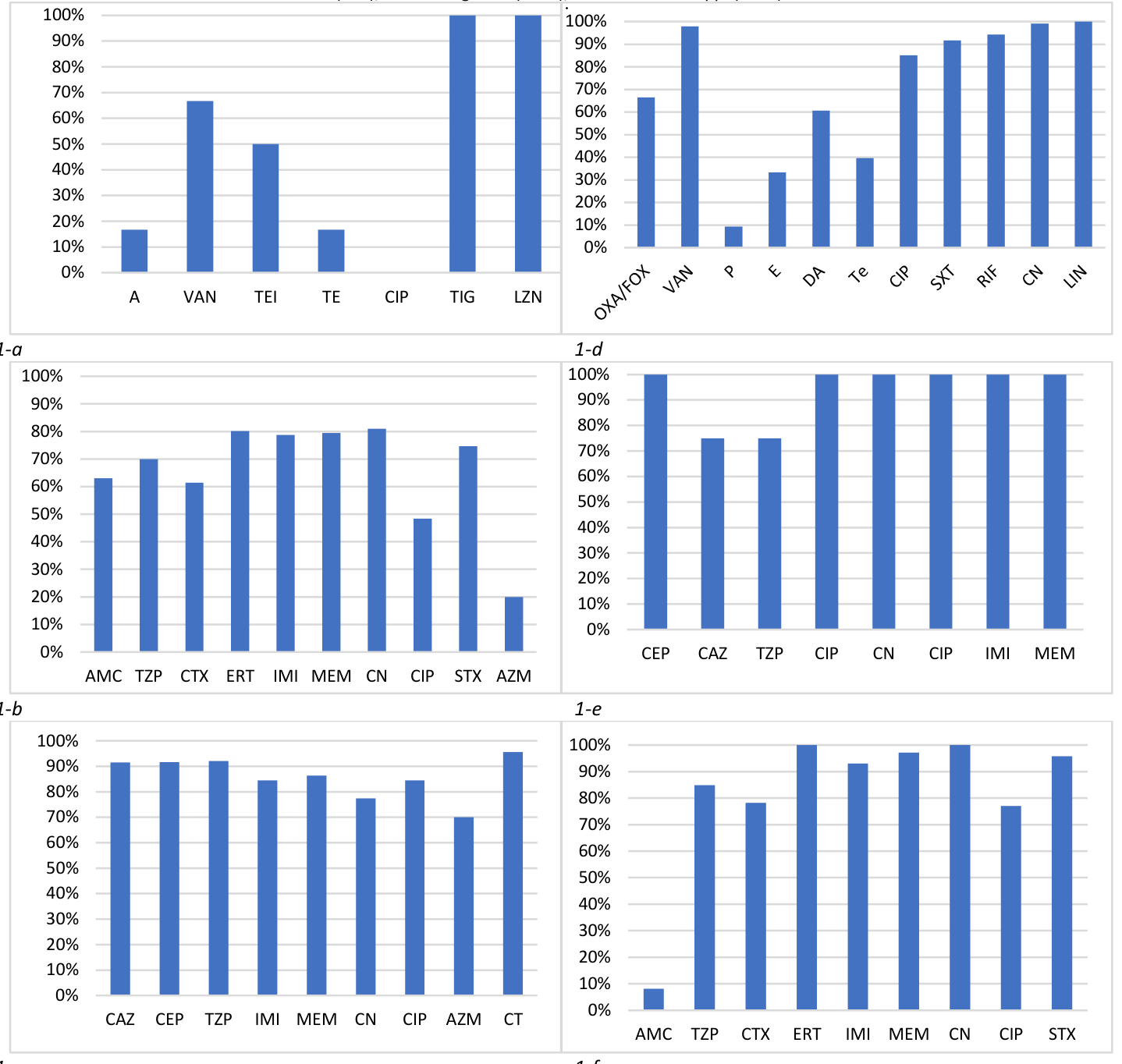
<!– Start of picture text –> 100% 100%<br>90% 90%<br>80% 80%<br>70% 70%<br>60% 60%<br>50%<br>50%<br>40%<br>40%<br>30%<br>30%<br>20%<br>20% 10%<br>10% 0%<br>0%<br>A VAN TEI TE CIP TIG LZN<br>1-a 1-d<br>100% 100%<br>90% 90%<br>80% 80%<br>70%<br>70%<br>60%<br>60%<br>50%<br>50%<br>40%<br>40%<br>30%<br>30%<br>20%<br>20%<br>10%<br>10% 0%<br>0% CEP CAZ TZP CIP CN CIP IMI MEM<br>AMC TZP CTX ERT IMI MEM CN CIP STX AZM<br>1-b 1-e<br>100% 100%<br>90% 90%<br>80% 80%<br>70%<br>70%<br>60%<br>60%<br>50%<br>50%<br>40%<br>40%<br>30%<br>30%<br>20%<br>20%<br>10%<br>10%<br>0%<br>0%<br>CAZ CEP TZP IMI MEM CN CIP AZM CT<br>AMC TZP CTX ERT IMI MEM CN CIP STX<br>1-c 1-f<br><!– End of picture text –>
Legend: P–penicillin; A–ampicillin; AMC-amoxicillin-clavulanate; TZP–piperacillin-tazobactam; CXM – cefuroxime; FOX – cefoxitin; CTX- cefotaxime; CAZ-ceftazidime; CEPcefepime; CT: colistin; AZM-aztreonam; IMP-imipenem; MEM-meropenem; ERT-ertapenem; CIP- ciprofloxacin; E-erythromycin; TE-tetracycline; TIG- tigecycline; DAclindamicyn; RIF-rifampicine; SXT– trimethoprim/suphamethoxazole; CN-gentamicin; VAN- vancomycin; TEI- teicoplanin; LNZ-linezolid.
A total of 128 staphylococcal strains were isolated and identified as follows: 71% S. aureus and 29% Coagulase-Negative Staphylococcus (Co-NS), represented by S. epidermidis (23), S. warneri (4), S. haemolyticus (3), S. hominis (2), S. lugdunesis (1), S. saprophyticus (1), and unspecified Co-NS (3). Most S. aureus strains were identified in nasal or pharyngeal exudates (29.7%), purulent secretions (18.7%), and ear secretions (17.6%). Most samples were taken from patients in the Otorhinolaryngology (ENT) department, Intensive Care Unit, and Surgery departments (85.7%). The frequency of MRSA strains was 33.6%. The MDR rate for S. aureus was 44.5%. The lowest susceptibility of S. aureus was recorded for Penicillin at 9.4%, Erythromycin at 30%, Daptomycin at 60.1%, and Tetracycline at 39.6%. Susceptibility remained at 85% for CIP, 91.66% for SXT, 94.2% for RIF, and 99% for CN (Figure 1b).
A total of 182 Klebsiella spp strains were isolated, including 85.16% K. pneumoniae, 5.5% K. oxytoca, and 9.3% unspecified species. Most of the cases (64.55%) were found in male patients, and most of the strains came from urine cultures (69%), sputum (9%), and purulent secretions (6%), mainly from the urology department (43.4%), intensive care (15.38%), pulmonology (9.3%), and internal medicine (9.3%). The antibiotic susceptibility profile highlighted AMC 69.8%, CTX 64.1%, TZP 75%, CN 80.9%, CIP 48.3%, STX 76.1%. Resistance to Aztreonam was found in 80% of antibiograms, noting that only 25 strains were tested. The resistance rate to carbapenems in K. pneumoniae strains was 21%, while MDR was found in 18.7% of the isolates (Figure 1c). There is no available data on the susceptibility of reserve antibiotics, as colistin, Ceftazidime + Avibactam. Meropenem + Vaborbactam.
Pseudomonas strains were identified in samples taken from 72 patients, of which 71 were P. aeruginosa and one was P. putida. 60.56% of the patients were males. The main products from which P. aeruginosa was isolated included urine (30.55%), ear secretion (23.6%), purulent secretions (15.27%), and sputum (6.9%), mainly from urology, ENT department, and intensive care units. The CBR rate is 15.5%, and the MDR rate is 6.8%. Among the 50 strains tested, resistance to Aztreonam (AZM) was 30%. Resistance issues were also identified for CN 22.5%, CIP 15.5%, but susceptibility was maintained for CAZ 91.55%, CEP 91.66%, TZP 92.1%, and CT 95.56% (Figure 1 e).
Forty-eight strains of Enterobacter spp were isolated (identified) and distributed as follows: 16.66% E. aerogenes, 50% E. cloacae, and 33.33% unspecified strains. Most strains were isolated from male patients (34/48), in urine cultures (25/48), sputum (7/48), wound swabs (6/48), and pus (5/48). They originated predominantly from the urology department (39.85%), ENT department (12.5%), ICU (10.41%), internal medicine (10.41%), pneumology (8.33%), surgery (3/48), and cardiology (2/48). Isolates were also found in the orthopedics, rheumatology, and diabetology departments. ESBL frequency was found to be 14.58% among isolates, and CBR was identified in 2.85% of strains and MDR in 4.16%. The most concerning antibiotic resistance issues were observed with beta-lactams, influencing the following susceptibility profiles: AMC 8.1%, CTX 78.2%, TZP 84.85%, CIP 77%, SMX 95.75%, CN 100% (Figure 1f).
A total of 479 strains of E. coli were isolated, with 61.8% from female patients and 89.5% originating from urine cultures. E. coli strains were obtained from the following departments: urology 37.3%, internal medicine 20.6%, neurology 17.1%, ICU 5.8%, surgery 4.5%, and 14.7% from other departments. Identified antimicrobial resistance issues had frequencies of 15% MDR, 2.6% CBR, and 7.5% ESBL. The lowest susceptibility was found for AMP (37.5%), AZM (62%), CIP (64%), and SXT (72.4%). Better susceptibility was reported for AMC (86.7%), CTX (85.4%), TZP (95.5%), and CN (91.4%). Fosfomycin and Nitrofurantoin testing was limited to the E. coli strains isolated from urine culture, which proved to be susceptible in 100% and 98.25%, respectively (Figure 2).
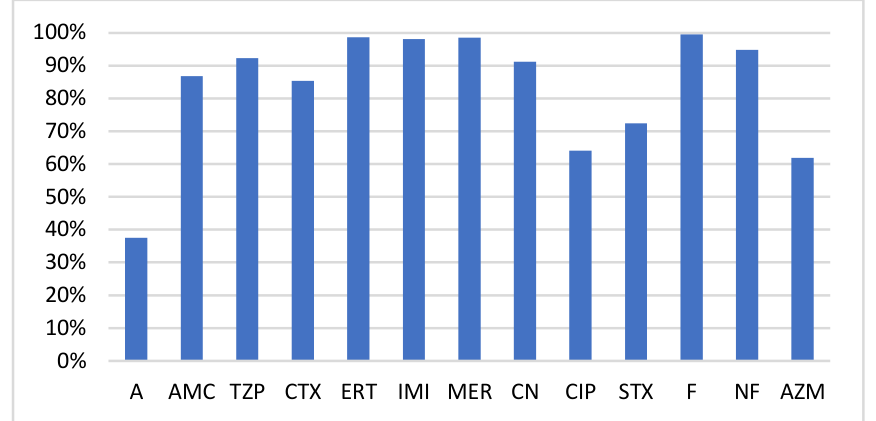
<!– Start of picture text –> 100%<br>90%<br>80%<br>70%<br>60%<br>50%<br>40%<br>30%<br>20%<br>10%<br>0%<br>A AMC TZP CTX ERT IMI MER CN CIP STX F NF AZM<br><!– End of picture text –>
Legend: A – Ampicillin; AMC – amoxicillin-clavulanate; TZP – piperacillin-tazobactam; CXM – cefuroxime; CTX – cefotaxime; AZM – aztreonam; IMP – Imipenem; MEM – meropenem; ERT – ertapenem; CIP – ciprofloxacin; F – fosfomycine; SXT – trimethoprim/suphamethoxazole; CN – gentamicin.
Antibiotic resistance issues among ESKAPE pathogens have variable frequency and impact, both regarding the microorganisms surveyed and within each word, influenced by the characteristics of specific diseases to each specialty.
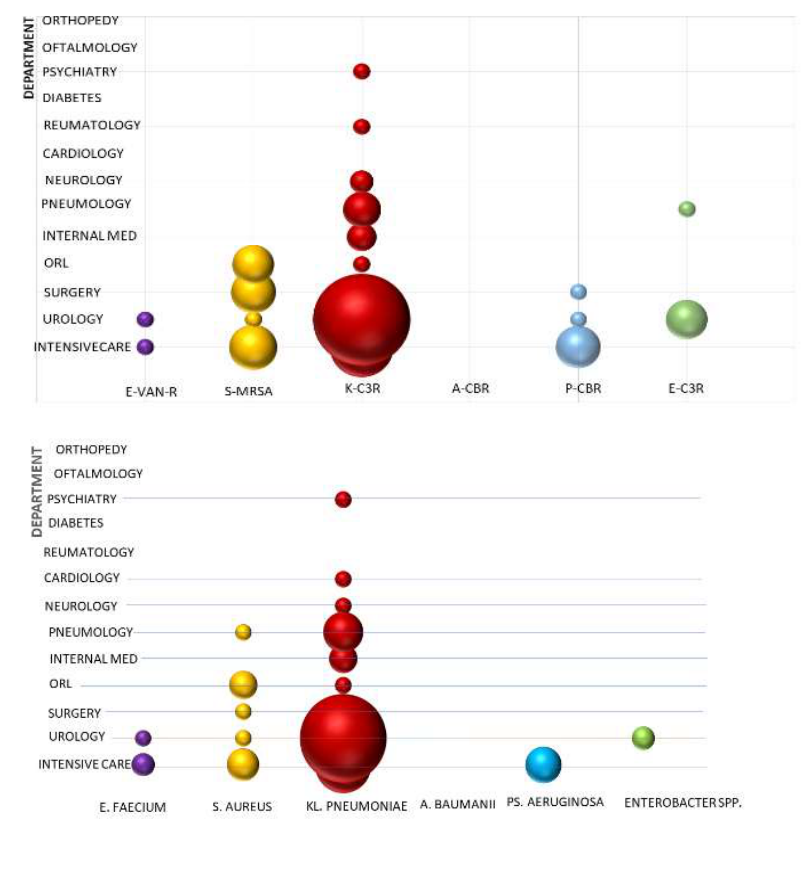
Acinetobacter baumannii is one of the most concerning public health problems worldwide but CBR has not been identified in any of the hospital’s departments. All strains highlighted maintained sensitivity to carbapenems and other commonly tested antibiotics, but a single case evidenced an intermediary pattern, signaling decreasing susceptibility that requires vigilant epidemiological surveillance.
Pseudomonas aeruginosa – Carbapenem-resistant cases were found in isolated instances in the ICU, urology, and surgery departments without being considered a source for healthcare-associated infections. The urology department was the primary source for these isolates, but a sporadic case was also reported from the surgery department.
Enterobacter spp – Third-generation cephalosporin-resistant (C3R) was found occasionally, only in the urology department, having the slightest impact among “critical” Gram-negative bacteria on antibiotic stewardship.
The “critical” pathogen Klebsiella pneumoniae C3R is causing the most problems because it was most identified and is spreading the most in hospital wards. It mainly affects the urology department, then the intensive care unit, pneumology, internal medicine, and neurology departments. Epidemiological unrelated cases have also been reported rarely from the ENT, rheumatology, and psychiatry departments (Figure 3 a).
<!– Start of picture text –> a: Specific AMR<br><!– End of picture text –>
<!– Start of picture text –> b. MDR<br><!– End of picture text –>
Among ESKAPE Gram-positive cocci, MRSA draws attention in the intensive care, surgery, and ENT departments, while only a single case was identified in urology. Vancomycin resistance in Enterococcus faecium is reported in isolated cases in the intensive care and urology departments (Figure 3 a).
Total ESKAPE pathogens cumulate specific AMRs (E. faecium Van-R, MRSA, P. aeruginosa CBR, A. baumannii CBR, K. pneumoniae, and Enterobacter spp- C3R) of 30.9%. In addition, MDR is superposing to 21% of these strains. The multidrug resistance of S. aureus, K. pneumoniae, and P. aeruginosa was associated with respect to
w strains,
that are not considered epidemiologically significant.
The reported bacterial burden is low, with a yearly average of 1.95 bacterial strains per hospital bed. This result could be explained by the hospital’s multidisciplinary profile, mainly in short hospitalization, for patients from the community. The reorganization of COVID-19 support wards has disturbed the specific activities of specialized departments. Additionally, in COVID-19 wards there were
few recommendations for microbiological investigations and properly sampling bacteriological specimens was frequently difficult.
The major challenges of the COVID-19 pandemic for Antibiotic Stewardship, Infections Prevention, and Control were the increase in the number of critical cases, diminution of vigilance in infection control, short supply of specialized staff resources, and absence of guidelines for COVID-19 diagnostic and treatment at the beginning of the pandemic [1,19,20,21]. Moreover, redistribution of lab resources was required during the pandemic, by prioritizing virologic tests and reducing the bacteriological investigations1,19,20. Apart from these general respects, Romania is considered “in the red zone” of European antimicrobial resistance, since is the country with the second highest consumption of antibacterials in Europe and 11% of the population declared antibiotic prescription from the pharmacy, without medical consultation. Therefore, we could assume that patients hospitalized in most wards used antibiotics before hospital admission, so the results of this report should be taken with caution [22,23].
WHO report on antimicrobial resistance (AMR) surveillance in the European Region highlighted a decrease in E. coli isolates in 2020 compared to previous years, attributed to reduced non-COVID-19 care activities and a decline in AMR surveillance vigilance [20,24]. Unlike other countries in the European Region that reported an increase in the frequency of commonly associated healthcare pathogens, such as Acinetobacter baumannii and Enterococcus faecium, these issues were not observed in our study. However, monitoring VAN-R enterococci remains a priority for AMR surveillance in our hospital, given the elevated regional prevalence of Clostridioides difficile infections and the intensive use of oral vancomycin, exerting selective pressure on enteric bacteria [25,26].
Like other European countries, resistance to carbapenems in E. coli and Enterobacter spp. remains low, below 3%, while the rates of C3R in our study exceed 14%, consistent with the European report [1]. The complete susceptibility to Fosfomycin of urinal E. coli isolates justifies the local guideline recommendation of this antibiotic in the initial antibiotic therapy for uncomplicated infections, -lactam class [27].
Our study’s carbapenem-resistant Pseudomonas aeruginosa (CBR) rate was consistent with the European report (15.5% vs. 17.8%). However, it showed a higher resistance to aminoglycosides (22.5% vs. 9.4%) [1]. Surprisingly, susceptibility to cephalosporins of P. aerugionosa in our setting is above 90%, recommending piperacillin/tazobactam as a first-line therapeutic option for this presuming etiology of infections.
Klebsiella pneumoniae demonstrated the highest frequency among “critical” pathogens but also exhibited the most concerning antibiotic resistance. Resistance rates exceeded 20% for all antibiotic classes, including carbapenems, reaching over 50% for quinolones. It is necessary to systematically the antibiotic testing of K. pneumoniae strains for reserve antibiotics considering colimicin and combinations of ceftolozane–tazobactam, imipenem–cilastatin/relebactam, meropenem–vaborbactam or ceftazidime– avibactam [16]. The recommendation for the first-line treatment of suspected carbapenem-resistant strains should consider these reserve antibiotics. Other additional potent drugs for carbapenem-resistant K. pneumoniae such as plazomicin, eravacycline, cefiderocol or temocillin could become available by governmental regulations [28]. Furthermore, the emergence of K. pneumoniae hypervirulent strains, especially in association with CBR, is linked to antibiotic treatment failure and an elevated mortality rate. Monitoring these variants necessitates using advanced molecular techniques to identify virulence and resistance factors [29].
We have tested the susceptibility on Aztreonam, according to the standardized procedures, although Aztreonam has not been available in Romania for therapeutic use. We found over 30% resistance between the tested Gram-Negative rods, predicting low benefit as a first-choice antibiotic in clinical practice.
Staphylococcus aureus ranks second in the frequency of pathogens with antibiotic resistance risk. The MRSA rate is among the highest in Europe, meaning over 33% of strains. The notably high rate of multidrug-resistant (MDR) strains is mainly attributed to intensive community usage of penicillin, macrolides, and tetracyclines. Vancomycin and Linezolid are valuable options for first-line antibiotic treatment in severe invasive infections, while sulfamethoxazole could be used in non-severe infections. Although not within the study’s scope, we observed a higher MDR rate in Coagulase-Negative Staphylococci (Co-N), which colonizes the skin, mucous membranes, and environmental surfaces in the community and the hospital. This may contribute to the transmission of antibiotic resistance to Staphylococcus aureus [30].
ESKAPE pathogens are found in the community, but more frequent in healthcare settings. The mechanisms of antibiotic resistance emergence and persistence of the ESKAPE pathogens are heterogeneous, but they share the ability to build biofilms related to biotic and abiotic surfaces [14]. Regarding the characteristics of our health care services, the source of the ESKAPE pathogens is more probable community than acquired in the hospital but could reflect the regional antimicrobial practices of the practitioners in family medicine and other specialists.
Monitoring and analyzing antimicrobial resistance in the hospital setting is essential for identifying the risks associated with the emergence of “critical” strains and healthcare-associated transmission. Specific resistances within the ESKAPE group, as well as MDR within this group, were more frequently identified in males compared to E. coli, which predominantly originated from females. Both Gram-negative ESKAPE pathogens and E. coli were predominantly associated with urinary tract infections in most cases. This observation could be considered for the risk evaluation in the first-line antibiotic treatment decision, in addition to the predictive clinical scores, such as CarbaSCORE, Tumbarello score, Duke score, or machine learning models [30,31,32,33].
This is the first surveillance report of AMR in the Emergency Military Hospital “Dr. Aristide Serfioti” from Galati, developed to understand the local impact of COVID-19 on bacterial charge, diversity, frequency, and antibiotic resistance, for updating the regional antibiotic stewardship strategy. Revising the clinical protocols for diagnosis and treatment in each department, intensifying the
bacteriological samples collection, and improving the microbiological diagnostic techniques for AMR identification, including high technologies of molecular investigations and point of care antimicrobial resistance tests are highly interests for the near future stewardship. Systematic epidemiological monitoring and control of the hospital environment, hand hygiene procedures stimulation, strict assurance of safe medical procedures, and continuing education are ongoing necessary components of the antibiotic stewardship program.
This is a retrospective study, based only on microbiological records. Consequently, the patient history and clinical data were not available. Furthermore, the community or healthcare-acquired source of infection was not analyzed. Hemocultures accounted for only 1% of the total positive samples and 3.18% of them are categorized in ESKAPE group. Therefore, comparing the antimicrobial resistance profile resulting from our study with reference data reported by representative laboratories that monitor antibiotic resistance in epidemiological surveillance networks for invasive bacterial strains, has limited significance [24]. The molecular investigation of antimicrobial resistance mechanisms was not affordable. The antibiotic consumption was not included in the present study but should be correlated with the antimicrobial resistance pattern of the hospital.
The COVID-19 pandemic impaired the hospital practice for infections and bacterial diagnostics and weakened the vigilance of antibiotic stewardship. ESKAPE pathogens are almost one-third of the total bacterial isolates, with 21% associated MDR.
The “red flag” for antibiotic stewardship between ESKAPE pathogens is Klebsiella pneumoniae. The directions of the near future antibiotic stewardship program focus on revising the clinical protocols of diagnostic and treatment in each department, to intensify the bacteriological samples collection, to improve the microbiological diagnostic techniques for AMR identification, and to intensify the epidemiological actions of surveillance, control, and education.
The authors declare no conflict of interest. This research received no external funding.
The current manuscript does not contain previously published materials or self-generated AI text.
Conceptualization, M.A., C-M.V.; methodology, A-V.I, , M.A., C-N.D.; software, I.D., C-S.S; validation, M.A., C-M. V. and A-V-I.; formal analysis, I.D., C-N.D., A.N.; investigation, C-M.V., I.D.; resources, C-M.V. and C-S.S.; data curation, A-V.I.; C-N.D.; writing—original draft preparation, C-M.V., C-S.S, A-V.I., I.D., C-N.D., A.N.; writing—review and editing, M.A.; visualization, C-S.S., A. N.; supervision, M.A.; project administration, C-M.V., A.N. All authors have read and agreed to the published version of the manuscript
The study was conducted in accordance with the Declaration of Helsinki, and approved by the Institutional Review Board Institutional Board of Emergency Military Hospital – .
Not applicable. Our retrospective study used laboratory management which regularly collected data from the databases. The consent for the use of personal data was given by each patient as a routine procedure of the hospital health care provision.