
Obesity represents a worldwide health issue with an alarming increasing incidence in the modern era [1-3]. Hence, multiple concerns of the medical community involve, not only addressing new drugs, but, also the development of new panels of biomarkers to highlight the cardio-metabolic risk, long-term outcomes in order to be integrated in a targeted strategy of life-long management [4-6].
Under these circumstances, microarray analysis for blood factors represents a cutting edge exploration of the potential biomarkers, including in obesity, pointing out more than an interesting tool beyond the well-known genetic and epigenetic exploration amid this lab method [7-9]. Notably, there are no standardized panels of microarray-based biomarkers detection at this point in daily approach of obesity, thus the importance of exploratory researches to pinpoint their true value for the everyday practice of different clinicians with various backgrounds who treat numerous obesity-related complications [10-12].
Adipokines, adipocyte-derivate molecules, [e.g. adiponectin, adipsin, leptin, resistin, chemerin, omentin, visfatin, vaspin, osteonectin, PAI-1 (Plasminogen Activator Inhibitor), TNF-alpha (Tumor Necrosis Factor), IL-6 (Interleukin), IL-8, IL-10, IL-18, angiopoietin 1 and 2, etc.] are released by the adipose tissue, which represents an active endocrine organ, serving multiple functions others than the traditional role of lipids storage. The fat tissue-derived molecules interplay with all body organs and systems, both centrally and peripherally. The detection of some adipokines levels might serve as indicators of metabolism homeostasis and regulation amid physiological circumstances, but, also, in type 2 diabetes, obesity, arterial hypertension, fatty liver disease, metabolic syndrome, and some other endocrine diseases (e.g. primary hyperparathyroidism, acromegaly, Cushing’s syndrome, adrenal tumours, etc.) [13-15].
Adipectin is an insulin sensitizing protein that also is prone to anti-inflammatory effects, while adipsin, less known than adiponectin, prior named “complement factor D” (CFD) involves an alternative pathway in complement activation with immune and inflammatory effects. Moreover, its deficiency has been found in relationship with metabolic impairment, specifically, type 2 diabetes, due to its actions of stimulating insulin release and glucose uptake in the muscle. Agouti-related peptide (AgRP), another fat-derived molecule, works both centrally and peripherally. The central role is to serve as orexigenic peptide (the hypothalamus-released factor), which increases the appetite and decreases the body energy expenditure. These actions of the neurotransmitter are prone to increased body fat and overall weight. In addition to the central production (next to the neurons that also produce neuropeptide Y), AgRP represents an adipokine that induces fat accumulation and reduces the cleavage of lipids by its peripheral effects. While AgRP might be dysregulated in obesity, it has been suggested to correlate with anomalies of the glucose profile [16-19].
Noting that in the modern medical era the search for novel panels of obesity biomarkers is continuously expanding, we aimed to explore the microarray-based circulating levels of adiponectin, adipsin, and AgRP in menopausal women with obesity.
This was an exploratory, pilot, prospective, bi-centric study in post-menopause adults confirmed with obesity based on the body mass index calculation, between December 2024 and December 2025. The ethical approval was provided by both centres: a tertiary centre of endocrinology in Romania and a medical university in Moldova. Ethical Boards approvals were: number 32 from 30 September 2024 for Bucharest, Romania, respectively, number 97 from 20 November 2024 for Chisinau, Republic of Moldova.
Inclusion criteria: adults over 50 years, body mass index of 30 kg/m2 or above, confirmed menopause, signed informed consent.
Exclusion criteria: any endocrine cause of obesity (e.g. acromegaly, Cushing’s syndrome), endocrine tumours, type 1 diabetes, type 2 diabetes, dyslipidaemia of any type, arterial hypertension, prior or current medication such as anti-diabetes drugs, anti-obesity medication, corticotherapy, lipids lowering drugs, anti-hypertensive medication, bariatric surgery, anti-osteoporotics, malignancies, active infections, autoimmune and immune disorders, bone metabolic disorders, osteoporosis, (hereditary) syndromes with central obesity, obesity with paediatric onset, regardless of the syndromic or non-syndromic presentation.
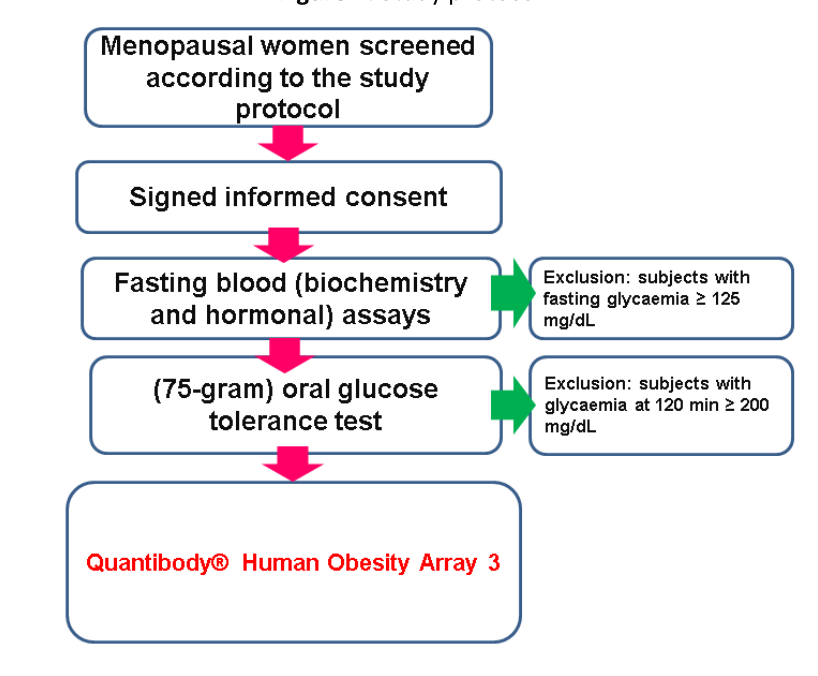
After the informed consent was signed, the patients underwent fasting morning blood testing in addition to oral glucose tolerance test. We excluded the subjects with type 2 diabetes confirmation based on fasting glycaemia above 125 mg/dL or glycaemia at 120 min during 75-gram oral glucose tolerance test equal or above 200 mg/dL.
The collected data included: age (years), menopause (years since last menstruation), and body mass index [weight (kg) / height (m2)].
The panel of standard biochemical and hormonal markers included: glycaemia (mg/dL), uric acid (mg/dL), glycated haemoglobin A1c (%), HDL-cholesterol (mg/dL), triglycerides (mg/dL), fibrinogen (mg/dL), PTH (parathromone) in pg/mL, 25OHD (25-hydroxyvitamin D) in ng/mL, cortisol (µg/dL), as well as HOMA (Homeostasis Model Assessment) of insulin resistant with a calculation formula: fasting glycaemia (mg/dL) X fasting insulin (mU/L)/ 405.
Quantibody® Human Obesity Array 3 (RayBiotech, Norcross, GA, USA) was used. Quantibody® array represents a multiplexed sandwich enzyme-linked immunoserovent assay (ELISA)-based quantitative array platform that accurately determines the concentration of multiple cytokines simultaneously. It combines the advantages of the high detection sensitivity and specificity of immunoassay and the high throughput of arrays. The assay uses a pair of cytokine specific antibodies for detection. Firstly, a capture antibody is bond on the solid surface of a glass slide. Secondly, the target molecule is linked to the antibody. Then, a second antibody biotin-labeled is added and attached to the antigen-antibody complex. This complex is visualized by adding a streptavidin-conjugated Cy3 dye on a laser fluorescent scanner (GenePix 4400, Molecular Devices LLC, San Jose, CA, USA). For quantitation the array specific cytokine standards, whose concentration has been predetermined, are provided to generate a standard curve for each cytokine. The slide has a 16-well removable gasket which allows for the process of 16 samples on one slide or 8 standard samples and another 8 unknown samples. The samples are based on human serum. Adiponectin, adipsin and AgRP associate a CV (coefficient of variation) of less than 20% per each molecule assay. The panel of analysis also included IL-1Ra (Receptor Antagonist) in ng/mL, IL-6 (ng/mL), IL-8 (pg/mL), leptin (ng/mL), lipocalin-2 (ng/mL), PAI-1 (ng/mL), and TNF-RII (receptor II), which all show the same CV. The sample volume is 50 to 100 µl per array. (Figure 1)
MedCalc® Statistical Software version 23.3.7 was applied for data interpretation. Kolmogorov-Smirnov test was done for normality. Comparison of independent samples included t-test for normal distribution and Mann-Whithey test for non-normal distribution. The data were presented as mean ± standard deviation (SD) or median and interquartile interval (IQR), depending on normal or non-normal distribution. Pearson correlation was used for normal distribution, respectively, Spearman rank correlation for non-normal distribution. The cut-off < 0.05 showed statistical significance.
We enrolled in this exploratory study 24 patients with a median age of 60 years, and a median menopause duration of 7 years. Body mass index showed a median of 32.47 kg/m2. (Table 1)
| Clinical parameters (units) | Study population |
|---|---|
| Age (years), median (min, max) | 60 (53.00, 73.00) |
| Years since menopause, median (Q1, Q3) | 7.00 (5.00, 13.00) |
| Body mass index (kg/m2), median (95% confidence interval) | 32.47 (32.32 to 34.34) |
The baseline panel of biochemical and hormonal markers was performed in order to analyse the correlations of the mentioned array-based adipocytes. (Table 2)
| Parameter, unit | Median | 95% confidence interval |
|---|---|---|
| Uric acid, mg/dL | 5.37 | 4.65 to 6.03 |
| Cortisol, µg/dL | 9.02 | 8.9 to 21 |
| Glycaemia (120′), mg/dL | 155 | 126.79 to 175.03 |
| Glycaemia (60′), mg/dL | 186 | 170.48 to 236.72 |
| Glycaemia (0′), mg/dL | 104 | 97.61 to 110.48 |
| Glycated haemoglobin A1c, % | 5.69 | 5.59 to 6.00 |
| HDL-cholesterol, mg/dL | 64.6 | 42.85 to 72.85 |
| HOMA-IR | 1.98 | 1.44 to 3.91 |
| Triglycerides, mg/dL | 97 | 81.69 to 114.62 |
| PTH, pg/mL | 40.94 | 32.55 to 52.55 |
| 25OHD, ng/mL | 26.8 | 17.79 to 32.94 |
| Fibrinogen, mg/dL | 441.65 |
Median values for adiponectin, adipsin and AgRP were of 279.98 ng/mL, 12.01 ng/mL, respectively, 260.3 ng/mL. (Table 3)
| Parameter, unit | Median | 95% confidence interval |
|---|---|---|
| Adiponectin, ng/mL | 279.98 | 144.59 to 486.13 |
| Adipsin, ng/mL | 12.01 | 7.68 to 17.30 |
| AgRP, pg/mL | 260.3 | 99.85 to 536.65 |
| IL-1Ra, ng/mL | 7.51 | 1.05 to 10.76 |
| IL-6, ng/mL | 0.36 | 0.21 to 1.18 |
| IL-8, pg/mL | 169.3 | 99.34 to 240.08 |
| Leptin, ng/mL | 55.61 | 26.45 to 642.61 |
| Lipocalin-2, ng/mL | 2.42 | 1.88 to 3.62 |
| PAI-1, ng/mL | 58.27 | 51.09 to 89.95 |
| TNF-RII, ng/mL | 1.32 |
All mentioned parameters from Table 2 and 3 were analysed with respect to the potential correlation with one another. Table 4 introduces the statistically significant results (p < 0.05). Adiponectin positively and statistically significantly correlated with lipocalin-2 (r = 0.943, p = 0.0048) and PAI-1 (r = 0.829, p = 0.0416). Adipsin displayed statistically significant and positive correlation coefficients for Il-1Ra (r = 0.691, p = 0.0186), IL-8 (r = 0.786, p = 0.0362), leptin (r = 0.832, p = 0.0008), and lipocalin-2 (r = 0.786, p = 0.0208). AgRP showed a positive association with the level of glycaemia at 120 minute during oral glucose tolerance test (r = 0.829, p = 0.416), and IL-6 (r = 0.886, p = 0.0188) and a negative correlation with TNF-RII (r = -0.820, p = 0.04). (Table 4)
| Parameter 1, units | Parameter 2, units | r | p |
|---|---|---|---|
| Adiponectin, ng/mL | Lipocalin-2, ng/mL | 0.943 | 0.0048 |
| Adiponectin, ng/mL | PAI-1, ng/mL | 0.829 | 0.0416 |
| Adipsin, ng/mL | IL-1Ra, ng/mL | 0.691 | 0.0186 |
| Adipsin, ng/mL | IL-8, pg/mL | 0.786 | 0.0362 |
| Adipsin, ng/mL | Leptin, ng/mL | 0.832 | 0.0008 |
| Adipsin, ng/mL | Lipocalin-2, ng/mL | 0.786 | 0.0208 |
| AgRP, pg/mL | Glycaemia (120′), mg/dL | 0.829 | 0.0416 |
| AgRP, pg/mL | TNF-RII, ng/mL | -0.820 | 0.0400 |
| AgRP, pg/mL | IL-6, ng/mL | 0.886 | 0.0188 |
In this exploratory study of array-based adipokines detection amid the presence of obesity in menopausal women, we only included the subjects who did not present a large area of obesity-related complications (e.g. diabetes, high blood pressure, dyslipidaemia, osteoporosis, and even malignancies across a general screening of evaluation based on patients’ medical records). This was designed in order to avoid the bias than comes from additional interferences such as insulin resistance or chronic inflammation [20]. One of the most important applications of the adipokines assays might be in so-called “healthy obesity” whereas a panel of circulating biomarkers (which are easily tested by fasting blood assays) may indicate the need of an active strategy to control the cardio-metabolic outcomes, which are not obvious at this stage [20,21].
This present kit of human array allows a rapid testing of numerous adipokines and in this analysis we focused on three of them, none of which being a matter of a standardized guideline or protocol so far. Adiponectin shows anti-diabetic effects via its receptors AdipoR1 and AdipoR2 [22]. In this study, we found it to be strongly correlated with the circulating lipocalin-2. Similarly, Daoud et al. [23] published a study in 2025 that identified the same correlation (r = 0.54, p = 0.001) in 80 adults participants (50% of them were females). Of note, the correlation was statistically significant only in obese subgroup, not in the normal-weight subjects [23]. Centrally, lipocalin-2 acts as an important appetite suppressor and gender-related differences in high-fat diet obese mice have been found, with indeterminate significance in humans so far [24].
Moreover, the correlation between adiponectin and PAI-1 potentially links the fat tissue hormonal activity with chronic inflammation and coagulation anomalies, including in some malignancies [25-27]. A recent prospective study from 2025 found that individuals with a persistent high glucose during oral glucose tolerance test had higher PAI-1 and lower adiponectin [28], hence, the positive correlation for the current study might involve alternative pathways of connection, a multi-factorial influence or a different metabolic profile in the study population diagnosed with obesity [28]. Notably, we found no correlation between adiponectin and glucose profile (from fasting to the values at one hour and two hours following glucose administration).
In the current exploratory array, lipocalin-2 was also correlated with adipsin, which might show a synergic effect with adiponectin, while direct correlation adipsin-adiponectin was not confirmed. Recently, Lee et al. [29] showed that adiponectin, adipsin and lipcalin-2 are predictors of diabetic retinopathy in type 2 diabetic patients, which suggest interplay of their actions to the endothelium level [29].
The fact that fat-secreted molecules interfere with inflammation is reflected in this study by the correlation with IL-6 and Il-8, which are also released by the muscle, not only by the adipose tissue, and they might all be involve to the crosstalk between glucose metabolism and bone turnover, as well as overall bone health [30]. Notably, we excluded the patients diagnosed with osteoporosis and associated anti-osteoporotic medication in order to the bias of skeletal anomalies.
Additionally, AgRP was the single biomarker to be associated with glycaemia at two hours after oral glucose was provided to the subjects. Thus, a glycaemia increase under these circumstances is associated with a high AgRP that further on might increase the appetite, a similar effect of elevated insulin stimulation by glucose. Yet, we tested the peripheral level, and the central effects (involving the neurons from arcuate nucleus) might not be tidily correlated with the circulating level [31-33].
We are aware of the sample size and a distinct study population in terms of including only menopausal women with uncomplicated obesity. Yet, this is an exploratory analysis and a further expansion involves a larger cohort presenting a complex panel of obesity-related complications and longitudinal surveillance to address the predictive value of these biomarkers under conservative lifestyle intervention, anti-obesity medication as glucagon-like peptide-1 (GLP-1) agonists medication or anti-obesity surgery.
Authors should discuss the results and how they can be interpreted from the perspective of previous studies and of the working hypotheses. The findings and their implications should be discussed in the broadest context possible.
Future research directions may also be highlighted.
In this exploratory study in apparently healthy obese menopausal individuals, we identified by applying an novel adipokines detection panel (Quantibody® Human Obesity Array 3) the correlation between adiponectin, respectively, adipsin, with lipocalin-2, while adiponectin also associated with PAI-1, respectively, adipsin with IL-8. AgRP, despite being a well-known central orexigenic factor, might serve as circulating biomarker, noting its correlations with IL-6 and glycaemia at 120 min during oral glucose tolerance test.
This work was supported by a grant of the Ministry of Research, Innovation and Digitization, UEFISCDI “Crossroad of metabolism and bone: the impact of irisin, bone turnover and inflammatory markers in patients with menopausal osteoporosis and obesity”; PN-IV-P8-8.3-ROMD-2023-0262.
The research was conducted in accordance with the Declaration of Helsinki. The study was approved by the Ethical Boards of both centres (number 32 from 30 September 2024 – Bucharest, Romania, respectively, number 97 from 20 November 2024 – Chisinau, Republic of Moldova).
The patients signed the informed consent to participate to this study.
All available data are in the article.
This is part of the project PN-IV-P8-8.3-ROMD-2023-0262 in addition to collaboration with the PhD research according to the following theme “Non-invasive techniques for identification of osteoporotic fracture risk in menopause” (contract number 28086 from 9 September 2024).
The authors declare no conflict of interest.